

1
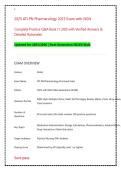
2025 ATI PN Pharmacology 2023 Exam with NGN
Complete Practice Q&A Bank (1-200) with Verified Answers &
Detailed Rationales
Updated for 2025/2026 | Next Generation NCLEX Style
EXAM OVERVIEW
Feature Detail
Exam Name ATI PN Pharmacology Proctored Exam
Edition 2023 with NGN (Next Generation NCLEX)
NGN-style: Multiple Choice, Select All That Apply, Bowtie, Matrix, Cloze, Drop-down,
Question Format
Case Scenarios
Number of
60 scored items (this bank contains 200 practice questions)
Questions
Medication Administration, Dosage Calculations, Pharmacokinetics, Adverse Effects,
Key Topics
Drug Interactions, Patient Education
Target Audience Practical Nursing (PN) Students
Passing Score Determined by ATI (typically Level 1 or higher)
Sure pass
,2
SECTION 1: SAFE MEDICATION ADMINISTRATION & DOSAGE
CALCULATIONS (Questions 1-40)
Question 1:
A nurse is assisting in the care of a client in the provider's office. The provider prescribes
fluticasone propionate 100 mcg per nostril once daily PRN seasonal allergies. Which of
the following actions should the nurse take when administering this medication?
A) Shake the container vigorously before each use
B) Prime the spray before the first use and if not used for several days
C) Have the client tilt their head back and sniff forcefully
D) Administer the spray directly onto the nasal septum
Correct Answer: B) Prime the spray before the first use and if not used for several
days
Rationale: Intranasal corticosteroids like fluticasone should be primed before the first use
and if not used for several days to ensure proper dosage delivery. The client should not
sniff forcefully; gentle sniffing is recommended. The spray should be directed away from
the nasal septum to avoid irritation .
Question 2:
A nurse is reviewing medication prescriptions for a group of clients. Which of the
following prescriptions can result in a medication error?
A) Penicillin G benzathine 1.2 million units IM daily
B) Furosemide 10.0 mg PO daily
C) Albuterol 2.5 mg 2 inhalations every 6 hr as needed
D) Insulin glargine 15 units subcutaneous daily at bedtime
Correct Answer: B) Furosemide 10.0 mg PO daily
Rationale: The nurse should avoid using a trailing zero following a whole number. This
prescription can result in a medication error because the nurse can mistake the dosage as
Sure pass
,3
100 mg instead of 10 mg since the decimal point is not always recognized. Leading zeros
should be used for numbers less than 1 (e.g., 0.5 mg), but trailing zeros should be avoided
(e.g., 10 mg, not 10.0 mg) .
Question 3:
A nurse is monitoring a client who has been receiving long-term hydrochlorothiazide
therapy for recurring episodes of heart failure. Which of the following findings should
the nurse identify as an adverse effect of this medication?
A) Hypokalemia
B) Hypermagnesemia
C) Hypernatremia
D) Hypocalcemia
Correct Answer: A) Hypokalemia
Rationale: Hydrochlorothiazide is a thiazide diuretic that can cause hypokalemia due to
excessive potassium excretion in the urine. The nurse should monitor serum potassium
levels and assess for signs of hypokalemia such as muscle weakness, arrhythmias, and
fatigue .
Question 4:
A nurse is reinforcing teaching with a client who has a prescription for alendronate.
Which of the following client responses indicates to the nurse an understanding of the
teaching?
A) "I will take the medication with my breakfast."
B) "I will take the medication with 1 tablespoon of an antacid."
C) "I will lie down for 30 minutes after taking the medication."
D) "I will take the medication with 8 ounces of water."
Correct Answer: D) "I will take the medication with 8 ounces of water."
Rationale: Alendronate should be taken on an empty stomach with 8 ounces (240 mL) of
water to ensure it does not lodge in the esophagus, which can result in esophageal
ulcerations. The client should remain upright for at least 30 minutes after taking the
medication to prevent esophageal irritation .
Sure pass
, 4
Question 5:
A nurse is instilling timolol eyedrops for a client who has glaucoma. Which of the
following actions should the nurse take after instilling the eyedrops?
A) Ask the client to blink their eyes several times
B) Apply pressure to the upper eyelid
C) Press the nasolacrimal duct
D) Tell the client to keep their eyes open for at least 15 seconds
Correct Answer: C) Press the nasolacrimal duct
Rationale: The nurse should press the client's nasolacrimal duct after instilling eye drops to
prevent the medication from absorbing into systemic circulation. This technique is known
as punctal occlusion and reduces systemic absorption of ophthalmic medications .
Question 6:
At 0800, a nurse assists with initiating a 1,000 mL IV infusion for a client, which is
running at 125 mL/hr. How much fluid is left in the IV bag at 1300? (Round the answer
to the nearest whole number.)
A) 375 mL
B) 500 mL
C) 625 mL
D) 750 mL
Correct Answer: A) 375 mL
Rationale: Time elapsed from 0800 to 1300 is 5 hours. Volume infused = 125 mL/hr × 5 hr
= 625 mL. Remaining volume = 1,000 mL - 625 mL = 375 mL .
Question 7:
A nurse is reinforcing dietary teaching with a client who has a new prescription for
phenelzine. Which of the following foods should the nurse include in the teaching as an
appropriate food choice?
A) Yogurt
Sure pass
2025 ATI PN Pharmacology 2023 Exam with NGN
Complete Practice Q&A Bank (1-200) with Verified Answers &
Detailed Rationales
Updated for 2025/2026 | Next Generation NCLEX Style
EXAM OVERVIEW
Feature Detail
Exam Name ATI PN Pharmacology Proctored Exam
Edition 2023 with NGN (Next Generation NCLEX)
NGN-style: Multiple Choice, Select All That Apply, Bowtie, Matrix, Cloze, Drop-down,
Question Format
Case Scenarios
Number of
60 scored items (this bank contains 200 practice questions)
Questions
Medication Administration, Dosage Calculations, Pharmacokinetics, Adverse Effects,
Key Topics
Drug Interactions, Patient Education
Target Audience Practical Nursing (PN) Students
Passing Score Determined by ATI (typically Level 1 or higher)
Sure pass
,2
SECTION 1: SAFE MEDICATION ADMINISTRATION & DOSAGE
CALCULATIONS (Questions 1-40)
Question 1:
A nurse is assisting in the care of a client in the provider's office. The provider prescribes
fluticasone propionate 100 mcg per nostril once daily PRN seasonal allergies. Which of
the following actions should the nurse take when administering this medication?
A) Shake the container vigorously before each use
B) Prime the spray before the first use and if not used for several days
C) Have the client tilt their head back and sniff forcefully
D) Administer the spray directly onto the nasal septum
Correct Answer: B) Prime the spray before the first use and if not used for several
days
Rationale: Intranasal corticosteroids like fluticasone should be primed before the first use
and if not used for several days to ensure proper dosage delivery. The client should not
sniff forcefully; gentle sniffing is recommended. The spray should be directed away from
the nasal septum to avoid irritation .
Question 2:
A nurse is reviewing medication prescriptions for a group of clients. Which of the
following prescriptions can result in a medication error?
A) Penicillin G benzathine 1.2 million units IM daily
B) Furosemide 10.0 mg PO daily
C) Albuterol 2.5 mg 2 inhalations every 6 hr as needed
D) Insulin glargine 15 units subcutaneous daily at bedtime
Correct Answer: B) Furosemide 10.0 mg PO daily
Rationale: The nurse should avoid using a trailing zero following a whole number. This
prescription can result in a medication error because the nurse can mistake the dosage as
Sure pass
,3
100 mg instead of 10 mg since the decimal point is not always recognized. Leading zeros
should be used for numbers less than 1 (e.g., 0.5 mg), but trailing zeros should be avoided
(e.g., 10 mg, not 10.0 mg) .
Question 3:
A nurse is monitoring a client who has been receiving long-term hydrochlorothiazide
therapy for recurring episodes of heart failure. Which of the following findings should
the nurse identify as an adverse effect of this medication?
A) Hypokalemia
B) Hypermagnesemia
C) Hypernatremia
D) Hypocalcemia
Correct Answer: A) Hypokalemia
Rationale: Hydrochlorothiazide is a thiazide diuretic that can cause hypokalemia due to
excessive potassium excretion in the urine. The nurse should monitor serum potassium
levels and assess for signs of hypokalemia such as muscle weakness, arrhythmias, and
fatigue .
Question 4:
A nurse is reinforcing teaching with a client who has a prescription for alendronate.
Which of the following client responses indicates to the nurse an understanding of the
teaching?
A) "I will take the medication with my breakfast."
B) "I will take the medication with 1 tablespoon of an antacid."
C) "I will lie down for 30 minutes after taking the medication."
D) "I will take the medication with 8 ounces of water."
Correct Answer: D) "I will take the medication with 8 ounces of water."
Rationale: Alendronate should be taken on an empty stomach with 8 ounces (240 mL) of
water to ensure it does not lodge in the esophagus, which can result in esophageal
ulcerations. The client should remain upright for at least 30 minutes after taking the
medication to prevent esophageal irritation .
Sure pass
, 4
Question 5:
A nurse is instilling timolol eyedrops for a client who has glaucoma. Which of the
following actions should the nurse take after instilling the eyedrops?
A) Ask the client to blink their eyes several times
B) Apply pressure to the upper eyelid
C) Press the nasolacrimal duct
D) Tell the client to keep their eyes open for at least 15 seconds
Correct Answer: C) Press the nasolacrimal duct
Rationale: The nurse should press the client's nasolacrimal duct after instilling eye drops to
prevent the medication from absorbing into systemic circulation. This technique is known
as punctal occlusion and reduces systemic absorption of ophthalmic medications .
Question 6:
At 0800, a nurse assists with initiating a 1,000 mL IV infusion for a client, which is
running at 125 mL/hr. How much fluid is left in the IV bag at 1300? (Round the answer
to the nearest whole number.)
A) 375 mL
B) 500 mL
C) 625 mL
D) 750 mL
Correct Answer: A) 375 mL
Rationale: Time elapsed from 0800 to 1300 is 5 hours. Volume infused = 125 mL/hr × 5 hr
= 625 mL. Remaining volume = 1,000 mL - 625 mL = 375 mL .
Question 7:
A nurse is reinforcing dietary teaching with a client who has a new prescription for
phenelzine. Which of the following foods should the nurse include in the teaching as an
appropriate food choice?
A) Yogurt
Sure pass


