

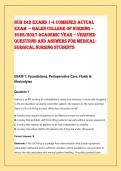
NUR 242 Exams 1-4 Combined Actual
Exam – Galen College of Nursing –
2026/2027 Academic Year – Verified
Questions and Answers for Medical-
Surgical Nursing Students
EXAM 1: Foundations, Perioperative Care, Fluids &
Electrolytes
Question 1
Patricia is an RN working at a rehabilitation center and witnesses a nurse aide struggling
to lift and reposition an elderly, bedridden patient. She explains to the nurse aide that
there is a No Lift Policy in place. What does this policy entail?
A. A policy that requires all patients to be lifted by at least two staff members
B. A policy that prohibits staff from lifting patients manually without proper equipment
C. A policy that requires all patients to be fully independent in mobility
D. A policy that allows staff to lift patients only if they are under 150 pounds
Correct Answer: B
Rationale: A No Lift Policy is a pledge from administrators that proper equipment,
adequately maintained and in sufficient numbers, will be available to care providers to
reduce the risks associated with manual patient handling. This policy protects both
,patients and healthcare workers from injury by eliminating manual lifting whenever
possible.
Question 2
Immobility affects multiple body systems. What interventions can you implement to
decrease these effects? (Select all that apply)
A. Utilizing waffle mattress to reduce the need for repositioning
B. TEDs/SCDs
C. Rubbing reddened areas
D. Limiting fluid intake
E. ROM exercises
Correct Answer: B and E
Rationale: TEDs (thromboembolic deterrent stockings) and SCDs (sequential
compression devices) help prevent venous stasis and deep vein thrombosis by
promoting venous return. Range of motion exercises maintain joint mobility and prevent
contractures. Regardless of mattress type, repositioning should occur every 2 hours.
Rubbing reddened areas increases the risk for skin breakdown. Proper hydration should
be encouraged to promote healthy skin.
Question 3
True or False: Nurses should do skin assessments once a week.
Correct Answer: False
,Rationale: Nurses should perform full skin assessments a minimum of once per shift to
identify early signs of pressure injuries and skin breakdown.
Question 4
A patient goes to the ER for swelling and pain in her right calf. The patient states that it
occurred after she accidentally cut herself. Based on her symptoms, what skin condition
might the nurse suspect?
A. Deep vein thrombosis
B. Cellulitis
C. Osteomyelitis
D. Peripheral vascular disease
Correct Answer: B
Rationale: Cellulitis is inflammation of the skin and subcutaneous tissue, typically
caused by bacterial infection. It presents with localized swelling, redness, pain, and
warmth. A cut or break in the skin is a common portal of entry for bacteria. DVT
presents with unilateral leg swelling but typically without a history of skin break.
Osteomyelitis involves bone infection, and PVD is a chronic condition.
Question 5
Patient A is admitted from a nursing home with a stage 3 pressure ulcer. When creating
his plan of care, who else would be involved besides the primary care physician?
, A. Wound care nurse, Dietician, Physical therapist
B. Only the wound care nurse
C. Social worker and chaplain
D. Occupational therapist only
Correct Answer: A
Rationale: A stage 3 pressure ulcer requires a multidisciplinary approach. The wound
care nurse specializes in wound assessment and treatment. The dietician ensures
adequate nutrition for wound healing (protein, calories, vitamins, minerals). The physical
therapist addresses mobility and positioning needs. Occupational therapy may also be
involved but focuses more on fine motor skills and ADLs.
Question 6
An 85-year-old woman is admitted to the hospital. When doing the initial assessment,
what factors put her at risk for pressure injuries?
A. Immobility only
B. Incontinence only
C. Immobility, incontinence, comorbidities, malnutrition/dehydration, decreased sensory
perception
D. Age alone
Correct Answer: C
Rationale: Risk factors for pressure injuries include: immobility (inability to change
position), incontinence (moisture damages skin), comorbidities such as diabetes or PVD
(impaired circulation and healing), malnutrition or dehydration (poor skin integrity and
healing capacity), and decreased sensory perception (inability to feel pressure or pain).
Age is a factor but not the sole determinant.
Exam – Galen College of Nursing –
2026/2027 Academic Year – Verified
Questions and Answers for Medical-
Surgical Nursing Students
EXAM 1: Foundations, Perioperative Care, Fluids &
Electrolytes
Question 1
Patricia is an RN working at a rehabilitation center and witnesses a nurse aide struggling
to lift and reposition an elderly, bedridden patient. She explains to the nurse aide that
there is a No Lift Policy in place. What does this policy entail?
A. A policy that requires all patients to be lifted by at least two staff members
B. A policy that prohibits staff from lifting patients manually without proper equipment
C. A policy that requires all patients to be fully independent in mobility
D. A policy that allows staff to lift patients only if they are under 150 pounds
Correct Answer: B
Rationale: A No Lift Policy is a pledge from administrators that proper equipment,
adequately maintained and in sufficient numbers, will be available to care providers to
reduce the risks associated with manual patient handling. This policy protects both
,patients and healthcare workers from injury by eliminating manual lifting whenever
possible.
Question 2
Immobility affects multiple body systems. What interventions can you implement to
decrease these effects? (Select all that apply)
A. Utilizing waffle mattress to reduce the need for repositioning
B. TEDs/SCDs
C. Rubbing reddened areas
D. Limiting fluid intake
E. ROM exercises
Correct Answer: B and E
Rationale: TEDs (thromboembolic deterrent stockings) and SCDs (sequential
compression devices) help prevent venous stasis and deep vein thrombosis by
promoting venous return. Range of motion exercises maintain joint mobility and prevent
contractures. Regardless of mattress type, repositioning should occur every 2 hours.
Rubbing reddened areas increases the risk for skin breakdown. Proper hydration should
be encouraged to promote healthy skin.
Question 3
True or False: Nurses should do skin assessments once a week.
Correct Answer: False
,Rationale: Nurses should perform full skin assessments a minimum of once per shift to
identify early signs of pressure injuries and skin breakdown.
Question 4
A patient goes to the ER for swelling and pain in her right calf. The patient states that it
occurred after she accidentally cut herself. Based on her symptoms, what skin condition
might the nurse suspect?
A. Deep vein thrombosis
B. Cellulitis
C. Osteomyelitis
D. Peripheral vascular disease
Correct Answer: B
Rationale: Cellulitis is inflammation of the skin and subcutaneous tissue, typically
caused by bacterial infection. It presents with localized swelling, redness, pain, and
warmth. A cut or break in the skin is a common portal of entry for bacteria. DVT
presents with unilateral leg swelling but typically without a history of skin break.
Osteomyelitis involves bone infection, and PVD is a chronic condition.
Question 5
Patient A is admitted from a nursing home with a stage 3 pressure ulcer. When creating
his plan of care, who else would be involved besides the primary care physician?
, A. Wound care nurse, Dietician, Physical therapist
B. Only the wound care nurse
C. Social worker and chaplain
D. Occupational therapist only
Correct Answer: A
Rationale: A stage 3 pressure ulcer requires a multidisciplinary approach. The wound
care nurse specializes in wound assessment and treatment. The dietician ensures
adequate nutrition for wound healing (protein, calories, vitamins, minerals). The physical
therapist addresses mobility and positioning needs. Occupational therapy may also be
involved but focuses more on fine motor skills and ADLs.
Question 6
An 85-year-old woman is admitted to the hospital. When doing the initial assessment,
what factors put her at risk for pressure injuries?
A. Immobility only
B. Incontinence only
C. Immobility, incontinence, comorbidities, malnutrition/dehydration, decreased sensory
perception
D. Age alone
Correct Answer: C
Rationale: Risk factors for pressure injuries include: immobility (inability to change
position), incontinence (moisture damages skin), comorbidities such as diabetes or PVD
(impaired circulation and healing), malnutrition or dehydration (poor skin integrity and
healing capacity), and decreased sensory perception (inability to feel pressure or pain).
Age is a factor but not the sole determinant.


