

CPCE Psychology Theories Practice Test 2026 | Most Tested
Questions | Graded A+
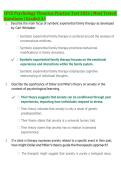
1. Describe the main focus of symbolic experiential family therapy as developed
by Carl Whitaker.
Symbolic experiential family therapy is centered around the analysis of
unconscious motives.
Symbolic experiential family therapy prioritizes behavioral
modifications in family dynamics.
Symbolic experiential family therapy focuses on the emotional
experiences and interactions within the family system.
Symbolic experiential family therapy emphasizes cognitive
restructuring of individual thoughts.
2. Describe the significance of Dollar and Miller's theory on anxiety in the
context of psychological learning.
Their theory suggests that anxiety can be conditioned through past
experiences, impacting how individuals respond to stress.
Their theory indicates that anxiety is only a result of genetic
predisposition.
Their theory states that anxiety is a universal human trait.
Their theory claims that anxiety has no relation to personal
experiences.
3. If a client in therapy expresses anxiety related to a specific event in their past,
how might Dollar and Miller's theory guide the therapeutic approach?
The therapist might suggest that anxiety is purely a biological issue.
, The therapist might prescribe medication to alleviate anxiety
symptoms.
The therapist might focus solely on the client's current feelings without
considering past experiences.
The therapist might explore the client's past experiences to identify
learned behaviors associated with anxiety.
4. List the four stages of cognitive development as identified by Jean Piaget.
sensorimotor, preoperational, concrete operational, and formal
operational
sensorimotor, preoperational, abstract operational, and formal
operational
concrete operational, formal operational, preoperational, and
reflective
sensorimotor, operational, formal, and reflective
5. What are the stages that Lawrence Kohlberg proposed in his theory?
Stages of social development
Stages of emotional development
Stages of moral development
Stages of cognitive development
6. Describe the purpose of the Career Maturity Inventory in vocational
guidance.
The Career Maturity Inventory is used to assess an individual's
vocational maturity.
The Career Maturity Inventory evaluates emotional intelligence.
, The Career Maturity Inventory measures psychological resilience.
The Career Maturity Inventory is a tool for measuring academic
performance.
7. Describe the main principle behind B.F. Skinner's theory of operant
conditioning.
Behaviors are determined by genetic predispositions.
Behaviors are influenced by the consequences that follow them,
such as rewards and punishments.
Behaviors are learned through observation and imitation.
Behaviors are shaped by unconscious desires and conflicts.
8. What psychological theory is B.F. Skinner most associated with?
Operant conditioning
Classical conditioning
Humanistic psychology
Cognitive dissonance
9. Lawrence Kohlberg is noted for his theories of development.
social
emotional
moral
cognitive
10. What key concept is central to Bandura's Social Learning Theory?
Operant conditioning
Questions | Graded A+
1. Describe the main focus of symbolic experiential family therapy as developed
by Carl Whitaker.
Symbolic experiential family therapy is centered around the analysis of
unconscious motives.
Symbolic experiential family therapy prioritizes behavioral
modifications in family dynamics.
Symbolic experiential family therapy focuses on the emotional
experiences and interactions within the family system.
Symbolic experiential family therapy emphasizes cognitive
restructuring of individual thoughts.
2. Describe the significance of Dollar and Miller's theory on anxiety in the
context of psychological learning.
Their theory suggests that anxiety can be conditioned through past
experiences, impacting how individuals respond to stress.
Their theory indicates that anxiety is only a result of genetic
predisposition.
Their theory states that anxiety is a universal human trait.
Their theory claims that anxiety has no relation to personal
experiences.
3. If a client in therapy expresses anxiety related to a specific event in their past,
how might Dollar and Miller's theory guide the therapeutic approach?
The therapist might suggest that anxiety is purely a biological issue.
, The therapist might prescribe medication to alleviate anxiety
symptoms.
The therapist might focus solely on the client's current feelings without
considering past experiences.
The therapist might explore the client's past experiences to identify
learned behaviors associated with anxiety.
4. List the four stages of cognitive development as identified by Jean Piaget.
sensorimotor, preoperational, concrete operational, and formal
operational
sensorimotor, preoperational, abstract operational, and formal
operational
concrete operational, formal operational, preoperational, and
reflective
sensorimotor, operational, formal, and reflective
5. What are the stages that Lawrence Kohlberg proposed in his theory?
Stages of social development
Stages of emotional development
Stages of moral development
Stages of cognitive development
6. Describe the purpose of the Career Maturity Inventory in vocational
guidance.
The Career Maturity Inventory is used to assess an individual's
vocational maturity.
The Career Maturity Inventory evaluates emotional intelligence.
, The Career Maturity Inventory measures psychological resilience.
The Career Maturity Inventory is a tool for measuring academic
performance.
7. Describe the main principle behind B.F. Skinner's theory of operant
conditioning.
Behaviors are determined by genetic predispositions.
Behaviors are influenced by the consequences that follow them,
such as rewards and punishments.
Behaviors are learned through observation and imitation.
Behaviors are shaped by unconscious desires and conflicts.
8. What psychological theory is B.F. Skinner most associated with?
Operant conditioning
Classical conditioning
Humanistic psychology
Cognitive dissonance
9. Lawrence Kohlberg is noted for his theories of development.
social
emotional
moral
cognitive
10. What key concept is central to Bandura's Social Learning Theory?
Operant conditioning


