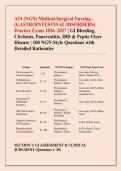
ATI (NGN) Medical-Surgical Nursing –
(GASTROINTESTINAL DISORDERS)
Practice Exam 2026–2027 | GI Bleeding,
Cirrhosis, Pancreatitis, IBD & Peptic Ulcer
Disease | 100 NGN-Style Questions with
Detailed Rationales
Section Questions NCLEX Category NGN Item Types Used
GI Assessment & Physiological Case study, Bow-tie,
1–20
Clinical Judgment Integrity Matrix, Trend, SATA
GI Bleeding & Physiological Case study, SATA, Drop-
21–35
Peptic Ulcer Disease Integrity / Safety down
Physiological Case study, SATA, Matrix,
Liver Disorders 36–50 Integrity / Therapeutic
Psychosocial communication
Pancreatitis &
Physiological
Gallbladder 51–65 Case study, SATA, Matrix
Integrity
Disorders
Physiological
IBD, IBS & Bowel Case study, SATA, Matrix,
66–80 Integrity / Health
Obstruction Trend
Promotion
Nutrition, Ostomy & Physiological
81–90 SATA, Priority action
GI Procedures Integrity / Safety
Pharmacology & Physiological SATA, Matrix, Trend
91–100
Lab Interpretation Integrity / Safety interpretation
SECTION 1: GI ASSESSMENT & CLINICAL
JUDGMENT (Questions 1–20)
,NGN CASE STUDY 1 (Questions 1–6)
A 58-year-old male presents to the emergency department with a 2-day history of worsening
epigastric pain radiating to the back, nausea, vomiting, and inability to tolerate oral intake. He
reports drinking a six-pack of beer daily for 20 years. Vital signs: BP 98/62 mmHg, HR 118
bpm, RR 22/min, Temp 38.8°C, SpO2 94% on room air. Labs: Lipase 1,240 U/L, WBC 18,500,
BUN 28, Creatinine 1.4, Na 132, K 3.1.
1. RECOGNIZE CUES — Which of the following assessment findings are MOST concerning
and require immediate attention? Select all that apply.
A. Blood pressure of 98/62 mmHg
B. Heart rate of 118 bpm
C. Temperature of 38.8°C
D. SpO2 of 94% on room air
E. Serum potassium of 3.1 mEq/L
F. BUN of 28 mg/dL
Rationale: Hypotension, tachycardia, low SpO2, and hypokalemia represent immediate threats
to physiological stability requiring priority intervention. Fever and elevated BUN are
concerning but secondary priorities.
2. ANALYZE CUES — Based on the clinical presentation and laboratory findings, which
condition does the nurse MOST likely suspect?
A. Acute cholecystitis with ascending cholangitis
B. Acute pancreatitis with systemic inflammatory response syndrome (SIRS)
C. Peptic ulcer perforation with peritonitis
D. Hepatic encephalopathy from alcohol-related cirrhosis
Rationale: Lipase >3x ULN, epigastric pain radiating to the back, alcohol history, SIRS criteria
(fever, tachycardia, elevated WBC, tachypnea), and hemodynamic instability collectively confirm
acute pancreatitis with SIRS.
3. PRIORITIZE HYPOTHESES — The nurse places the following problems in order of
priority. Which problem requires the FIRST intervention?
,A. Hypokalemia with K 3.1 mEq/L
B. Elevated lipase indicating pancreatic inflammation
C. Hemodynamic instability with hypotension and tachycardia
D. Elevated WBC indicating infection risk
Rationale: Using ABCs and Maslow's hierarchy, hemodynamic instability is the highest priority
life threat; fluid resuscitation must begin immediately before addressing other abnormalities.
4. GENERATE SOLUTIONS — The nurse anticipates which of the following provider orders?
Select all that apply.
A. IV Lactated Ringer's solution at 250–500 mL/hour
B. NPO status
C. IV morphine or hydromorphone for pain management
D. Immediate surgical consultation for laparotomy
E. Supplemental oxygen to maintain SpO2 greater than 95%
F. Oral pancreatic enzyme replacement immediately
Rationale: Aggressive IV fluid resuscitation with LR, NPO status, IV analgesia, and
supplemental oxygen are the cornerstones of acute pancreatitis management. Surgery is not
indicated initially; PERT is for chronic pancreatitis.
5. TAKE ACTION — The provider orders IV Lactated Ringer's at 300 mL/hour. Two hours
later the nurse reassesses the patient. Which finding indicates the fluid resuscitation is achieving
its goal?
A. Lipase trending downward to 900 U/L
B. Urine output increasing to 55 mL/hour and heart rate decreasing to 96 bpm
C. Patient reports decreased pain from 9/10 to 7/10
D. Temperature decreasing from 38.8°C to 38.2°C
Rationale: Adequate urine output (≥0.5 mL/kg/hr) and decreasing heart rate are the most
reliable indicators of effective fluid resuscitation and restored end-organ perfusion.
6. EVALUATE OUTCOMES — On day 3, the patient's pain has resolved, bowel sounds have
returned, and he is tolerating sips of clear liquids. Which intervention does the nurse implement
next?
A. Advance diet to low-fat soft foods and begin nutrition counseling including alcohol
cessation
, B. Continue NPO and begin total parenteral nutrition
C. Maintain clear liquid diet for 7 days before advancing
D. Insert a nasojejunal tube for enteral feeding
Rationale: Early oral feeding is recommended when pain resolves and bowel sounds return in
mild pancreatitis; alcohol cessation counseling is essential given the etiology.
MATRIX QUESTION (Question 7)
7. A nurse is assessing four patients in the emergency department. For each patient, indicate
whether the finding suggests an UPPER GI bleed, LOWER GI bleed, or REQUIRES FURTHER
ASSESSMENT to determine the source.
Upper GI Lower GI Requires Further
Patient Finding
Bleed Bleed Assessment
Patient A: Hematemesis with coffee-
✓
ground material
Patient B: Bright red blood per
✓
rectum with hypotension and HR 130
Patient C: Black tarry malodorous
✓
stool with epigastric pain
Patient D: Bright red blood coating
✓
formed stool after straining
Rationale: Hematemesis and melena indicate upper GI source. Hematochezia usually indicates
lower GI source but massive upper GI bleeding with rapid transit can cause bright red rectal
bleeding requiring further assessment. Blood coating formed stool suggests anorectal
(hemorrhoidal) source.
8. A nurse is triaging four patients in the emergency department. Which patient requires
assessment FIRST?
A. A 45-year-old with Crohn disease reporting increased diarrhea for 3 days
B. A 62-year-old with cirrhosis who vomited bright red blood and has BP of 82/54 mmHg
C. A 38-year-old with epigastric burning after meals for 2 weeks
D. A 55-year-old with mild RUQ pain after eating fatty foods
(GASTROINTESTINAL DISORDERS)
Practice Exam 2026–2027 | GI Bleeding,
Cirrhosis, Pancreatitis, IBD & Peptic Ulcer
Disease | 100 NGN-Style Questions with
Detailed Rationales
Section Questions NCLEX Category NGN Item Types Used
GI Assessment & Physiological Case study, Bow-tie,
1–20
Clinical Judgment Integrity Matrix, Trend, SATA
GI Bleeding & Physiological Case study, SATA, Drop-
21–35
Peptic Ulcer Disease Integrity / Safety down
Physiological Case study, SATA, Matrix,
Liver Disorders 36–50 Integrity / Therapeutic
Psychosocial communication
Pancreatitis &
Physiological
Gallbladder 51–65 Case study, SATA, Matrix
Integrity
Disorders
Physiological
IBD, IBS & Bowel Case study, SATA, Matrix,
66–80 Integrity / Health
Obstruction Trend
Promotion
Nutrition, Ostomy & Physiological
81–90 SATA, Priority action
GI Procedures Integrity / Safety
Pharmacology & Physiological SATA, Matrix, Trend
91–100
Lab Interpretation Integrity / Safety interpretation
SECTION 1: GI ASSESSMENT & CLINICAL
JUDGMENT (Questions 1–20)
,NGN CASE STUDY 1 (Questions 1–6)
A 58-year-old male presents to the emergency department with a 2-day history of worsening
epigastric pain radiating to the back, nausea, vomiting, and inability to tolerate oral intake. He
reports drinking a six-pack of beer daily for 20 years. Vital signs: BP 98/62 mmHg, HR 118
bpm, RR 22/min, Temp 38.8°C, SpO2 94% on room air. Labs: Lipase 1,240 U/L, WBC 18,500,
BUN 28, Creatinine 1.4, Na 132, K 3.1.
1. RECOGNIZE CUES — Which of the following assessment findings are MOST concerning
and require immediate attention? Select all that apply.
A. Blood pressure of 98/62 mmHg
B. Heart rate of 118 bpm
C. Temperature of 38.8°C
D. SpO2 of 94% on room air
E. Serum potassium of 3.1 mEq/L
F. BUN of 28 mg/dL
Rationale: Hypotension, tachycardia, low SpO2, and hypokalemia represent immediate threats
to physiological stability requiring priority intervention. Fever and elevated BUN are
concerning but secondary priorities.
2. ANALYZE CUES — Based on the clinical presentation and laboratory findings, which
condition does the nurse MOST likely suspect?
A. Acute cholecystitis with ascending cholangitis
B. Acute pancreatitis with systemic inflammatory response syndrome (SIRS)
C. Peptic ulcer perforation with peritonitis
D. Hepatic encephalopathy from alcohol-related cirrhosis
Rationale: Lipase >3x ULN, epigastric pain radiating to the back, alcohol history, SIRS criteria
(fever, tachycardia, elevated WBC, tachypnea), and hemodynamic instability collectively confirm
acute pancreatitis with SIRS.
3. PRIORITIZE HYPOTHESES — The nurse places the following problems in order of
priority. Which problem requires the FIRST intervention?
,A. Hypokalemia with K 3.1 mEq/L
B. Elevated lipase indicating pancreatic inflammation
C. Hemodynamic instability with hypotension and tachycardia
D. Elevated WBC indicating infection risk
Rationale: Using ABCs and Maslow's hierarchy, hemodynamic instability is the highest priority
life threat; fluid resuscitation must begin immediately before addressing other abnormalities.
4. GENERATE SOLUTIONS — The nurse anticipates which of the following provider orders?
Select all that apply.
A. IV Lactated Ringer's solution at 250–500 mL/hour
B. NPO status
C. IV morphine or hydromorphone for pain management
D. Immediate surgical consultation for laparotomy
E. Supplemental oxygen to maintain SpO2 greater than 95%
F. Oral pancreatic enzyme replacement immediately
Rationale: Aggressive IV fluid resuscitation with LR, NPO status, IV analgesia, and
supplemental oxygen are the cornerstones of acute pancreatitis management. Surgery is not
indicated initially; PERT is for chronic pancreatitis.
5. TAKE ACTION — The provider orders IV Lactated Ringer's at 300 mL/hour. Two hours
later the nurse reassesses the patient. Which finding indicates the fluid resuscitation is achieving
its goal?
A. Lipase trending downward to 900 U/L
B. Urine output increasing to 55 mL/hour and heart rate decreasing to 96 bpm
C. Patient reports decreased pain from 9/10 to 7/10
D. Temperature decreasing from 38.8°C to 38.2°C
Rationale: Adequate urine output (≥0.5 mL/kg/hr) and decreasing heart rate are the most
reliable indicators of effective fluid resuscitation and restored end-organ perfusion.
6. EVALUATE OUTCOMES — On day 3, the patient's pain has resolved, bowel sounds have
returned, and he is tolerating sips of clear liquids. Which intervention does the nurse implement
next?
A. Advance diet to low-fat soft foods and begin nutrition counseling including alcohol
cessation
, B. Continue NPO and begin total parenteral nutrition
C. Maintain clear liquid diet for 7 days before advancing
D. Insert a nasojejunal tube for enteral feeding
Rationale: Early oral feeding is recommended when pain resolves and bowel sounds return in
mild pancreatitis; alcohol cessation counseling is essential given the etiology.
MATRIX QUESTION (Question 7)
7. A nurse is assessing four patients in the emergency department. For each patient, indicate
whether the finding suggests an UPPER GI bleed, LOWER GI bleed, or REQUIRES FURTHER
ASSESSMENT to determine the source.
Upper GI Lower GI Requires Further
Patient Finding
Bleed Bleed Assessment
Patient A: Hematemesis with coffee-
✓
ground material
Patient B: Bright red blood per
✓
rectum with hypotension and HR 130
Patient C: Black tarry malodorous
✓
stool with epigastric pain
Patient D: Bright red blood coating
✓
formed stool after straining
Rationale: Hematemesis and melena indicate upper GI source. Hematochezia usually indicates
lower GI source but massive upper GI bleeding with rapid transit can cause bright red rectal
bleeding requiring further assessment. Blood coating formed stool suggests anorectal
(hemorrhoidal) source.
8. A nurse is triaging four patients in the emergency department. Which patient requires
assessment FIRST?
A. A 45-year-old with Crohn disease reporting increased diarrhea for 3 days
B. A 62-year-old with cirrhosis who vomited bright red blood and has BP of 82/54 mmHg
C. A 38-year-old with epigastric burning after meals for 2 weeks
D. A 55-year-old with mild RUQ pain after eating fatty foods