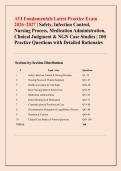
ATI Fundamentals Latest Practice Exam
2026–2027 | Safety, Infection Control,
Nursing Process, Medication Administration,
Clinical Judgment & NGN Case Studies | 100
Practice Questions with Detailed Rationales
Section-by-Section Distribution
# Topic Area Questions
1 Safety, Infection Control & Nursing Priorities Q1–15
2 Nursing Process & Clinical Judgment Q16–27
3 Health Assessment & Vital Signs Q28–38
4 Basic Nursing Skills & Patient Care Q39–52
5 Medication Administration Q53–63
6 Fluid, Electrolytes & Elimination Q64–73
7 Communication & Psychosocial Care Q74–80
8 Documentation, Delegation & Legal/Ethical Practice Q81–88
9 Nutrition & Comfort Q89–94
10 Clinical Case Studies & Priority Questions Q95–100
TOTAL 100
,SECTION 1: Safety, Infection Control & Nursing Priorities
(Q1–15)
1. A nurse is caring for a patient with active pulmonary tuberculosis (TB). Which type of
transmission-based precaution is required?
A. Contact precautions
B. Droplet precautions
C. Airborne precautions
D. Protective environment precautions
Rationale: TB is transmitted via airborne droplet nuclei (particles <5 microns); airborne
precautions require a negative pressure room, N95 respirator, and door kept closed.
2. A nurse is preparing to perform a sterile dressing change. Which action breaks sterile
technique?
A. Opening sterile packages away from the body
B. Placing sterile items at the center of the sterile field
C. Reaching across the sterile field to retrieve supplies
D. Wearing sterile gloves throughout the procedure
Rationale: Reaching across a sterile field causes contamination because unsterile clothing or
skin may contact sterile items; always reach around or to the sides of the sterile field.
3. A nurse is caring for a patient on contact precautions for MRSA. What PPE is required
upon entering the room?
A. N95 respirator and face shield only
B. Gloves and gown
C. Surgical mask and gloves only
D. Gloves, gown, and N95 respirator
Rationale: Contact precautions require gloves and gown upon entry to prevent transmission of
organisms spread by direct or indirect contact.
4. A patient has been identified as a fall risk. Which intervention is the MOST important?
,A. Place the patient in a room farthest from the nursing station
B. Apply a vest restraint to keep the patient in bed
C. Keep the call light within reach and the bed in the lowest position with brakes locked
D. Raise all four side rails to prevent the patient from getting up
Rationale: Keeping the call light accessible and the bed in the lowest locked position are
evidence-based fall prevention strategies; raising all four side rails constitutes a restraint.
5. A nurse is performing hand hygiene. According to the CDC, when is alcohol-based hand
rub (ABHR) NOT appropriate?
A. After removing gloves
B. Before performing a non-invasive procedure
C. When hands are visibly soiled with blood or body fluids
D. Before medication administration
Rationale: Alcohol-based hand rubs are ineffective against visible soiling and C. difficile spores;
soap and water must be used when hands are visibly dirty or contaminated.
6. A nurse discovers a patient on the floor next to the bed. After ensuring patient safety,
what is the nurse's NEXT priority action?
A. Complete the incident report before calling for help
B. Immediately transfer the patient back to bed
C. Assess the patient for injury before moving them
D. Notify the patient's family immediately
Rationale: Before moving a patient who has fallen, a thorough assessment for injury (fractures,
head injury, pain) must be performed to prevent further harm.
7. Which of the following is an example of a healthcare-associated infection (HAI)?
A. A patient admitted with pneumonia acquired at home
B. A patient who develops a cold after visiting a family member
C. A patient who develops a urinary tract infection 72 hours after Foley catheter insertion
D. A patient readmitted for wound dehiscence from a prior surgery
Rationale: HAIs develop during the course of healthcare and were not present at admission; a
catheter-associated UTI (CAUTI) developing after 48–72 hours is a classic example.
, 8. A nurse is implementing surgical asepsis for urinary catheter insertion. Which action is
correct?
A. Using clean gloves throughout the procedure
B. Cleansing the urethral meatus using a back-and-forth motion
C. Maintaining a sterile field and using sterile gloves throughout
D. Placing the sterile catheter tray on the patient's lap
Rationale: Urinary catheter insertion requires surgical asepsis (sterile technique) to prevent
CAUTI; sterile gloves and a sterile field must be maintained throughout.
9. A nurse is caring for a patient with C. difficile infection. Which precaution is required?
A. Contact precautions with soap-and-water hand washing
B. Airborne precautions with N95 respirator
C. Droplet precautions with surgical mask
D. Standard precautions only
Rationale: C. difficile requires contact precautions; alcohol-based hand rub does NOT kill C.
difficile spores — soap and water hand washing is mandatory.
10. A nurse is applying restraints to a patient. Which action reflects the BEST nursing
practice?
A. Apply the restraint as tightly as possible to prevent movement
B. Obtain a standing order to apply restraints whenever needed
C. Assess and document circulation, skin integrity, and patient behavior every 2 hours
D. Keep the restraint in place continuously once applied
Rationale: Restrained patients require monitoring every 2 hours for circulation, skin integrity,
comfort, and behavior to prevent injury and ensure the least restrictive option is used.
11. According to the National Patient Safety Goals (NPSGs), which is the recommended
method for patient identification?
A. Ask the patient their room number and bed assignment
B. Check the patient's wristband only
2026–2027 | Safety, Infection Control,
Nursing Process, Medication Administration,
Clinical Judgment & NGN Case Studies | 100
Practice Questions with Detailed Rationales
Section-by-Section Distribution
# Topic Area Questions
1 Safety, Infection Control & Nursing Priorities Q1–15
2 Nursing Process & Clinical Judgment Q16–27
3 Health Assessment & Vital Signs Q28–38
4 Basic Nursing Skills & Patient Care Q39–52
5 Medication Administration Q53–63
6 Fluid, Electrolytes & Elimination Q64–73
7 Communication & Psychosocial Care Q74–80
8 Documentation, Delegation & Legal/Ethical Practice Q81–88
9 Nutrition & Comfort Q89–94
10 Clinical Case Studies & Priority Questions Q95–100
TOTAL 100
,SECTION 1: Safety, Infection Control & Nursing Priorities
(Q1–15)
1. A nurse is caring for a patient with active pulmonary tuberculosis (TB). Which type of
transmission-based precaution is required?
A. Contact precautions
B. Droplet precautions
C. Airborne precautions
D. Protective environment precautions
Rationale: TB is transmitted via airborne droplet nuclei (particles <5 microns); airborne
precautions require a negative pressure room, N95 respirator, and door kept closed.
2. A nurse is preparing to perform a sterile dressing change. Which action breaks sterile
technique?
A. Opening sterile packages away from the body
B. Placing sterile items at the center of the sterile field
C. Reaching across the sterile field to retrieve supplies
D. Wearing sterile gloves throughout the procedure
Rationale: Reaching across a sterile field causes contamination because unsterile clothing or
skin may contact sterile items; always reach around or to the sides of the sterile field.
3. A nurse is caring for a patient on contact precautions for MRSA. What PPE is required
upon entering the room?
A. N95 respirator and face shield only
B. Gloves and gown
C. Surgical mask and gloves only
D. Gloves, gown, and N95 respirator
Rationale: Contact precautions require gloves and gown upon entry to prevent transmission of
organisms spread by direct or indirect contact.
4. A patient has been identified as a fall risk. Which intervention is the MOST important?
,A. Place the patient in a room farthest from the nursing station
B. Apply a vest restraint to keep the patient in bed
C. Keep the call light within reach and the bed in the lowest position with brakes locked
D. Raise all four side rails to prevent the patient from getting up
Rationale: Keeping the call light accessible and the bed in the lowest locked position are
evidence-based fall prevention strategies; raising all four side rails constitutes a restraint.
5. A nurse is performing hand hygiene. According to the CDC, when is alcohol-based hand
rub (ABHR) NOT appropriate?
A. After removing gloves
B. Before performing a non-invasive procedure
C. When hands are visibly soiled with blood or body fluids
D. Before medication administration
Rationale: Alcohol-based hand rubs are ineffective against visible soiling and C. difficile spores;
soap and water must be used when hands are visibly dirty or contaminated.
6. A nurse discovers a patient on the floor next to the bed. After ensuring patient safety,
what is the nurse's NEXT priority action?
A. Complete the incident report before calling for help
B. Immediately transfer the patient back to bed
C. Assess the patient for injury before moving them
D. Notify the patient's family immediately
Rationale: Before moving a patient who has fallen, a thorough assessment for injury (fractures,
head injury, pain) must be performed to prevent further harm.
7. Which of the following is an example of a healthcare-associated infection (HAI)?
A. A patient admitted with pneumonia acquired at home
B. A patient who develops a cold after visiting a family member
C. A patient who develops a urinary tract infection 72 hours after Foley catheter insertion
D. A patient readmitted for wound dehiscence from a prior surgery
Rationale: HAIs develop during the course of healthcare and were not present at admission; a
catheter-associated UTI (CAUTI) developing after 48–72 hours is a classic example.
, 8. A nurse is implementing surgical asepsis for urinary catheter insertion. Which action is
correct?
A. Using clean gloves throughout the procedure
B. Cleansing the urethral meatus using a back-and-forth motion
C. Maintaining a sterile field and using sterile gloves throughout
D. Placing the sterile catheter tray on the patient's lap
Rationale: Urinary catheter insertion requires surgical asepsis (sterile technique) to prevent
CAUTI; sterile gloves and a sterile field must be maintained throughout.
9. A nurse is caring for a patient with C. difficile infection. Which precaution is required?
A. Contact precautions with soap-and-water hand washing
B. Airborne precautions with N95 respirator
C. Droplet precautions with surgical mask
D. Standard precautions only
Rationale: C. difficile requires contact precautions; alcohol-based hand rub does NOT kill C.
difficile spores — soap and water hand washing is mandatory.
10. A nurse is applying restraints to a patient. Which action reflects the BEST nursing
practice?
A. Apply the restraint as tightly as possible to prevent movement
B. Obtain a standing order to apply restraints whenever needed
C. Assess and document circulation, skin integrity, and patient behavior every 2 hours
D. Keep the restraint in place continuously once applied
Rationale: Restrained patients require monitoring every 2 hours for circulation, skin integrity,
comfort, and behavior to prevent injury and ensure the least restrictive option is used.
11. According to the National Patient Safety Goals (NPSGs), which is the recommended
method for patient identification?
A. Ask the patient their room number and bed assignment
B. Check the patient's wristband only