
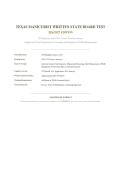
TEXAS MANICURIST WRITTEN STATE BOARD TEST
2026/2027 EDITION
250 Questions with 100% Correct Verified Answers
Aligned with Texas Department of Licensing and Regulation (TDLR) Requirements
Total Questions: 250 (Multiple Choice, A-D)
Passing Score: 70% (175 Correct Answers)
Exam Coverage: Infection Control, Nail Anatomy, Manicuring/Pedicuring, Nail Enhancements, TDLR
Regulations, Professional Ethics, Clinical Scenarios
Cognitive Levels: 35% Recall, 45% Application, 20% Analysis
Written Exam Pass Rate: Approximately 68% (FY2025)
Training Requirement: 600 Hours at TDLR-Licensed School
License Renewal: Every 2 Years with Mandatory Continuing Education
ANSWER KEY FORMAT
Each question includes the correct answer marked with [CORRECT], the letter answer, and a detailed rationale.
,Texas Manicurist Written State Board Test 2026/2027 250 Questions - TDLR Compliant
Section 1: Infection Control, Sanitation, and Safety Procedures (Q1-Q50)
Q1: A salon licensee in Houston is preparing implements for reuse. Which process destroys or inactivates most
pathogens but does NOT guarantee the elimination of bacterial spores?
A. Sterilization
B. Disinfection
C. Autoclaving [CORRECT]
D. Boiling
Correct Answer: C
Rationale: Disinfection destroys or inactivates most pathogens but may not kill bacterial spores, which is the correct level of disinfection
required for salon implements under TDLR guidelines. Sterilization destroys all microorganisms including spores but is not required for salon
use. Autoclaving is a form of sterilization. Boiling is not an accepted salon disinfection method per TDLR.
Q2: During a TDLR salon inspection, the inspector asks what type of disinfectant must be used in a Texas nail salon.
Which answer is correct?
A. Any household cleaner
B. EPA-registered hospital-grade disinfectant [CORRECT]
C. Rubbing alcohol at 50% concentration
D. Homemade bleach solution only
Correct Answer: B
Rationale: Texas TDLR requires the use of EPA-registered hospital-grade disinfectants for salon implement disinfection. Household cleaners
are not sufficient. Rubbing alcohol must be at 70% or higher and is not the primary required disinfectant. Homemade solutions alone do not
meet the EPA-registered hospital-grade standard.
Q3: A new manicurist asks the salon manager why sterilization is not required for nail implements. What is the most
accurate explanation?
A. Sterilization is too expensive for salons
B. TDLR does not require sterilization; hospital-grade disinfection is sufficient [CORRECT]
C. Sterilization damages metal implements
D. Clients do not expect sterile implements
Correct Answer: B
Rationale: TDLR regulations specify that salon implements do not require sterilization; proper cleaning followed by hospital-grade
disinfection is the required standard. Cost, implement damage, and client expectations are not the regulatory basis for this requirement.
Q4: A salon professional is mixing disinfectant solution and notices the label instructions specify a 10-minute contact
time. What should the professional do?
A. Reduce contact time to 5 minutes for efficiency
B. Follow the manufacturer's directions exactly [CORRECT]
C. Double the concentration to reduce contact time
D. Use a different disinfectant with a shorter contact time
Correct Answer: B
Rationale: EPA-registered disinfectants must be used according to the manufacturer's directions, including the specified contact time.
Altering contact time, concentration, or switching products undermines the disinfection process and violates TDLR compliance requirements
for 2026-2027.
Q5: Which of the following statements about disinfection versus sterilization is TRUE according to TDLR
standards?
A. Disinfection eliminates all microorganisms including spores
B. Sterilization is the minimum standard for multi-use implements
C. Disinfection is sufficient for salon implements; sterilization is not required [CORRECT]
Page 2
, D. Both processes are identical in their effectiveness
Correct Answer: C
Rationale: TDLR standards establish that disinfection (not sterilization) is sufficient for salon implements. Disinfection does not eliminate all
spores, while sterilization does, but the higher standard is not mandated for salon settings. The two processes differ significantly in
effectiveness.
Q6: A client asks a Texas manicurist if the implements used during their service are sterilized. What is the most
appropriate and TDLR-compliant response?
A. Yes, we sterilize everything between clients
B. No, but we use EPA-registered hospital-grade disinfectants as required by TDLR [CORRECT]
C. We only disinfect when we have time
D. Sterilization is not necessary in salons
Correct Answer: B
Rationale: The professional and accurate response is that implements are cleaned and disinfected with EPA-registered hospital-grade
disinfectants, which is the TDLR-required standard. Claiming sterilization when only disinfection is performed is dishonest. Disinfection
should always be performed, not just when time permits.
Q7: In a Texas nail salon, a manicurist accidentally uses a disinfectant that is NOT EPA-registered. What is the
primary regulatory concern?
A. The disinfectant costs too much
B. The product may not effectively destroy pathogens required for salon-level disinfection [CORRECT]
C. The salon will lose its TDLR license immediately
D. The disinfectant has an unpleasant odor
Correct Answer: B
Rationale: The primary concern is that a non-EPA-registered disinfectant may not meet the efficacy standards needed to destroy or
inactivate the range of pathogens encountered in salon settings. While TDLR violations can result in penalties, the core issue is ineffective
pathogen control.
Q8: A salon owner wants to switch from a liquid disinfectant to ultraviolet (UV) electrical sanitizers for all
implement disinfection. Is this compliant with TDLR regulations?
A. Yes, UV sanitizers are superior to chemical disinfectants
B. No, UV sanitizers can only be used as dry storage for clean implements [CORRECT]
C. Yes, if the UV light is replaced monthly
D. No, UV sanitizers are banned in Texas salons
Correct Answer: B
Rationale: TDLR regulations specify that UV electrical sanitizers may be used only as dry storage containers for already-clean and
disinfected implements. They are NOT approved as a primary disinfection method. The implements must still be properly cleaned and
chemically disinfected before being placed in a UV sanitizer for storage.
Q9: What is the correct order of steps for disinfecting multi-use implements in a Texas salon per TDLR
requirements?
A. Disinfect, rinse, dry, store
B. Clean, disinfect according to manufacturer directions, dry, store in clean container [CORRECT]
C. Store, remove, use on client, repeat
D. Rinse, disinfect, clean, store
Correct Answer: B
Rationale: The correct TDLR-compliant sequence is: clean implements first to remove debris, then disinfect according to the manufacturer's
directions for the EPA-registered product, dry the implements, and store in a clean, dry, debris-free environment. Skipping the cleaning step
or reversing the order compromises disinfection efficacy.
, Q10: A TDLR inspector observes that a salon is using a household disinfectant spray on nail implements. Which
violation has occurred?
A. No violation; any disinfectant is acceptable
B. The salon is not using an EPA-registered hospital-grade disinfectant [CORRECT]
C. The spray format is not allowed; only liquid immersion is permitted
D. Household disinfectants require a longer contact time
Correct Answer: B
Rationale: TDLR requires the use of EPA-registered hospital-grade disinfectants for salon implements. Household disinfectant sprays do not
meet this standard. The format (spray vs. immersion) is not the primary issue; the product classification is what matters for regulatory
compliance.
Q11: After completing a manicure, a manicurist must prepare multi-use implements for the next client. Which
statement is correct?
A. Implements only need disinfection once per day
B. Multi-use implements must be cleaned and disinfected prior to each client [CORRECT]
C. Wiping implements with a dry towel is sufficient between clients
D. Multi-use implements can be reused without cleaning if used on the same client
Correct Answer: B
Rationale: TDLR regulations mandate that all multi-use implements must be thoroughly cleaned and then disinfected before each client
service. Once-daily disinfection, dry wiping, and reuse without cleaning are all violations of Texas salon sanitation requirements.
Q12: A manicurist in Dallas is preparing for a busy day. Which of the following items must be discarded after each
client?
A. Metal cuticle nippers
B. Porous nail files and orangewood sticks [CORRECT]
C. Stainless steel pushers
D. acrylic brushes
Correct Answer: B
Rationale: Porous items such as nail files and orangewood sticks cannot be effectively disinfected and must be discarded after each client.
Metal implements like cuticle nippers, stainless steel pushers, and acrylic brushes are multi-use items that must be cleaned and disinfected
between clients per TDLR regulations.
Q13: A salon professional has just finished disinfecting metal implements. Where should they be stored until the
next use?
A. In the UV sanitizer with the power off
B. In a dry, debris-free environment such as a closed container [CORRECT]
C. On the workstation counter uncovered
D. In a drawer with other tools without cleaning them
Correct Answer: B
Rationale: After disinfection, implements must be stored in a clean, dry, debris-free environment to prevent recontamination. A closed
container or UV sanitizer (used only for dry storage) meets this requirement. Leaving implements uncovered on a counter or in an unclean
drawer risks contamination.
Q14: Which of the following is classified as a single-use disposable item in a Texas nail salon?
A. Cuticle pusher
B. Nail clipper
C. Orangewood stick [CORRECT]
D. Tweezers
Correct Answer: C
Rationale: Orangewood sticks are porous and classified as single-use disposable items that must be discarded after each client. Cuticle
pushers, nail clippers, and tweezers are non-porous, multi-use implements that must be cleaned and disinfected between clients per TDLR
2026/2027 EDITION
250 Questions with 100% Correct Verified Answers
Aligned with Texas Department of Licensing and Regulation (TDLR) Requirements
Total Questions: 250 (Multiple Choice, A-D)
Passing Score: 70% (175 Correct Answers)
Exam Coverage: Infection Control, Nail Anatomy, Manicuring/Pedicuring, Nail Enhancements, TDLR
Regulations, Professional Ethics, Clinical Scenarios
Cognitive Levels: 35% Recall, 45% Application, 20% Analysis
Written Exam Pass Rate: Approximately 68% (FY2025)
Training Requirement: 600 Hours at TDLR-Licensed School
License Renewal: Every 2 Years with Mandatory Continuing Education
ANSWER KEY FORMAT
Each question includes the correct answer marked with [CORRECT], the letter answer, and a detailed rationale.
,Texas Manicurist Written State Board Test 2026/2027 250 Questions - TDLR Compliant
Section 1: Infection Control, Sanitation, and Safety Procedures (Q1-Q50)
Q1: A salon licensee in Houston is preparing implements for reuse. Which process destroys or inactivates most
pathogens but does NOT guarantee the elimination of bacterial spores?
A. Sterilization
B. Disinfection
C. Autoclaving [CORRECT]
D. Boiling
Correct Answer: C
Rationale: Disinfection destroys or inactivates most pathogens but may not kill bacterial spores, which is the correct level of disinfection
required for salon implements under TDLR guidelines. Sterilization destroys all microorganisms including spores but is not required for salon
use. Autoclaving is a form of sterilization. Boiling is not an accepted salon disinfection method per TDLR.
Q2: During a TDLR salon inspection, the inspector asks what type of disinfectant must be used in a Texas nail salon.
Which answer is correct?
A. Any household cleaner
B. EPA-registered hospital-grade disinfectant [CORRECT]
C. Rubbing alcohol at 50% concentration
D. Homemade bleach solution only
Correct Answer: B
Rationale: Texas TDLR requires the use of EPA-registered hospital-grade disinfectants for salon implement disinfection. Household cleaners
are not sufficient. Rubbing alcohol must be at 70% or higher and is not the primary required disinfectant. Homemade solutions alone do not
meet the EPA-registered hospital-grade standard.
Q3: A new manicurist asks the salon manager why sterilization is not required for nail implements. What is the most
accurate explanation?
A. Sterilization is too expensive for salons
B. TDLR does not require sterilization; hospital-grade disinfection is sufficient [CORRECT]
C. Sterilization damages metal implements
D. Clients do not expect sterile implements
Correct Answer: B
Rationale: TDLR regulations specify that salon implements do not require sterilization; proper cleaning followed by hospital-grade
disinfection is the required standard. Cost, implement damage, and client expectations are not the regulatory basis for this requirement.
Q4: A salon professional is mixing disinfectant solution and notices the label instructions specify a 10-minute contact
time. What should the professional do?
A. Reduce contact time to 5 minutes for efficiency
B. Follow the manufacturer's directions exactly [CORRECT]
C. Double the concentration to reduce contact time
D. Use a different disinfectant with a shorter contact time
Correct Answer: B
Rationale: EPA-registered disinfectants must be used according to the manufacturer's directions, including the specified contact time.
Altering contact time, concentration, or switching products undermines the disinfection process and violates TDLR compliance requirements
for 2026-2027.
Q5: Which of the following statements about disinfection versus sterilization is TRUE according to TDLR
standards?
A. Disinfection eliminates all microorganisms including spores
B. Sterilization is the minimum standard for multi-use implements
C. Disinfection is sufficient for salon implements; sterilization is not required [CORRECT]
Page 2
, D. Both processes are identical in their effectiveness
Correct Answer: C
Rationale: TDLR standards establish that disinfection (not sterilization) is sufficient for salon implements. Disinfection does not eliminate all
spores, while sterilization does, but the higher standard is not mandated for salon settings. The two processes differ significantly in
effectiveness.
Q6: A client asks a Texas manicurist if the implements used during their service are sterilized. What is the most
appropriate and TDLR-compliant response?
A. Yes, we sterilize everything between clients
B. No, but we use EPA-registered hospital-grade disinfectants as required by TDLR [CORRECT]
C. We only disinfect when we have time
D. Sterilization is not necessary in salons
Correct Answer: B
Rationale: The professional and accurate response is that implements are cleaned and disinfected with EPA-registered hospital-grade
disinfectants, which is the TDLR-required standard. Claiming sterilization when only disinfection is performed is dishonest. Disinfection
should always be performed, not just when time permits.
Q7: In a Texas nail salon, a manicurist accidentally uses a disinfectant that is NOT EPA-registered. What is the
primary regulatory concern?
A. The disinfectant costs too much
B. The product may not effectively destroy pathogens required for salon-level disinfection [CORRECT]
C. The salon will lose its TDLR license immediately
D. The disinfectant has an unpleasant odor
Correct Answer: B
Rationale: The primary concern is that a non-EPA-registered disinfectant may not meet the efficacy standards needed to destroy or
inactivate the range of pathogens encountered in salon settings. While TDLR violations can result in penalties, the core issue is ineffective
pathogen control.
Q8: A salon owner wants to switch from a liquid disinfectant to ultraviolet (UV) electrical sanitizers for all
implement disinfection. Is this compliant with TDLR regulations?
A. Yes, UV sanitizers are superior to chemical disinfectants
B. No, UV sanitizers can only be used as dry storage for clean implements [CORRECT]
C. Yes, if the UV light is replaced monthly
D. No, UV sanitizers are banned in Texas salons
Correct Answer: B
Rationale: TDLR regulations specify that UV electrical sanitizers may be used only as dry storage containers for already-clean and
disinfected implements. They are NOT approved as a primary disinfection method. The implements must still be properly cleaned and
chemically disinfected before being placed in a UV sanitizer for storage.
Q9: What is the correct order of steps for disinfecting multi-use implements in a Texas salon per TDLR
requirements?
A. Disinfect, rinse, dry, store
B. Clean, disinfect according to manufacturer directions, dry, store in clean container [CORRECT]
C. Store, remove, use on client, repeat
D. Rinse, disinfect, clean, store
Correct Answer: B
Rationale: The correct TDLR-compliant sequence is: clean implements first to remove debris, then disinfect according to the manufacturer's
directions for the EPA-registered product, dry the implements, and store in a clean, dry, debris-free environment. Skipping the cleaning step
or reversing the order compromises disinfection efficacy.
, Q10: A TDLR inspector observes that a salon is using a household disinfectant spray on nail implements. Which
violation has occurred?
A. No violation; any disinfectant is acceptable
B. The salon is not using an EPA-registered hospital-grade disinfectant [CORRECT]
C. The spray format is not allowed; only liquid immersion is permitted
D. Household disinfectants require a longer contact time
Correct Answer: B
Rationale: TDLR requires the use of EPA-registered hospital-grade disinfectants for salon implements. Household disinfectant sprays do not
meet this standard. The format (spray vs. immersion) is not the primary issue; the product classification is what matters for regulatory
compliance.
Q11: After completing a manicure, a manicurist must prepare multi-use implements for the next client. Which
statement is correct?
A. Implements only need disinfection once per day
B. Multi-use implements must be cleaned and disinfected prior to each client [CORRECT]
C. Wiping implements with a dry towel is sufficient between clients
D. Multi-use implements can be reused without cleaning if used on the same client
Correct Answer: B
Rationale: TDLR regulations mandate that all multi-use implements must be thoroughly cleaned and then disinfected before each client
service. Once-daily disinfection, dry wiping, and reuse without cleaning are all violations of Texas salon sanitation requirements.
Q12: A manicurist in Dallas is preparing for a busy day. Which of the following items must be discarded after each
client?
A. Metal cuticle nippers
B. Porous nail files and orangewood sticks [CORRECT]
C. Stainless steel pushers
D. acrylic brushes
Correct Answer: B
Rationale: Porous items such as nail files and orangewood sticks cannot be effectively disinfected and must be discarded after each client.
Metal implements like cuticle nippers, stainless steel pushers, and acrylic brushes are multi-use items that must be cleaned and disinfected
between clients per TDLR regulations.
Q13: A salon professional has just finished disinfecting metal implements. Where should they be stored until the
next use?
A. In the UV sanitizer with the power off
B. In a dry, debris-free environment such as a closed container [CORRECT]
C. On the workstation counter uncovered
D. In a drawer with other tools without cleaning them
Correct Answer: B
Rationale: After disinfection, implements must be stored in a clean, dry, debris-free environment to prevent recontamination. A closed
container or UV sanitizer (used only for dry storage) meets this requirement. Leaving implements uncovered on a counter or in an unclean
drawer risks contamination.
Q14: Which of the following is classified as a single-use disposable item in a Texas nail salon?
A. Cuticle pusher
B. Nail clipper
C. Orangewood stick [CORRECT]
D. Tweezers
Correct Answer: C
Rationale: Orangewood sticks are porous and classified as single-use disposable items that must be discarded after each client. Cuticle
pushers, nail clippers, and tweezers are non-porous, multi-use implements that must be cleaned and disinfected between clients per TDLR


