

VATI PN GREEN LIGHT COMPREHENSIVE EXAM 2026/2027 180 Questions | NCLEX-PN Test Plan (Apr 2026)
VATI PN PROCTORED
GREEN LIGHT COMPREHENSIVE EXAM
LATEST 2026/2027
180-Question Comprehensive Predictor Examination
Total Questions: 180 (Multiple Choice)
Test Plan: NCSBN NCLEX-PN Test Plan (effective April 2026)
Framework: Clinical Judgment Measurement Model (CJMM)
Cognitive Levels: 25% Recall | 55% Application | 20% Analysis
Question Style: 75% Scenario-based | 20% Direct Recall | 5% NGN-Style Cases
Sections: 9 Comprehensive Content Areas
Grading: A+ Rated Rationales with ATI/VATI Clinical Reasoning
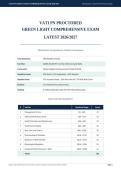
EXAM CONTENT BLUEPRINT
# Section Question Range Count
1 Management of Care Q1 - Q25 25
2 Safety and Infection Control Q26 - Q45 20
3 Health Promotion and Maintenance Q46 - Q65 20
4 Psychosocial Integrity Q66 - Q85 20
5 Basic Care and Comfort Q86 - Q105 20
6 Pharmacological Therapies Q106 - Q125 20
7 Reduction of Risk Potential Q126 - Q145 20
8 Physiological Adaptation Q146 - Q165 20
9 Integrated Clinical Scenarios / NGN Q166 - Q180 15
TOTAL 180
Aligned with NCSBN NCLEX-PN Test Plan & Clinical Judgment Measurement Model (CJMM) Page 1
,VATI PN GREEN LIGHT COMPREHENSIVE EXAM 2026/2027 180 Questions | NCLEX-PN Test Plan (Apr 2026)
SECTION 1: MANAGEMENT OF CARE
Delegation, Prioritization, Assignment, Supervision, Legal/Ethical, & Client Rights (Q1-25)
Q1: A charge nurse on a medical-surgical unit is planning client assignments for the shift. Which of the following
clients should the charge nurse assign to the LPN?
A. A client newly admitted with acute GI bleeding requiring fluid resuscitation
B. A client who is 2 days post-op from a hip replacement needing routine wound care and ambulation assistance
[CORRECT]
C. A client receiving their first dose of IV chemotherapy for lymphoma
D. A client with new-onset chest pain requiring STAT cardiac enzymes and telemetry
Correct Answer: B
Rationale: The LPN scope of practice includes caring for stable clients with predictable outcomes, performing routine wound care,
and reinforcing teaching. A 2-day post-op hip replacement client with routine needs fits this scope. Clients with acute GI bleeding
(unstable, fluid resuscitation), first-dose chemotherapy (requires RN assessment for adverse reactions), and new-onset chest pain
(acute, unpredictable) require the RN's assessment and complex clinical judgment. The RN retains clients with unstable
conditions, complex assessments, and high-risk interventions per ATI delegation principles.
Q2: A nurse is caring for four clients. Using the ABC priority framework, which client should the nurse assess first?
A. A client with a blood pressure of 160/90 mmHg complaining of a headache
B. A client with a respiratory rate of 28/min and wheezing on expiration [CORRECT]
C. A client with a blood glucose of 280 mg/dL requesting insulin
D. A client with an oral temperature of 101°F (38.3°C) and chills
Correct Answer: B
Rationale: Using the ABC framework, Airway and Breathing take priority over Circulation and other concerns. A respiratory rate
of 28/min with wheezing indicates respiratory distress requiring immediate assessment and intervention. Hypertension with
headache (Circulation), hyperglycemia (metabolic), and fever (infection) are important but secondary to a compromised
airway/breathing. The NCLEX-PN prioritization rule: life-threatening respiratory problems always come first, followed by
cardiovascular, then other body systems.
Q3: A nurse delegates ambulation of a stable post-op client to a UAP. Which statement by the UAP requires the nurse
to intervene?
A. I will check the client's identification band before ambulating.
B. I will ambulate the client even if they feel dizzy to build endurance. [CORRECT]
C. I will report any shortness of breath during ambulation to you immediately.
D. I will use a gait belt when ambulating the client.
Correct Answer: B
Rationale: The UAP must report dizziness and stop ambulation—continuing to ambulate a dizzy client creates a fall risk and is
unsafe. The nurse must intervene immediately. Checking ID (right client), reporting shortness of breath (right communication),
and using a gait belt (right safety practice) are all appropriate UAP actions. The Five Rights of Delegation (right task, right
circumstance, right person, right direction, right supervision) require the nurse to ensure the UAP understands safety limits.
Aligned with NCSBN NCLEX-PN Test Plan & Clinical Judgment Measurement Model (CJMM) Page 2
,VATI PN GREEN LIGHT COMPREHENSIVE EXAM 2026/2027 180 Questions | NCLEX-PN Test Plan (Apr 2026)
Q4: A client signs a consent form for surgery, then tells the nurse, 'I'm not really sure what they're going to do.' What
is the nurse's best action?
A. Witness the signature since the client already signed the form
B. Notify the provider so they can return to explain the procedure again [CORRECT]
C. Explain the surgical procedure to the client in detail
D. Document the client's statement and proceed with pre-op preparation
Correct Answer: B
Rationale: Informed consent requires the client to understand the procedure, risks, benefits, and alternatives. The nurse's role is
to witness the signature AND verify understanding. If the client doesn't understand, the nurse must notify the provider, who is
legally responsible for explaining the procedure. The nurse should NOT explain the procedure (outside scope for surgical consent),
NOT witness if understanding is questionable, and NOT proceed without proper consent. This protects client autonomy and the
nurse's legal practice.
Q5: A client with a terminal illness has a living will that states no heroic measures. The client's spouse demands
'everything be done' when the client stops breathing. What should the nurse do?
A. Call a code and begin resuscitation to honor the spouse's wishes
B. Follow the living will and do not initiate resuscitation [CORRECT]
C. Contact the ethics committee before taking any action
D. Ask the provider to determine the appropriate action
Correct Answer: B
Rationale: A living will is a legal advance directive that the client created while competent. It takes precedence over family
wishes. The nurse must honor the client's autonomous decision as documented in the living will. Initiating resuscitation would
violate the client's explicit directives and could constitute battery. Ethics committee consultation may be appropriate for conflict
resolution but does not override the directive. The provider should be notified, but the nurse's action is to follow the advance
directive.
Q6: A nurse discovers a coworker diverting narcotics from the medication dispensing system. What is the nurse's
priority action?
A. Confront the coworker privately about the diversion
B. Report the observation to the nurse manager immediately [CORRECT]
C. Wait to gather more evidence before reporting
D. Document the observation in the client's medical record
Correct Answer: B
Rationale: The nurse has a legal and ethical duty to report suspected narcotic diversion to the nurse manager immediately. This
protects client safety (impaired provider), meets mandatory reporting requirements, and ensures proper investigation.
Confronting the coworker directly is unsafe and could allow evidence destruction. Waiting delays intervention while client safety
is at risk. Documenting in the client's medical record is inappropriate—the incident is a personnel matter, not client care
documentation.
Aligned with NCSBN NCLEX-PN Test Plan & Clinical Judgment Measurement Model (CJMM) Page 3
, VATI PN GREEN LIGHT COMPREHENSIVE EXAM 2026/2027 180 Questions | NCLEX-PN Test Plan (Apr 2026)
Q7: A nurse is preparing to administer medications to a client who refuses, stating, 'Those pills make me sick.' What is
the nurse's best response?
A. I'll document that you refused your medications.
B. Tell me more about what happens when you take these medications. [CORRECT]
C. Your provider prescribed these, so you really should take them.
D. I'll mix them in applesauce so you won't taste them.
Correct Answer: B
Rationale: Therapeutic communication requires the nurse to explore the client's concerns before acting. Asking 'tell me more'
uses the therapeutic technique of exploring and allows assessment of the actual problem (side effect, fear, misunderstanding).
Simply documenting refusal ignores the underlying issue. Pressuring the client violates autonomy. Hiding medications in food is
unethical and potentially dangerous (medication error, trust violation). The nurse must investigate, then collaborate with the
provider if side effects are confirmed.
Q8: A client asks the nurse about a coworker who was admitted to the hospital. What is the nurse's best response?
A. I can tell you that she is in room 214 and is doing better.
B. I cannot share any information about clients admitted to this facility. [CORRECT]
C. She's been having a rough time, but she's stable now.
D. You should ask her directly when she's discharged.
Correct Answer: B
Rationale: HIPAA strictly prohibits sharing any client information—including admission status, location, or condition—with
unauthorized individuals, even if the requester knows the client. The nurse's only appropriate response is to refuse disclosure.
Revealing room numbers, condition, or any detail violates confidentiality. Suggesting the person ask the client later does not
address the current privacy violation attempt. HIPAA violations carry civil and criminal penalties for the nurse and facility.
Q9: An RN, LPN, and UAP are caring for a group of clients. Which task is appropriate to assign to the LPN?
A. Performing the initial admission assessment for a new client
B. Administering oral medications to a stable client with a feeding tube [CORRECT]
C. Developing the plan of care for a client with a new colostomy
D. Providing education to a newly diagnosed diabetic client
Correct Answer: B
Rationale: The LPN can administer oral and enteral medications to stable clients. Initial admission assessments (RN scope), care
plan development (RN scope), and initial diabetic teaching (RN scope requiring complex teaching) all require RN-level practice.
The LPN reinforces teaching but does not provide initial complex education. ATI delegation principles: LPN manages stable clients
with predictable outcomes, performs focused assessments, administers medications (most routes), and reinforces teaching.
Q10: A nurse is caring for a client who is Jehovah's Witness and refuses a blood transfusion despite a hemoglobin of
6.2 g/dL. What is the nurse's priority action?
A. Administer the transfusion as the client's life is in danger
B. Notify the provider and document the client's refusal [CORRECT]
C. Contact the ethics committee for an emergency override
D. Have the client's family convince them to accept the transfusion
Correct Answer: B
Rationale: Competent adults have the right to refuse any treatment, including life-saving interventions, based on religious or
personal beliefs. The nurse must respect the client's autonomy, notify the provider for alternative treatments (e.g.,
erythropoietin, iron), and document the refusal. Administering against the client's will is battery. Ethics committee override is
inappropriate for a competent adult's informed refusal. Family pressure violates the client's autonomous decision-making right.
Aligned with NCSBN NCLEX-PN Test Plan & Clinical Judgment Measurement Model (CJMM) Page 4
VATI PN PROCTORED
GREEN LIGHT COMPREHENSIVE EXAM
LATEST 2026/2027
180-Question Comprehensive Predictor Examination
Total Questions: 180 (Multiple Choice)
Test Plan: NCSBN NCLEX-PN Test Plan (effective April 2026)
Framework: Clinical Judgment Measurement Model (CJMM)
Cognitive Levels: 25% Recall | 55% Application | 20% Analysis
Question Style: 75% Scenario-based | 20% Direct Recall | 5% NGN-Style Cases
Sections: 9 Comprehensive Content Areas
Grading: A+ Rated Rationales with ATI/VATI Clinical Reasoning
EXAM CONTENT BLUEPRINT
# Section Question Range Count
1 Management of Care Q1 - Q25 25
2 Safety and Infection Control Q26 - Q45 20
3 Health Promotion and Maintenance Q46 - Q65 20
4 Psychosocial Integrity Q66 - Q85 20
5 Basic Care and Comfort Q86 - Q105 20
6 Pharmacological Therapies Q106 - Q125 20
7 Reduction of Risk Potential Q126 - Q145 20
8 Physiological Adaptation Q146 - Q165 20
9 Integrated Clinical Scenarios / NGN Q166 - Q180 15
TOTAL 180
Aligned with NCSBN NCLEX-PN Test Plan & Clinical Judgment Measurement Model (CJMM) Page 1
,VATI PN GREEN LIGHT COMPREHENSIVE EXAM 2026/2027 180 Questions | NCLEX-PN Test Plan (Apr 2026)
SECTION 1: MANAGEMENT OF CARE
Delegation, Prioritization, Assignment, Supervision, Legal/Ethical, & Client Rights (Q1-25)
Q1: A charge nurse on a medical-surgical unit is planning client assignments for the shift. Which of the following
clients should the charge nurse assign to the LPN?
A. A client newly admitted with acute GI bleeding requiring fluid resuscitation
B. A client who is 2 days post-op from a hip replacement needing routine wound care and ambulation assistance
[CORRECT]
C. A client receiving their first dose of IV chemotherapy for lymphoma
D. A client with new-onset chest pain requiring STAT cardiac enzymes and telemetry
Correct Answer: B
Rationale: The LPN scope of practice includes caring for stable clients with predictable outcomes, performing routine wound care,
and reinforcing teaching. A 2-day post-op hip replacement client with routine needs fits this scope. Clients with acute GI bleeding
(unstable, fluid resuscitation), first-dose chemotherapy (requires RN assessment for adverse reactions), and new-onset chest pain
(acute, unpredictable) require the RN's assessment and complex clinical judgment. The RN retains clients with unstable
conditions, complex assessments, and high-risk interventions per ATI delegation principles.
Q2: A nurse is caring for four clients. Using the ABC priority framework, which client should the nurse assess first?
A. A client with a blood pressure of 160/90 mmHg complaining of a headache
B. A client with a respiratory rate of 28/min and wheezing on expiration [CORRECT]
C. A client with a blood glucose of 280 mg/dL requesting insulin
D. A client with an oral temperature of 101°F (38.3°C) and chills
Correct Answer: B
Rationale: Using the ABC framework, Airway and Breathing take priority over Circulation and other concerns. A respiratory rate
of 28/min with wheezing indicates respiratory distress requiring immediate assessment and intervention. Hypertension with
headache (Circulation), hyperglycemia (metabolic), and fever (infection) are important but secondary to a compromised
airway/breathing. The NCLEX-PN prioritization rule: life-threatening respiratory problems always come first, followed by
cardiovascular, then other body systems.
Q3: A nurse delegates ambulation of a stable post-op client to a UAP. Which statement by the UAP requires the nurse
to intervene?
A. I will check the client's identification band before ambulating.
B. I will ambulate the client even if they feel dizzy to build endurance. [CORRECT]
C. I will report any shortness of breath during ambulation to you immediately.
D. I will use a gait belt when ambulating the client.
Correct Answer: B
Rationale: The UAP must report dizziness and stop ambulation—continuing to ambulate a dizzy client creates a fall risk and is
unsafe. The nurse must intervene immediately. Checking ID (right client), reporting shortness of breath (right communication),
and using a gait belt (right safety practice) are all appropriate UAP actions. The Five Rights of Delegation (right task, right
circumstance, right person, right direction, right supervision) require the nurse to ensure the UAP understands safety limits.
Aligned with NCSBN NCLEX-PN Test Plan & Clinical Judgment Measurement Model (CJMM) Page 2
,VATI PN GREEN LIGHT COMPREHENSIVE EXAM 2026/2027 180 Questions | NCLEX-PN Test Plan (Apr 2026)
Q4: A client signs a consent form for surgery, then tells the nurse, 'I'm not really sure what they're going to do.' What
is the nurse's best action?
A. Witness the signature since the client already signed the form
B. Notify the provider so they can return to explain the procedure again [CORRECT]
C. Explain the surgical procedure to the client in detail
D. Document the client's statement and proceed with pre-op preparation
Correct Answer: B
Rationale: Informed consent requires the client to understand the procedure, risks, benefits, and alternatives. The nurse's role is
to witness the signature AND verify understanding. If the client doesn't understand, the nurse must notify the provider, who is
legally responsible for explaining the procedure. The nurse should NOT explain the procedure (outside scope for surgical consent),
NOT witness if understanding is questionable, and NOT proceed without proper consent. This protects client autonomy and the
nurse's legal practice.
Q5: A client with a terminal illness has a living will that states no heroic measures. The client's spouse demands
'everything be done' when the client stops breathing. What should the nurse do?
A. Call a code and begin resuscitation to honor the spouse's wishes
B. Follow the living will and do not initiate resuscitation [CORRECT]
C. Contact the ethics committee before taking any action
D. Ask the provider to determine the appropriate action
Correct Answer: B
Rationale: A living will is a legal advance directive that the client created while competent. It takes precedence over family
wishes. The nurse must honor the client's autonomous decision as documented in the living will. Initiating resuscitation would
violate the client's explicit directives and could constitute battery. Ethics committee consultation may be appropriate for conflict
resolution but does not override the directive. The provider should be notified, but the nurse's action is to follow the advance
directive.
Q6: A nurse discovers a coworker diverting narcotics from the medication dispensing system. What is the nurse's
priority action?
A. Confront the coworker privately about the diversion
B. Report the observation to the nurse manager immediately [CORRECT]
C. Wait to gather more evidence before reporting
D. Document the observation in the client's medical record
Correct Answer: B
Rationale: The nurse has a legal and ethical duty to report suspected narcotic diversion to the nurse manager immediately. This
protects client safety (impaired provider), meets mandatory reporting requirements, and ensures proper investigation.
Confronting the coworker directly is unsafe and could allow evidence destruction. Waiting delays intervention while client safety
is at risk. Documenting in the client's medical record is inappropriate—the incident is a personnel matter, not client care
documentation.
Aligned with NCSBN NCLEX-PN Test Plan & Clinical Judgment Measurement Model (CJMM) Page 3
, VATI PN GREEN LIGHT COMPREHENSIVE EXAM 2026/2027 180 Questions | NCLEX-PN Test Plan (Apr 2026)
Q7: A nurse is preparing to administer medications to a client who refuses, stating, 'Those pills make me sick.' What is
the nurse's best response?
A. I'll document that you refused your medications.
B. Tell me more about what happens when you take these medications. [CORRECT]
C. Your provider prescribed these, so you really should take them.
D. I'll mix them in applesauce so you won't taste them.
Correct Answer: B
Rationale: Therapeutic communication requires the nurse to explore the client's concerns before acting. Asking 'tell me more'
uses the therapeutic technique of exploring and allows assessment of the actual problem (side effect, fear, misunderstanding).
Simply documenting refusal ignores the underlying issue. Pressuring the client violates autonomy. Hiding medications in food is
unethical and potentially dangerous (medication error, trust violation). The nurse must investigate, then collaborate with the
provider if side effects are confirmed.
Q8: A client asks the nurse about a coworker who was admitted to the hospital. What is the nurse's best response?
A. I can tell you that she is in room 214 and is doing better.
B. I cannot share any information about clients admitted to this facility. [CORRECT]
C. She's been having a rough time, but she's stable now.
D. You should ask her directly when she's discharged.
Correct Answer: B
Rationale: HIPAA strictly prohibits sharing any client information—including admission status, location, or condition—with
unauthorized individuals, even if the requester knows the client. The nurse's only appropriate response is to refuse disclosure.
Revealing room numbers, condition, or any detail violates confidentiality. Suggesting the person ask the client later does not
address the current privacy violation attempt. HIPAA violations carry civil and criminal penalties for the nurse and facility.
Q9: An RN, LPN, and UAP are caring for a group of clients. Which task is appropriate to assign to the LPN?
A. Performing the initial admission assessment for a new client
B. Administering oral medications to a stable client with a feeding tube [CORRECT]
C. Developing the plan of care for a client with a new colostomy
D. Providing education to a newly diagnosed diabetic client
Correct Answer: B
Rationale: The LPN can administer oral and enteral medications to stable clients. Initial admission assessments (RN scope), care
plan development (RN scope), and initial diabetic teaching (RN scope requiring complex teaching) all require RN-level practice.
The LPN reinforces teaching but does not provide initial complex education. ATI delegation principles: LPN manages stable clients
with predictable outcomes, performs focused assessments, administers medications (most routes), and reinforces teaching.
Q10: A nurse is caring for a client who is Jehovah's Witness and refuses a blood transfusion despite a hemoglobin of
6.2 g/dL. What is the nurse's priority action?
A. Administer the transfusion as the client's life is in danger
B. Notify the provider and document the client's refusal [CORRECT]
C. Contact the ethics committee for an emergency override
D. Have the client's family convince them to accept the transfusion
Correct Answer: B
Rationale: Competent adults have the right to refuse any treatment, including life-saving interventions, based on religious or
personal beliefs. The nurse must respect the client's autonomy, notify the provider for alternative treatments (e.g.,
erythropoietin, iron), and document the refusal. Administering against the client's will is battery. Ethics committee override is
inappropriate for a competent adult's informed refusal. Family pressure violates the client's autonomous decision-making right.
Aligned with NCSBN NCLEX-PN Test Plan & Clinical Judgment Measurement Model (CJMM) Page 4


