

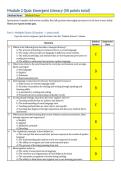
Module 2 Quiz: Emergent Literacy (50 points total)
Student Name: Melinda Coney
Instructions: Complete each section carefully. Read all questions thoroughly and answer to the best of your ability.
There are 4 parts to this quiz.
Part 1: Multiple Choice (10 points – 1 point each)
- Type the correct response (just the letter) into the “Student Answer” column.
Student Instructor
Question
Answer Note
1 Which of the following best describes 'emergent literacy'?
a) The process of learning to read and write in a second language
b) The study of how people use language in different social contexts
c) The skills, knowledge, and attitudes that are developmental precursors to C
reading and writing
d) The ability to understand and produce spoken language
2 What term refers to the print found in the everyday environment, such as signs,
labels, and logos?
a) Oral language
b) Explicit D
c) Schemata
d) Environmental print
3 Oral language is important for literacy development because it:
a) Only focuses on written language skills
b) Provides a foundation for reading and writing through speaking and
listening skills B
c) Is unrelated to reading and writing
d) Primarily involves memorizing vocabulary words
4 In educational settings, what does the term 'explicit' refer to?
a) Teaching methods that are indirect and inferred
b) The understanding of social language cues
c) Teaching methods that are clear, direct, and specific C
d) Learning that happens through exploration and discovery without direct
instruction
5 Which term describes learning that occurs without conscious awareness, often
through exposure and experience?
a) Explicit
b) Implicit B
c) Alphabetic principle
d) Decoding
6 The 'alphabetic principle' is best defined as:
a) The concept that letters and letter patterns represent the sounds of spoken
language
b) The understanding that spoken words are composed of sounds A
c) The ability to recognize and read environmental print
d) The process of deriving meaning from text
7 Metacognition refers to:
a) The study of sound patterns in language
b) The structure and organization of knowledge in the brain D
c) The automatic recognition of words during reading
d) The ability to think about and regulate one's own learning processes
Student Name: Melinda Coney
Instructions: Complete each section carefully. Read all questions thoroughly and answer to the best of your ability.
There are 4 parts to this quiz.
Part 1: Multiple Choice (10 points – 1 point each)
- Type the correct response (just the letter) into the “Student Answer” column.
Student Instructor
Question
Answer Note
1 Which of the following best describes 'emergent literacy'?
a) The process of learning to read and write in a second language
b) The study of how people use language in different social contexts
c) The skills, knowledge, and attitudes that are developmental precursors to C
reading and writing
d) The ability to understand and produce spoken language
2 What term refers to the print found in the everyday environment, such as signs,
labels, and logos?
a) Oral language
b) Explicit D
c) Schemata
d) Environmental print
3 Oral language is important for literacy development because it:
a) Only focuses on written language skills
b) Provides a foundation for reading and writing through speaking and
listening skills B
c) Is unrelated to reading and writing
d) Primarily involves memorizing vocabulary words
4 In educational settings, what does the term 'explicit' refer to?
a) Teaching methods that are indirect and inferred
b) The understanding of social language cues
c) Teaching methods that are clear, direct, and specific C
d) Learning that happens through exploration and discovery without direct
instruction
5 Which term describes learning that occurs without conscious awareness, often
through exposure and experience?
a) Explicit
b) Implicit B
c) Alphabetic principle
d) Decoding
6 The 'alphabetic principle' is best defined as:
a) The concept that letters and letter patterns represent the sounds of spoken
language
b) The understanding that spoken words are composed of sounds A
c) The ability to recognize and read environmental print
d) The process of deriving meaning from text
7 Metacognition refers to:
a) The study of sound patterns in language
b) The structure and organization of knowledge in the brain D
c) The automatic recognition of words during reading
d) The ability to think about and regulate one's own learning processes


