
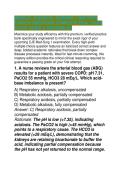
MEDICAL-SURGICAL NURSING 1 MASTERY
EDITION QUESTIONS COMPLETE REAL EXAM
STUDY GUIDE & RATIONALES
Maximize your study efficiency with this premium, verified practice
bank specifically engineered to mirror the exact rigor of your
upcoming CJE Med-Surg 1 examination. Every high-yield
multiple-choice question features an italicized correct answer and
deep, bolded academic rationales that break down complex
disease processes instantly. Ideal for last-minute cramming, this
mastery edition provides the critical clinical reasoning required to
guarantee a passing grade on your first attempt.
1. A nurse reviews the arterial blood gas (ABG)
results for a patient with severe COPD: pH 7.31,
PaCO2 55 mmHg, HCO3 28 mEq/L. Which acid-
base imbalance is present?
A) Respiratory alkalosis, uncompensated
B) Metabolic acidosis, partially compensated
C) Respiratory acidosis, partially compensated
D) Metabolic alkalosis, fully compensated
Answer: C) Respiratory acidosis, partially
compensated
Rationale: The pH is low (<7.35), indicating
acidosis. The PaCO2 is high (>45 mmHg), which
points to a respiratory cause. The HCO3 is
elevated (>26 mEq/L), demonstrating that the
kidneys are retaining bicarbonate to buffer the
acid, indicating partial compensation because
the pH has not yet returned to the normal range.
,2. An acute care nurse assesses a patient 2
hours post-thyroidectomy. The patient
complains of tingling around the mouth and
muscle twitching. Which medication should the
nurse prepare?
A) Potassium chloride
B) Calcium gluconate
C) Sodium bicarbonate
D) Magnesium sulfate
Answer: B) Calcium gluconate
Rationale: Tingling around the mouth (circumoral
paresthesia) and muscle twitching indicate
hypocalcemia, a common complication of
thyroidectomy if the parathyroid glands are
accidentally damaged or removed. Intravenous
calcium gluconate is the standard emergency
treatment to restore calcium levels and prevent
tetany.
3. A patient with a deep vein thrombosis (DVT) is
receiving a continuous intravenous heparin
infusion. The nurse notes the patient’s aPTT is
115 seconds. Which action should the nurse take
first?
A) Increase the infusion rate by 10%
B) Stop the infusion immediately
C) Administer Vitamin K intramuscularly
D) Document the finding as expected
,Answer: B) Stop the infusion immediately
Rationale: A normal aPTT is roughly 30 to 40
seconds, and the therapeutic range for heparin
therapy is typically 1.5 to 2.5 times the normal
limit (about 60 to 80 seconds). An aPTT of 115
seconds indicates severe over-coagulation and
high bleeding risk, necessitating immediate
cessation of the infusion before notifying the
healthcare provider.
4. Which clinical manifestation should a nurse
prioritize as an early sign of hypovolemic shock
in a post-operative trauma patient?
A) Decreased urine output below 10 mL/hr
B) Hypotension with a systolic BP of 80 mmHg
C) Lethargy and unresponsiveness
D) Tachycardia and narrowing pulse pressure
Answer: D) Tachycardia and narrowing pulse
pressure
Rationale: Tachycardia is one of the earliest
compensatory mechanisms in hypovolemic
shock as the heart beats faster to maintain
cardiac output. Narrowing pulse pressure also
occurs early as diastolic pressure rises due to
systemic vasoconstriction. Hypotension and
lethargy are late signs indicating compensatory
failure.
, 5. A nurse cares for a patient admitted with acute
pancreatitis. Which dietary prescription should
the nurse anticipate during the initial acute
phase?
A) High-protein, low-fat liquid diet
B) Regular diet as tolerated
C) Strict NPO status
D) Low-sodium, high-carbohydrate diet
Answer: C) Strict NPO status
Rationale: The primary goal in treating acute
pancreatitis is to rest the pancreas and minimize
the secretion of pancreatic enzymes that cause
autodigestion of the organ. Keeping the patient
strictly NPO (nothing by mouth) eliminates the
cephalic and gastric phases of pancreatic
stimulation.
6. A patient is diagnosed with primary primary
hyperaldosteronism (Conn's syndrome). Which
electrolyte abnormality is the nurse most likely
to find in the lab results?
A) Hyperkalemia
B) Hypokalemia
C) Hyponatremia
D) Hypocalcemia
Answer: B) Hypokalemia
Rationale: Aldosterone causes the renal tubules
to retain sodium and water while excreting
EDITION QUESTIONS COMPLETE REAL EXAM
STUDY GUIDE & RATIONALES
Maximize your study efficiency with this premium, verified practice
bank specifically engineered to mirror the exact rigor of your
upcoming CJE Med-Surg 1 examination. Every high-yield
multiple-choice question features an italicized correct answer and
deep, bolded academic rationales that break down complex
disease processes instantly. Ideal for last-minute cramming, this
mastery edition provides the critical clinical reasoning required to
guarantee a passing grade on your first attempt.
1. A nurse reviews the arterial blood gas (ABG)
results for a patient with severe COPD: pH 7.31,
PaCO2 55 mmHg, HCO3 28 mEq/L. Which acid-
base imbalance is present?
A) Respiratory alkalosis, uncompensated
B) Metabolic acidosis, partially compensated
C) Respiratory acidosis, partially compensated
D) Metabolic alkalosis, fully compensated
Answer: C) Respiratory acidosis, partially
compensated
Rationale: The pH is low (<7.35), indicating
acidosis. The PaCO2 is high (>45 mmHg), which
points to a respiratory cause. The HCO3 is
elevated (>26 mEq/L), demonstrating that the
kidneys are retaining bicarbonate to buffer the
acid, indicating partial compensation because
the pH has not yet returned to the normal range.
,2. An acute care nurse assesses a patient 2
hours post-thyroidectomy. The patient
complains of tingling around the mouth and
muscle twitching. Which medication should the
nurse prepare?
A) Potassium chloride
B) Calcium gluconate
C) Sodium bicarbonate
D) Magnesium sulfate
Answer: B) Calcium gluconate
Rationale: Tingling around the mouth (circumoral
paresthesia) and muscle twitching indicate
hypocalcemia, a common complication of
thyroidectomy if the parathyroid glands are
accidentally damaged or removed. Intravenous
calcium gluconate is the standard emergency
treatment to restore calcium levels and prevent
tetany.
3. A patient with a deep vein thrombosis (DVT) is
receiving a continuous intravenous heparin
infusion. The nurse notes the patient’s aPTT is
115 seconds. Which action should the nurse take
first?
A) Increase the infusion rate by 10%
B) Stop the infusion immediately
C) Administer Vitamin K intramuscularly
D) Document the finding as expected
,Answer: B) Stop the infusion immediately
Rationale: A normal aPTT is roughly 30 to 40
seconds, and the therapeutic range for heparin
therapy is typically 1.5 to 2.5 times the normal
limit (about 60 to 80 seconds). An aPTT of 115
seconds indicates severe over-coagulation and
high bleeding risk, necessitating immediate
cessation of the infusion before notifying the
healthcare provider.
4. Which clinical manifestation should a nurse
prioritize as an early sign of hypovolemic shock
in a post-operative trauma patient?
A) Decreased urine output below 10 mL/hr
B) Hypotension with a systolic BP of 80 mmHg
C) Lethargy and unresponsiveness
D) Tachycardia and narrowing pulse pressure
Answer: D) Tachycardia and narrowing pulse
pressure
Rationale: Tachycardia is one of the earliest
compensatory mechanisms in hypovolemic
shock as the heart beats faster to maintain
cardiac output. Narrowing pulse pressure also
occurs early as diastolic pressure rises due to
systemic vasoconstriction. Hypotension and
lethargy are late signs indicating compensatory
failure.
, 5. A nurse cares for a patient admitted with acute
pancreatitis. Which dietary prescription should
the nurse anticipate during the initial acute
phase?
A) High-protein, low-fat liquid diet
B) Regular diet as tolerated
C) Strict NPO status
D) Low-sodium, high-carbohydrate diet
Answer: C) Strict NPO status
Rationale: The primary goal in treating acute
pancreatitis is to rest the pancreas and minimize
the secretion of pancreatic enzymes that cause
autodigestion of the organ. Keeping the patient
strictly NPO (nothing by mouth) eliminates the
cephalic and gastric phases of pancreatic
stimulation.
6. A patient is diagnosed with primary primary
hyperaldosteronism (Conn's syndrome). Which
electrolyte abnormality is the nurse most likely
to find in the lab results?
A) Hyperkalemia
B) Hypokalemia
C) Hyponatremia
D) Hypocalcemia
Answer: B) Hypokalemia
Rationale: Aldosterone causes the renal tubules
to retain sodium and water while excreting


