

Written by students who passed Immediately available after payment Read online or as PDF Wrong document? Swap it for free 4.6 TrustPilot
logo-home
Document preview thumbnail
Preview 3 out of 28 pages
Exam (elaborations)

NR 222 Exam 2 (2026) | 40+ Nursing Fundamentals Practice Questions & Answers | Communication, Patient Education, Growth & Development, Therapeutic Relationships & Health Promotion

Document preview thumbnail
Preview 3 out of 28 pages

Prepare for NR 222 Exam 2 (2026) with this comprehensive Nursing Fundamentals study guide featuring 40+ practice questions and verified answers designed to strengthen clinical reasoning and mastery of essential nursing concepts. This resource presents exam-style questions with detailed answers and illustrations, making it an excellent review tool for classroom examinations, ATI, HESI, and NCLEX-RN preparation. The content reinforces foundational nursing principles through realistic clinical scenarios that promote critical thinking, effective communication, and evidence-based patient care. This study guide provides in-depth coverage of therapeutic communication, verbal and nonverbal communication, person-centered care, empathy, communication barriers, patient education, health literacy, teaching and learning principles, cognitive, affective, and psychomotor learning domains, health promotion, behavior change models, motivational teaching strategies, developmental theories (Erikson, Piaget, Kohlberg, and Freud), growth and development across the lifespan, infant and child development, adolescent risk-taking behaviors, older adult nursing care, polypharmacy, cultural competence, interpersonal relationships, therapeutic nurse-patient relationships, public health education, HIV prevention, intimate partner violence (IPV), patient-centered communication, and individualized nursing care planning. The practice questions emphasize application of nursing knowledge in realistic patient scenarios while strengthening clinical judgment and examination readiness. Students will develop confidence in communicating effectively with diverse patient populations, designing individualized teaching plans, applying developmental theories to nursing practice, promoting health across the lifespan, recognizing age-related physiological and psychosocial changes, and implementing evidence-based nursing interventions. This resource is ideal for preparing for nursing fundamentals examinations, simulation experiences, clinical rotations, standardized testing, and professional licensure. The content aligns with current nursing education standards and foundational concepts presented in leading nursing fundamentals textbooks while reflecting professional competencies established by the American Nurses Association (ANA), Quality and Safety Education for Nurses (QSEN), and the National Council of State Boards of Nursing (NCSBN). References (APA 7th Edition) Potter, P. A., Perry, A. G., Stockert, P. A., & Hall, A. M. (2025). Fundamentals of Nursing (11th ed.). Elsevier. American Nurses Association. (2025). Nursing: Scope and Standards of Practice (4th ed.). American Nurses Association. American Nurses Association. (2025). Code of Ethics for Nurses with Interpretive Statements. American Nurses Association. National Council of State Boards of Nursing. (2024). NCLEX-RN Test Plan. National Council of State Boards of Nursing. Quality and Safety Education for Nurses. (2024). QSEN Competencies. QSEN Institute. This study guide is highly recommended for NR 222 students, BSN students, ADN/ASN nursing students, accelerated BSN (ABSN) students, first-semester nursing students, Nursing Fundamentals students, pre-licensure nursing students, ATI Fundamentals students, HESI Fundamentals students, NCLEX-RN candidates, nursing educators, and healthcare learners preparing for nursing fundamentals examinations, clinical practice, competency assessments, and licensure success. Keywords NR 222, NR 222 Exam 2, Nursing Fundamentals, Nursing Practice Questions, Nursing Exam Questions, Therapeutic Communication, Verbal Communication, Nonverbal Communication, Person-Centered Care, Therapeutic Relationship, Empathy, Patient Education, Teaching and Learning, Health Literacy, Cognitive Learning, Affective Learning, Psychomotor Learning, Health Promotion, Behavior Change, Growth and Development, Erikson Theory, Piaget Theory, Kohlberg Theory, Freud Theory, Lifespan Development, Infant Development, Child Development, Adolescent Development, Older Adult Nursing, Polypharmacy, Cultural Competence, Communication Barriers, Public Health Nursing, HIV Prevention, Intimate Partner Violence, Patient-Centered Care, Nursing Study Guide, ATI Fundamentals, HESI Fundamentals, NCLEX Review

Content preview

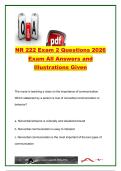
NR 222 Exam 2 Questions 2026
Exam All Answers and
Illustrations Given


The nurse is teaching a class on the importance of communication.

Which statement by a person is true of nonverbal communication or

behavior?


a. Nonverbal behavior is culturally and situational bound

b. Nonverbal communication is easy to interpret

c. Nonverbal communication is the most important of the two types of

communication

,d. Nonverbal behavior is not usually contextual - ANSWER ✔✔a.

Nonverbal behavior is culturally and situational bound

A nurse educator need to consider this first step in the process of setting

up an education program?


a. Evaluate morbidity data of that population

b. Evaluate health literacy of the population

c. Evaluate chronic illness of that population


d. Evaluate healthy behaviors of that population - ANSWER ✔✔b.

Evaluate health literacy of the population

A nurse attends a seminar on teaching/learning. Which statement

indicates the nurse has a good understanding of teaching/learning?


a. "Teaching is most effective when it responds to the learner's needs."

b. "Teaching and learning can be separated."

c. "Learning consists of a conscious, deliberate set of actions designed

to help the teacher."

, d. "Learning is an interactive process that promotes teaching." -

ANSWER ✔✔a. "Teaching is most effective when it responds to the

learner's needs."

A patient learns that a normal adult heartbeat is 60 to 100 beats/min

after a teaching session with a nurse. In which domain did learning take

place?


a. Kinesthetic

b. Cognitive

c. Psychomotor


d. Affective - ANSWER ✔✔b. Cognitive


A nurse is trying to help a patient begin to accept the chronic nature of

diabetes. Which teaching technique should the nurse use to enhance

learning?


a. Question and answer

b. Role Play

c. Demonstration


COPYRIGHT©PROFFKERRYMARTIN 2025/2026. YEAR PUBLISHED 2026. COMPANY REGISTRATION NUMBER: 619652435. TERMS OF USE.
PRIVACY STATEMENT. ALL RIGHTS RESERVED


Document information

Uploaded on
July 27, 2026
Number of pages
28
Written in
2025/2026
Type
Exam (elaborations)
Contains
Questions & answers
$18.99

Wrong document? Swap it for free Within 14 days of purchase and before downloading, you can choose a different document. You can simply spend the amount again.
Written by students who passed
Immediately available after payment
Read online or as PDF

Seller avatar
Reputation scores are based on the amount of documents a seller has sold for a fee and the reviews they have received for those documents. There are three levels: Bronze, Silver and Gold. The better the reputation, the more your can rely on the quality of the sellers work.
PROFFKERRYMARTIN
3.4
(53)
Sold
267
Followers
9
Items
10856
Last sold
1 day ago


Why students choose Stuvia

Created by fellow students, verified by reviews

Quality you can trust: written by students who passed their tests and reviewed by others who've used these notes.

Didn't get what you expected? Choose another document

No worries! You can instantly pick a different document that better fits what you're looking for.

Pay as you like, start learning right away

No subscription, no commitments. Pay the way you're used to via credit card and download your PDF document instantly.

Student with book image

“Bought, downloaded, and aced it. It really can be that simple.”

Alisha Student

Working on your references?

Create accurate citations in APA, MLA and Harvard with our free citation generator.

Working on your references?

Frequently asked questions
