

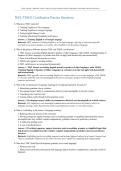
TEFL/TESOL CERTIFICATION | PRACTICE QUESTIONS WITH VERIFIED ANSWERS AND RATIONALES
TEFL/TESOL Certification Practice Questions
1. What does 'TEFL' stand for?
1. Teaching English as a First Language
2. Teaching English as a Foreign Language
3. Testing English Fluency Levels
4. Teaching Educational Foundations and Literacy
Answer: 2. Teaching English as a Foreign Language
Rationale: TEFL stands for Teaching English as a Foreign Language, referring to instruction typically
provided to non-native speakers in a country where English is not the primary language.
2. What is the primary difference between TEFL and TESOL certifications?
1. TEFL focuses on teaching English abroad to speakers of other languages, while TESOL (Teaching English to
Speakers of Other Languages) is a broader term that can apply both domestically and internationally
2. There is no difference between the two terms
3. TESOL only applies to teaching children
4. TEFL certification is not recognized internationally
Answer: 1. TEFL focuses on teaching English abroad to speakers of other languages, while TESOL
(Teaching English to Speakers of Other Languages) is a broader term that can apply both domestically
and internationally
Rationale: TEFL typically refers to teaching English in a country where it is a foreign language, while TESOL
is a broader umbrella term covering English instruction to non-native speakers both in English-speaking
countries and abroad.
3. What is the 'Communicative Language Teaching' (CLT) approach primarily focused on?
1. Memorizing grammar rules in isolation
2. Developing learners' ability to communicate effectively and meaningfully in real-life contexts
3. Translating texts word-for-word
4. Testing students solely through written grammar exams
Answer: 2. Developing learners' ability to communicate effectively and meaningfully in real-life contexts
Rationale: CLT emphasizes real, meaningful communication and interaction as the primary vehicle for
language learning, rather than focusing solely on grammatical accuracy or rote memorization.
4. What is 'scaffolding' in the context of language teaching?
1. Building a physical structure in the classroom
2. Providing temporary support structures (such as modeling, prompts, or simplified input) that help learners
accomplish tasks they couldn't complete independently, gradually removed as proficiency increases
3. A method for grading exams
4. A type of standardized test
Answer: 2. Providing temporary support structures (such as modeling, prompts, or simplified input) that
help learners accomplish tasks they couldn't complete independently, gradually removed as proficiency
increases
Rationale: Scaffolding involves providing temporary instructional supports tailored to a learner's current level,
which are gradually withdrawn as the learner becomes more capable of completing tasks independently.
5. What does 'TPR' (Total Physical Response) primarily use to teach language?
1. Written essays only
2. Physical movement and actions paired with language input to reinforce comprehension, especially useful for
beginners
TEFL/TESOL Certification Practice Questions
1. What does 'TEFL' stand for?
1. Teaching English as a First Language
2. Teaching English as a Foreign Language
3. Testing English Fluency Levels
4. Teaching Educational Foundations and Literacy
Answer: 2. Teaching English as a Foreign Language
Rationale: TEFL stands for Teaching English as a Foreign Language, referring to instruction typically
provided to non-native speakers in a country where English is not the primary language.
2. What is the primary difference between TEFL and TESOL certifications?
1. TEFL focuses on teaching English abroad to speakers of other languages, while TESOL (Teaching English to
Speakers of Other Languages) is a broader term that can apply both domestically and internationally
2. There is no difference between the two terms
3. TESOL only applies to teaching children
4. TEFL certification is not recognized internationally
Answer: 1. TEFL focuses on teaching English abroad to speakers of other languages, while TESOL
(Teaching English to Speakers of Other Languages) is a broader term that can apply both domestically
and internationally
Rationale: TEFL typically refers to teaching English in a country where it is a foreign language, while TESOL
is a broader umbrella term covering English instruction to non-native speakers both in English-speaking
countries and abroad.
3. What is the 'Communicative Language Teaching' (CLT) approach primarily focused on?
1. Memorizing grammar rules in isolation
2. Developing learners' ability to communicate effectively and meaningfully in real-life contexts
3. Translating texts word-for-word
4. Testing students solely through written grammar exams
Answer: 2. Developing learners' ability to communicate effectively and meaningfully in real-life contexts
Rationale: CLT emphasizes real, meaningful communication and interaction as the primary vehicle for
language learning, rather than focusing solely on grammatical accuracy or rote memorization.
4. What is 'scaffolding' in the context of language teaching?
1. Building a physical structure in the classroom
2. Providing temporary support structures (such as modeling, prompts, or simplified input) that help learners
accomplish tasks they couldn't complete independently, gradually removed as proficiency increases
3. A method for grading exams
4. A type of standardized test
Answer: 2. Providing temporary support structures (such as modeling, prompts, or simplified input) that
help learners accomplish tasks they couldn't complete independently, gradually removed as proficiency
increases
Rationale: Scaffolding involves providing temporary instructional supports tailored to a learner's current level,
which are gradually withdrawn as the learner becomes more capable of completing tasks independently.
5. What does 'TPR' (Total Physical Response) primarily use to teach language?
1. Written essays only
2. Physical movement and actions paired with language input to reinforce comprehension, especially useful for
beginners


