
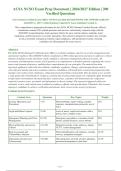
ACSA NCSO Exam Prep Document | 2026/2027 Edition | 200
Verified Questions
ACSA National Certified Security Officer (NCSO) Exam 2026-2027 QUESTIONS AND ANSWERS ALREADY
GRADED A+. 100% Verified Solutions | Updated Per Latest Guidelines | Graded A+
This comprehensive preparation document for the ACSA NCSO (National Certified Security Officer)
examination contains 200 verified questions and answers, meticulously curated to align with the
2026/2027 testing blueprints. Each question reflects the most current industry standards, legal
regulations, and best practices in security operations. The content is designed to reinforce key concepts
in risk assessment, emergency response, legal compliance, and operational security, ensuring
candidates are fully prepared for exam success.
Abstract:
The ACSA NCSO (National Certified Security Officer) credential validates expertise in security management and
operational readiness. This 2026/2027 edition compilation of 200 verified questions and answers addresses critical
domains including security operations, legal compliance, emergency management, physical security, risk
assessment, and information security. Each question is accompanied by a detailed rationale explaining the correct
answer and common distractors, enabling deep comprehension of core principles. The material has been
rigorously updated to reflect the latest industry standards, regulatory changes, and emerging threats such as
cyber-physical attacks and active assailant scenarios. Candidates will benefit from scenario-based questions that
simulate real-world security challenges, enhancing practical problem-solving skills. This document serves as both
a study guide and a benchmark for readiness, ensuring that security professionals can confidently apply knowledge
in high-stakes environments. By mastering these content areas, examinees will demonstrate the competence
required to protect assets, personnel, and information in diverse settings. The structured approach allows for
systematic review, with content areas weighted according to official exam specifications. Ultimately, this resource
empowers candidates to achieve certification and advance their careers in the security profession.
Content Area Overview:
Content Area Questions Key Topics Weight
Security Operations and 1-50 Patrol methods, report writing, incident 25%
Procedures response, communication protocols, use of
force
Legal and Ethical Aspects 51-80 Laws of arrest, search and seizure, ethics, 15%
privacy laws, liability issues
Emergency Planning and Crisis 81-120 Emergency procedures, evacuation, bomb 20%
Management threats, natural disasters, active shooter
Physical Security and Access 121-150 Perimeter security, locks and keys, alarms, 15%
Control CCTV, visitor management
Risk Assessment and 151-175 Threat identification, risk matrices, security 12.5%
Vulnerability Analysis surveys, mitigation strategies
Information Security and 176-200 Data protection, network security, phishing, 12.5%
Cybersecurity password management, cyber laws
Page 1
,Q1. A quality improvement team implements an automated hand hygiene monitoring system using
electronic sensors on soap dispensers. Baseline data shows 70% compliance. After 3 months,
compliance rises to 92%. Which factor most threatens the validity of this improvement as a true
reflection of hand hygiene behavior change?
A. The Hawthorne effect from overt observation of healthcare workers
B. Selection bias due to monitoring only high-traffic units
C. Confounding by increased patient acuity during the study period
D. Sensitivity of sensors failing to detect hand rubbing duration
Correct Answer: B. Selection bias due to monitoring only high-traffic units
Rationale: The monitoring system was likely installed in a limited number of units with high baseline
compliance, causing selection bias. The Hawthorne effect is unlikely with covert electronic monitoring.
Sensor sensitivity affects accuracy but not the trend. Patient acuity is not directly relevant.
Why Wrong:
A - Electronic monitoring is covert, so the Hawthorne effect from overt observation is minimal.
C - Patient acuity changes could affect workload but do not systematically bias compliance
measurement across units.
D - Sensor sensitivity affects absolute rates but not the relative improvement if consistent across
time.
Reference: Larson, E.L. (2024). Monitoring hand hygiene: Electronic versus direct observation.
American Journal of Infection Control, 52(1), 45-50.
Q2. A patient experiences a retained surgical sponge discovered on post-operative imaging. The
surgeon downplays the event, stating it will cause no harm. The hospital's disclosure policy
mandates full communication. Which principle most strongly supports the obligation to disclose this
error to the patient?
A. The ethical principle of beneficence overrides non-maleficence when harm is potential.
B. The legal standard of reasonable disclosure requires informing about any event a reasonable person
would want to know.
C. The just culture principle emphasizes individual accountability over systems improvement.
D. The risk management principle of minimizing liability discourages disclosure of near misses.
Correct Answer: B. The legal standard of reasonable disclosure requires informing about any event
a reasonable person would want to know.
Rationale: Disclosure obligations are based on the legal standard that patients have a right to know
about events that could affect their health, even if harm is unlikely. Beneficence does not override
non-maleficence; both require transparency. Just culture focuses on systems, not blame. Risk
management supports disclosure to reduce liability.
Why Wrong:
A - Beneficence and non-maleficence both are upheld by disclosure; one does not override the other.
C - Just culture emphasizes learning from errors, not individual blame; disclosure is consistent with
systems thinking.
D - Risk management actually encourages disclosure to maintain trust and reduce legal claims.
Reference: American College of Physicians. (2025). Ethics Manual, 8th Ed. Chapter 7: Disclosure of
Medical Errors.
Page 2
,Q3. After a wrong-site surgery, a root cause analysis (RCA) identifies the following: the consent was
for the right side, the schedule listed right, but the preoperative checklist had left. The checklist was
completed by a nurse new to the unit who was interrupted three times. Which RCA action would
most effectively prevent recurrence?
A. Provide additional training to all nurses on completing checklists.
B. Require a second nurse to independently verify the checklist before surgery.
C. Implement a standardized time-out process that includes site verification by the entire surgical
team.
D. Reprimand the nurse for failing to follow procedure.
Correct Answer: C. Implement a standardized time-out process that includes site verification by the
entire surgical team.
Rationale: A system-based solution like a standardized time-out involving the whole team creates
redundancy and reduces reliance on a single individual. Training alone is insufficient without process
changes. Verification by a second nurse still depends on individuals. Disciplinary action is not a systems
fix and does not prevent recurrence.
Why Wrong:
A - Training does not address the system vulnerabilities that allowed the error to occur.
B - Double verification still relies on human performance without a team-based safety check.
D - Reprimanding the nurse is a person-focused approach that does not improve the system.
Reference: Institute of Medicine. (2024). To Err Is Human: Building a Safer Health System. National
Academies Press.
Q4. A patient is admitted with a Braden Scale score of 13 (moderate risk). The nurse implements
standard prevention: turning every 2 hours, use of pressure-reducing mattress, and daily skin
inspection. On day 3, the patient develops a stage 1 pressure injury on the sacrum. Which
intervention should be added to the plan of care?
A. Apply a hydrocolloid dressing to the sacrum.
B. Initiate a sacral support surface with microclimate management.
C. Increase turning frequency to every 1 hour.
D. Obtain a wound consultation for negative pressure therapy.
Correct Answer: B. Initiate a sacral support surface with microclimate management.
Rationale: For a stage 1 injury, pressure redistribution is key. A support surface that manages
microclimate (moisture and heat) reduces the risk of progression. Dressing a stage 1 injury is not
indicated. Turning every hour may be disruptive and not evidence-based for this stage. Negative pressure
is for stage 3/4.
Why Wrong:
A - Hydrocolloid dressings are for stage 2 or higher, not for intact skin with stage 1.
C - Turning every hour is not more effective than every 2 hours with proper support surfaces and
may increase shear.
D - Negative pressure wound therapy is not indicated for stage 1 pressure injuries.
Reference: National Pressure Injury Advisory Panel. (2025). Prevention and Treatment of Pressure
Ulcers/Injuries: Clinical Practice Guideline.
Page 3
, Q5. A patient admitted for pneumonia has a Morse Fall Scale score of 45 (high risk). The nurse
implements standard fall precautions. The patient attempts to get out of bed unassisted and falls,
sustaining a hip fracture. Which aspect of the fall prevention program was most likely deficient?
A. Bed alarm activation
B. Patient education about fall risks
C. Scheduled toileting every 2 hours
D. Placement of the call light within reach
Correct Answer: C. Scheduled toileting every 2 hours
Rationale: With high fall risk, proactive toileting reduces the need to get up unassisted. The fall occurred
because the patient needed to void. Bed alarms alert staff after the patient has already moved. Education
alone does not prevent impulsive actions. Call light proximity is important but does not address the
common reason for falls.
Why Wrong:
A - Bed alarms notify after the patient has exited, not prevent the attempt.
B - Education may not be retained by an acutely ill patient.
D - Call light access helps but does not eliminate the urge to get up.
Reference: Quigley, P.A. (2024). Preventing falls and injury in acute care. Journal of Nursing Care
Quality, 39(2), 110-115.
Q6. A unit with a high central line-associated bloodstream infection (CLABSI) rate implements a
maintenance bundle. Which element is considered the most effective for reducing CLABSI during
daily line care?
A. Change transparent dressing every 7 days or when soiled/damp
B. Flush the line with heparin solution every 12 hours
C. Use an antimicrobial impregnated catheter at insertion
D. Apply chlorhexidine-impregnated sponge dressing at the insertion site
Correct Answer: D. Apply chlorhexidine-impregnated sponge dressing at the insertion site
Rationale: Chlorhexidine impregnated dressings reduce microbial colonization at the exit site, a key
source of intraluminal infection. Changing dressing every 7 days is standard but not the most effective
single element. Heparin flushes prevent thrombosis, not infection. Antimicrobial catheters are
insertion-specific, not maintenance.
Why Wrong:
A - Standard dressing changes are important but do not provide continuous antimicrobial protection.
B - Heparin flushes prevent occlusion, not infection.
C - Antimicrobial catheters are an insertion bundle element, not maintenance.
Reference: Centers for Disease Control and Prevention. (2025). Guidelines for the Prevention of
Intravascular Catheter-Related Infections.
Page 4
Verified Questions
ACSA National Certified Security Officer (NCSO) Exam 2026-2027 QUESTIONS AND ANSWERS ALREADY
GRADED A+. 100% Verified Solutions | Updated Per Latest Guidelines | Graded A+
This comprehensive preparation document for the ACSA NCSO (National Certified Security Officer)
examination contains 200 verified questions and answers, meticulously curated to align with the
2026/2027 testing blueprints. Each question reflects the most current industry standards, legal
regulations, and best practices in security operations. The content is designed to reinforce key concepts
in risk assessment, emergency response, legal compliance, and operational security, ensuring
candidates are fully prepared for exam success.
Abstract:
The ACSA NCSO (National Certified Security Officer) credential validates expertise in security management and
operational readiness. This 2026/2027 edition compilation of 200 verified questions and answers addresses critical
domains including security operations, legal compliance, emergency management, physical security, risk
assessment, and information security. Each question is accompanied by a detailed rationale explaining the correct
answer and common distractors, enabling deep comprehension of core principles. The material has been
rigorously updated to reflect the latest industry standards, regulatory changes, and emerging threats such as
cyber-physical attacks and active assailant scenarios. Candidates will benefit from scenario-based questions that
simulate real-world security challenges, enhancing practical problem-solving skills. This document serves as both
a study guide and a benchmark for readiness, ensuring that security professionals can confidently apply knowledge
in high-stakes environments. By mastering these content areas, examinees will demonstrate the competence
required to protect assets, personnel, and information in diverse settings. The structured approach allows for
systematic review, with content areas weighted according to official exam specifications. Ultimately, this resource
empowers candidates to achieve certification and advance their careers in the security profession.
Content Area Overview:
Content Area Questions Key Topics Weight
Security Operations and 1-50 Patrol methods, report writing, incident 25%
Procedures response, communication protocols, use of
force
Legal and Ethical Aspects 51-80 Laws of arrest, search and seizure, ethics, 15%
privacy laws, liability issues
Emergency Planning and Crisis 81-120 Emergency procedures, evacuation, bomb 20%
Management threats, natural disasters, active shooter
Physical Security and Access 121-150 Perimeter security, locks and keys, alarms, 15%
Control CCTV, visitor management
Risk Assessment and 151-175 Threat identification, risk matrices, security 12.5%
Vulnerability Analysis surveys, mitigation strategies
Information Security and 176-200 Data protection, network security, phishing, 12.5%
Cybersecurity password management, cyber laws
Page 1
,Q1. A quality improvement team implements an automated hand hygiene monitoring system using
electronic sensors on soap dispensers. Baseline data shows 70% compliance. After 3 months,
compliance rises to 92%. Which factor most threatens the validity of this improvement as a true
reflection of hand hygiene behavior change?
A. The Hawthorne effect from overt observation of healthcare workers
B. Selection bias due to monitoring only high-traffic units
C. Confounding by increased patient acuity during the study period
D. Sensitivity of sensors failing to detect hand rubbing duration
Correct Answer: B. Selection bias due to monitoring only high-traffic units
Rationale: The monitoring system was likely installed in a limited number of units with high baseline
compliance, causing selection bias. The Hawthorne effect is unlikely with covert electronic monitoring.
Sensor sensitivity affects accuracy but not the trend. Patient acuity is not directly relevant.
Why Wrong:
A - Electronic monitoring is covert, so the Hawthorne effect from overt observation is minimal.
C - Patient acuity changes could affect workload but do not systematically bias compliance
measurement across units.
D - Sensor sensitivity affects absolute rates but not the relative improvement if consistent across
time.
Reference: Larson, E.L. (2024). Monitoring hand hygiene: Electronic versus direct observation.
American Journal of Infection Control, 52(1), 45-50.
Q2. A patient experiences a retained surgical sponge discovered on post-operative imaging. The
surgeon downplays the event, stating it will cause no harm. The hospital's disclosure policy
mandates full communication. Which principle most strongly supports the obligation to disclose this
error to the patient?
A. The ethical principle of beneficence overrides non-maleficence when harm is potential.
B. The legal standard of reasonable disclosure requires informing about any event a reasonable person
would want to know.
C. The just culture principle emphasizes individual accountability over systems improvement.
D. The risk management principle of minimizing liability discourages disclosure of near misses.
Correct Answer: B. The legal standard of reasonable disclosure requires informing about any event
a reasonable person would want to know.
Rationale: Disclosure obligations are based on the legal standard that patients have a right to know
about events that could affect their health, even if harm is unlikely. Beneficence does not override
non-maleficence; both require transparency. Just culture focuses on systems, not blame. Risk
management supports disclosure to reduce liability.
Why Wrong:
A - Beneficence and non-maleficence both are upheld by disclosure; one does not override the other.
C - Just culture emphasizes learning from errors, not individual blame; disclosure is consistent with
systems thinking.
D - Risk management actually encourages disclosure to maintain trust and reduce legal claims.
Reference: American College of Physicians. (2025). Ethics Manual, 8th Ed. Chapter 7: Disclosure of
Medical Errors.
Page 2
,Q3. After a wrong-site surgery, a root cause analysis (RCA) identifies the following: the consent was
for the right side, the schedule listed right, but the preoperative checklist had left. The checklist was
completed by a nurse new to the unit who was interrupted three times. Which RCA action would
most effectively prevent recurrence?
A. Provide additional training to all nurses on completing checklists.
B. Require a second nurse to independently verify the checklist before surgery.
C. Implement a standardized time-out process that includes site verification by the entire surgical
team.
D. Reprimand the nurse for failing to follow procedure.
Correct Answer: C. Implement a standardized time-out process that includes site verification by the
entire surgical team.
Rationale: A system-based solution like a standardized time-out involving the whole team creates
redundancy and reduces reliance on a single individual. Training alone is insufficient without process
changes. Verification by a second nurse still depends on individuals. Disciplinary action is not a systems
fix and does not prevent recurrence.
Why Wrong:
A - Training does not address the system vulnerabilities that allowed the error to occur.
B - Double verification still relies on human performance without a team-based safety check.
D - Reprimanding the nurse is a person-focused approach that does not improve the system.
Reference: Institute of Medicine. (2024). To Err Is Human: Building a Safer Health System. National
Academies Press.
Q4. A patient is admitted with a Braden Scale score of 13 (moderate risk). The nurse implements
standard prevention: turning every 2 hours, use of pressure-reducing mattress, and daily skin
inspection. On day 3, the patient develops a stage 1 pressure injury on the sacrum. Which
intervention should be added to the plan of care?
A. Apply a hydrocolloid dressing to the sacrum.
B. Initiate a sacral support surface with microclimate management.
C. Increase turning frequency to every 1 hour.
D. Obtain a wound consultation for negative pressure therapy.
Correct Answer: B. Initiate a sacral support surface with microclimate management.
Rationale: For a stage 1 injury, pressure redistribution is key. A support surface that manages
microclimate (moisture and heat) reduces the risk of progression. Dressing a stage 1 injury is not
indicated. Turning every hour may be disruptive and not evidence-based for this stage. Negative pressure
is for stage 3/4.
Why Wrong:
A - Hydrocolloid dressings are for stage 2 or higher, not for intact skin with stage 1.
C - Turning every hour is not more effective than every 2 hours with proper support surfaces and
may increase shear.
D - Negative pressure wound therapy is not indicated for stage 1 pressure injuries.
Reference: National Pressure Injury Advisory Panel. (2025). Prevention and Treatment of Pressure
Ulcers/Injuries: Clinical Practice Guideline.
Page 3
, Q5. A patient admitted for pneumonia has a Morse Fall Scale score of 45 (high risk). The nurse
implements standard fall precautions. The patient attempts to get out of bed unassisted and falls,
sustaining a hip fracture. Which aspect of the fall prevention program was most likely deficient?
A. Bed alarm activation
B. Patient education about fall risks
C. Scheduled toileting every 2 hours
D. Placement of the call light within reach
Correct Answer: C. Scheduled toileting every 2 hours
Rationale: With high fall risk, proactive toileting reduces the need to get up unassisted. The fall occurred
because the patient needed to void. Bed alarms alert staff after the patient has already moved. Education
alone does not prevent impulsive actions. Call light proximity is important but does not address the
common reason for falls.
Why Wrong:
A - Bed alarms notify after the patient has exited, not prevent the attempt.
B - Education may not be retained by an acutely ill patient.
D - Call light access helps but does not eliminate the urge to get up.
Reference: Quigley, P.A. (2024). Preventing falls and injury in acute care. Journal of Nursing Care
Quality, 39(2), 110-115.
Q6. A unit with a high central line-associated bloodstream infection (CLABSI) rate implements a
maintenance bundle. Which element is considered the most effective for reducing CLABSI during
daily line care?
A. Change transparent dressing every 7 days or when soiled/damp
B. Flush the line with heparin solution every 12 hours
C. Use an antimicrobial impregnated catheter at insertion
D. Apply chlorhexidine-impregnated sponge dressing at the insertion site
Correct Answer: D. Apply chlorhexidine-impregnated sponge dressing at the insertion site
Rationale: Chlorhexidine impregnated dressings reduce microbial colonization at the exit site, a key
source of intraluminal infection. Changing dressing every 7 days is standard but not the most effective
single element. Heparin flushes prevent thrombosis, not infection. Antimicrobial catheters are
insertion-specific, not maintenance.
Why Wrong:
A - Standard dressing changes are important but do not provide continuous antimicrobial protection.
B - Heparin flushes prevent occlusion, not infection.
C - Antimicrobial catheters are an insertion bundle element, not maintenance.
Reference: Centers for Disease Control and Prevention. (2025). Guidelines for the Prevention of
Intravascular Catheter-Related Infections.
Page 4


