

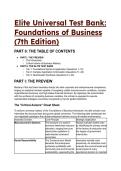
Elite Universal Test Bank:
Foundations of Business
(7th Edition)
PART 0: THE TABLE OF CONTENTS
● PART I: THE PREVIEW
○ The Introduction
○ Critical Axioms of Business Mastery
● PART II: THE ELITE TEST BANK
○ Tier 1: Foundational Syntax & Application (Questions 1–10)
○ Tier 2: Complex Application & Simulation (Questions 11–20)
○ Tier 3: Grandmaster Synthesis (Questions 21–30)
PART I: THE PREVIEW
Mastery of this test bank translates directly into elite corporate and entrepreneurial competence,
forging an analytical mindset capable of navigating volatile macroeconomic conditions, complex
organizational structures, and high-stakes financial decisions. By replacing rote memorization
with the synthesis of competing business variables, the scholar is equipped to execute
sophisticated strategies universally recognized by top-tier global institutions.
The "Critical Axioms" Cheat Sheet
To achieve universal mastery of the Foundations of Business framework, the elite scholar must
internalize the structural laws that govern global commerce. The following table synthesizes the
non-negotiable paradigms that dictate enterprise behavior across all market environments.
Axiomatic Domain Core Principle Strategic Application
Macroeconomic Systems The structure of a nation's Always evaluate market entry
economy determines resource by identifying the primary owner
allocation, ranging from pure of the factors of production and
laissez-faire capitalism to the degree of government
state-directed command intervention.
economies.
Social Responsibility The Socioeconomic Model Internalize societal costs
demands that enterprises proactively. An enterprise must
synthesize profitability with evaluate the environmental and
community and environmental social impact of every
sustainability, superseding the operational decision to maintain
,Axiomatic Domain Core Principle Strategic Application
Economic Model. market legitimacy.
Management Architecture Organizational excellence Strategic planning defines the
strictly adheres to the objective, while organizing
continuous, four-pillar structurally allocates the human
management process: and capital resources required
planning, organizing, leading, to execute it.
and controlling.
The Marketing Mix Elite market penetration A miscalculation in any single
requires the flawless, pillar of the marketing mix
synchronized alignment of catastrophically compromises
product, price, place the efficacy of the entire
(distribution), and promotion. strategic campaign.
Financial Equilibrium Absolute financial and Balance sheets must always
accounting equilibrium is reconcile; debt financing
maintained through the leverages growth but
universal law: Assets = exponentially increases
Liabilities + Owners' Equity. long-term solvency risk.
PART II: THE ELITE TEST BANK
Tier 1: Foundational Syntax & Application
Q1: A sovereign nation transitions its macroeconomic policy to allow private individuals to own
and operate the vast majority of consumer-facing businesses. However, the central government
continues to completely own, fund, and operate critical infrastructure, including transportation,
telecommunications, and healthcare utilities. Based on the principles of economic systems,
which classification is the MOST ACCURATE? A) The nation has adopted a pure capitalist
economy, prioritizing a complete laissez-faire approach to all sectors. B) The nation is operating
under a communist command economy, utilizing decentralized nodes for minor operations. C)
The nation has transitioned into a mixed economy that heavily incorporates socialist
characteristics within its foundational infrastructure. D) The nation is functioning as a perfect
competition market structure, balancing state and private interests.
● Answer: C (The nation has transitioned into a mixed economy that heavily incorporates
socialist characteristics within its foundational infrastructure.)
● Distractor Analysis:
○ A is incorrect: A pure capitalist system, specifically a laissez-faire model, strictly
precludes government ownership of major industries and relies entirely on market
forces.
○ B is incorrect: Communism relies on total state ownership of all resources and
central planning for all economic decisions, which directly contradicts the private
ownership of consumer businesses.
○ D is incorrect: Perfect competition is a microeconomic market structure that defines
the relationship between multiple buyers and sellers of identical products, not a
macroeconomic governance system.
The Mentor's Analysis: Mixed economies seamlessly blend the private enterprise of capitalism
with the state intervention of socialism. When a government retains absolute control over critical
infrastructure while permitting robust private enterprise in other sectors, it operates a mixed
, system heavily influenced by socialist resource allocation. Professional/Academic Intuition:
Always evaluate macroeconomic systems by identifying who legally owns the primary
factors of production and capital infrastructure.
Q2: A multinational chemical firm experiences a catastrophic failure where toxic runoff damages
a local water supply. The board of directors immediately compensates the affected community,
upgrades the facility's filtration systems far beyond the legal regulatory requirements, and
launches an ongoing environmental restoration initiative. Based on the principles of business
ethics, which framework BEST describes this executive response? A) The economic model of
social responsibility. B) The legal compliance threshold mechanism. C) The socioeconomic
model of social responsibility. D) The affirmative action mandate.
● Answer: C (The socioeconomic model of social responsibility.)
● Distractor Analysis:
○ A is incorrect: The economic model asserts that a firm's only responsibility is to
generate profit for shareholders within the strict confines of the law, fundamentally
leaving broader societal problems to the government.
○ B is incorrect: The firm deliberately exceeded legal requirements and invested
capital into community restoration, demonstrating voluntary ethical engagement
rather than mere legal compliance.
○ D is incorrect: Affirmative action refers strictly to employment practices aimed at
increasing workplace diversity and correcting past discrimination, which is entirely
unrelated to environmental stewardship.
The Mentor's Analysis: The socioeconomic model posits that corporations are citizens of the
communities in which they operate, possessing an inherent duty to consider the profound
impact of their decisions on society at large, not just on their shareholders' financial returns.
Professional/Academic Intuition: The socioeconomic model proactively internalizes
societal costs, whereas the traditional economic model aggressively externalizes them.
Q3: A mid-sized technology firm is analyzing an aggressive international expansion. The firm
possesses proprietary software that is highly sought after globally, but it severely lacks the
capital to build overseas manufacturing facilities and wishes to avoid the high risk of direct
foreign investment. Based on the methods of entering international business, which strategy is
MOST APPROPRIATE? A) Engaging in an international joint venture with a foreign sovereign
wealth fund. B) Establishing a fully owned multinational subsidiary in the target market. C)
Utilizing licensing agreements to allow foreign firms to produce and sell the software. D)
Implementing a global embargo protocol to restrict competitor access.
● Answer: C (Utilizing licensing agreements to allow foreign firms to produce and sell the
software.)
● Distractor Analysis:
○ A is incorrect: Joint ventures require significant capital investment and carry high
levels of shared operational risk, violating the firm's strict risk-aversion parameters.
○ B is incorrect: Direct investment via a subsidiary is the most capital-intensive and
high-risk method of market entry available in global business.
○ D is incorrect: An embargo is a government-imposed macroeconomic trade
restriction blocking commerce with a specific nation, not a corporate market entry
strategy.
The Mentor's Analysis: Licensing grants a foreign entity the legal right to manufacture or
market a proprietary product in exchange for a continuous royalty fee. This method effectively
bypasses the massive capital expenditure of direct investment while leveraging local market
expertise. Professional/Academic Intuition: When capital is heavily constrained and
Foundations of Business
(7th Edition)
PART 0: THE TABLE OF CONTENTS
● PART I: THE PREVIEW
○ The Introduction
○ Critical Axioms of Business Mastery
● PART II: THE ELITE TEST BANK
○ Tier 1: Foundational Syntax & Application (Questions 1–10)
○ Tier 2: Complex Application & Simulation (Questions 11–20)
○ Tier 3: Grandmaster Synthesis (Questions 21–30)
PART I: THE PREVIEW
Mastery of this test bank translates directly into elite corporate and entrepreneurial competence,
forging an analytical mindset capable of navigating volatile macroeconomic conditions, complex
organizational structures, and high-stakes financial decisions. By replacing rote memorization
with the synthesis of competing business variables, the scholar is equipped to execute
sophisticated strategies universally recognized by top-tier global institutions.
The "Critical Axioms" Cheat Sheet
To achieve universal mastery of the Foundations of Business framework, the elite scholar must
internalize the structural laws that govern global commerce. The following table synthesizes the
non-negotiable paradigms that dictate enterprise behavior across all market environments.
Axiomatic Domain Core Principle Strategic Application
Macroeconomic Systems The structure of a nation's Always evaluate market entry
economy determines resource by identifying the primary owner
allocation, ranging from pure of the factors of production and
laissez-faire capitalism to the degree of government
state-directed command intervention.
economies.
Social Responsibility The Socioeconomic Model Internalize societal costs
demands that enterprises proactively. An enterprise must
synthesize profitability with evaluate the environmental and
community and environmental social impact of every
sustainability, superseding the operational decision to maintain
,Axiomatic Domain Core Principle Strategic Application
Economic Model. market legitimacy.
Management Architecture Organizational excellence Strategic planning defines the
strictly adheres to the objective, while organizing
continuous, four-pillar structurally allocates the human
management process: and capital resources required
planning, organizing, leading, to execute it.
and controlling.
The Marketing Mix Elite market penetration A miscalculation in any single
requires the flawless, pillar of the marketing mix
synchronized alignment of catastrophically compromises
product, price, place the efficacy of the entire
(distribution), and promotion. strategic campaign.
Financial Equilibrium Absolute financial and Balance sheets must always
accounting equilibrium is reconcile; debt financing
maintained through the leverages growth but
universal law: Assets = exponentially increases
Liabilities + Owners' Equity. long-term solvency risk.
PART II: THE ELITE TEST BANK
Tier 1: Foundational Syntax & Application
Q1: A sovereign nation transitions its macroeconomic policy to allow private individuals to own
and operate the vast majority of consumer-facing businesses. However, the central government
continues to completely own, fund, and operate critical infrastructure, including transportation,
telecommunications, and healthcare utilities. Based on the principles of economic systems,
which classification is the MOST ACCURATE? A) The nation has adopted a pure capitalist
economy, prioritizing a complete laissez-faire approach to all sectors. B) The nation is operating
under a communist command economy, utilizing decentralized nodes for minor operations. C)
The nation has transitioned into a mixed economy that heavily incorporates socialist
characteristics within its foundational infrastructure. D) The nation is functioning as a perfect
competition market structure, balancing state and private interests.
● Answer: C (The nation has transitioned into a mixed economy that heavily incorporates
socialist characteristics within its foundational infrastructure.)
● Distractor Analysis:
○ A is incorrect: A pure capitalist system, specifically a laissez-faire model, strictly
precludes government ownership of major industries and relies entirely on market
forces.
○ B is incorrect: Communism relies on total state ownership of all resources and
central planning for all economic decisions, which directly contradicts the private
ownership of consumer businesses.
○ D is incorrect: Perfect competition is a microeconomic market structure that defines
the relationship between multiple buyers and sellers of identical products, not a
macroeconomic governance system.
The Mentor's Analysis: Mixed economies seamlessly blend the private enterprise of capitalism
with the state intervention of socialism. When a government retains absolute control over critical
infrastructure while permitting robust private enterprise in other sectors, it operates a mixed
, system heavily influenced by socialist resource allocation. Professional/Academic Intuition:
Always evaluate macroeconomic systems by identifying who legally owns the primary
factors of production and capital infrastructure.
Q2: A multinational chemical firm experiences a catastrophic failure where toxic runoff damages
a local water supply. The board of directors immediately compensates the affected community,
upgrades the facility's filtration systems far beyond the legal regulatory requirements, and
launches an ongoing environmental restoration initiative. Based on the principles of business
ethics, which framework BEST describes this executive response? A) The economic model of
social responsibility. B) The legal compliance threshold mechanism. C) The socioeconomic
model of social responsibility. D) The affirmative action mandate.
● Answer: C (The socioeconomic model of social responsibility.)
● Distractor Analysis:
○ A is incorrect: The economic model asserts that a firm's only responsibility is to
generate profit for shareholders within the strict confines of the law, fundamentally
leaving broader societal problems to the government.
○ B is incorrect: The firm deliberately exceeded legal requirements and invested
capital into community restoration, demonstrating voluntary ethical engagement
rather than mere legal compliance.
○ D is incorrect: Affirmative action refers strictly to employment practices aimed at
increasing workplace diversity and correcting past discrimination, which is entirely
unrelated to environmental stewardship.
The Mentor's Analysis: The socioeconomic model posits that corporations are citizens of the
communities in which they operate, possessing an inherent duty to consider the profound
impact of their decisions on society at large, not just on their shareholders' financial returns.
Professional/Academic Intuition: The socioeconomic model proactively internalizes
societal costs, whereas the traditional economic model aggressively externalizes them.
Q3: A mid-sized technology firm is analyzing an aggressive international expansion. The firm
possesses proprietary software that is highly sought after globally, but it severely lacks the
capital to build overseas manufacturing facilities and wishes to avoid the high risk of direct
foreign investment. Based on the methods of entering international business, which strategy is
MOST APPROPRIATE? A) Engaging in an international joint venture with a foreign sovereign
wealth fund. B) Establishing a fully owned multinational subsidiary in the target market. C)
Utilizing licensing agreements to allow foreign firms to produce and sell the software. D)
Implementing a global embargo protocol to restrict competitor access.
● Answer: C (Utilizing licensing agreements to allow foreign firms to produce and sell the
software.)
● Distractor Analysis:
○ A is incorrect: Joint ventures require significant capital investment and carry high
levels of shared operational risk, violating the firm's strict risk-aversion parameters.
○ B is incorrect: Direct investment via a subsidiary is the most capital-intensive and
high-risk method of market entry available in global business.
○ D is incorrect: An embargo is a government-imposed macroeconomic trade
restriction blocking commerce with a specific nation, not a corporate market entry
strategy.
The Mentor's Analysis: Licensing grants a foreign entity the legal right to manufacture or
market a proprietary product in exchange for a continuous royalty fee. This method effectively
bypasses the massive capital expenditure of direct investment while leveraging local market
expertise. Professional/Academic Intuition: When capital is heavily constrained and


