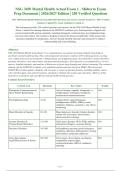
NSG 3450 Mental Health Actual Exam 1 - Midterm Exam
Prep Document | 2026/2027 Edition | 250 Verified Questions
NSG 3450 Mental Health Midterm Exam 2026-2027 Questions and Answers Already Graded A+. 100% Verified
Solutions | Updated Per Latest Guidelines | Graded A+
This document provides 250 verified questions and answers for the NSG 3450 Mental Health Actual
Exam 1, tailored for nursing students in the 2026/2027 academic year. Each question is aligned with
current mental health nursing standards, including therapeutic communication, psychopharmacology,
and crisis intervention. The content is designed to mirror the format and difficulty of the actual exam,
ensuring comprehensive preparation. Answers include detailed rationales and distractors to enhance
understanding and critical thinking.
Abstract:
NSG 3450 Mental Health Actual Exam 1 is a comprehensive assessment of nursing students' knowledge in
psychiatric mental health nursing. This exam preparation document comprises 250 verified questions covering
core content areas such as therapeutic communication, psychopharmacology, mood disorders, anxiety disorders,
psychotic disorders, crisis intervention, and legal-ethical principles. Each question is accompanied by a correct
answer, detailed rationale, and analysis of distractors to foster deep learning and clinical reasoning. The content is
aligned with the 2026/2027 academic year standards and incorporates the latest DSM-5-TR criteria and
NCLEX-RN test plan updates. Students will encounter a variety of question formats, including multiple-choice,
select-all-that-apply, and ordered-response, designed to simulate the actual exam experience. Mastery of this
material is essential for safe and effective mental health nursing practice.
Content Area Overview:
Content Area Questions Key Topics Weight
Therapeutic Communication & 1-40 Active listening, empathy, therapeutic vs. 16%
Nurse-Patient Relationship nontherapeutic techniques, boundaries,
transference/countertransference
Psychopharmacology 41-80 Antipsychotics (typical/atypical), 16%
antidepressants (SSRIs, SNRIs), mood
stabilizers (lithium), anxiolytics, side effects,
monitoring
Mood Disorders & Suicide 81-120 Major depressive disorder, bipolar disorder, 16%
suicide risk assessment, interventions,
electroconvulsive therapy
Anxiety Disorders & 121-160 GAD, panic disorder, OCD, PTSD, phobias, 16%
Trauma-Related Disorders relaxation techniques, exposure therapy
Psychotic Disorders 161-200 Schizophrenia spectrum, positive/negative 16%
symptoms, delusions, hallucinations, nursing
interventions, medication adherence
Crisis Intervention, 201-250 Crisis stages, de-escalation, involuntary 20%
Legal/Ethical Issues & Safety commitment, patient rights,
seclusion/restraints, HIPAA, mandatory
reporting
Page 1
,Q1. A client states, "I'm completely worthless. My family would be better off without me." The
nurse responds, "You feel that you have no value right now." Which therapeutic communication
technique did the nurse use?
A. Restating
B. Reflecting feelings
C. Validating
D. Confronting
Correct Answer: B. Reflecting feelings
Rationale: Reflecting feelings is a technique in which the nurse mirrors the client's stated emotion (e.g.,
"you feel worthless") to encourage further expression. Restating repeats the client's exact words, not the
underlying feeling. Validating confirms the client's experience but does not focus solely on emotion.
Confronting challenges discrepancies but is not appropriate here.
Why Wrong:
A - Restating would repeat the client's words verbatim, not rephrase the emotional content.
C - Validation would acknowledge the client's reality but does not explicitly reflect the feeling.
D - Confrontation would point out inconsistency, not reflect an expressed emotion.
Reference: Townsend, M. C. (2025). Psychiatric Mental Health Nursing: Concepts of Care in
Evidence-Based Practice, 10th Ed., Chapter 8.
Q2. A client with bipolar I disorder is admitted with acute mania. The provider orders lithium
carbonate 300 mg PO TID. The client's serum lithium level drawn yesterday is 1.8 mEq/L. Which
action should the nurse take first?
A. Administer the lithium with food to reduce gastrointestinal upset.
B. Hold the lithium and notify the provider.
C. Obtain a stat ECG to evaluate cardiac effects.
D. Increase the client's fluid intake to enhance lithium excretion.
Correct Answer: B. Hold the lithium and notify the provider.
Rationale: The therapeutic range for lithium is 0.6–1.2 mEq/L; a level of 1.8 mEq/L indicates toxicity.
The nurse must hold the medication and notify the provider immediately to prevent severe neurotoxicity.
Administering the drug would worsen toxicity. ECG and increased fluids are appropriate after holding
the dose and consulting the provider, but not first.
Why Wrong:
A - Administering lithium at a toxic level is dangerous regardless of administration with food.
C - ECG may be indicated but the priority is to stop the medication and notify the provider.
D - Increasing fluids can help but is not the first action; holding the medication is paramount.
Reference: Lehne, R. A. (2026). Pharmacology for Nursing Care, 12th Ed., Chapter 14.
Page 2
,Q3. A client has experienced at least four episodes of hypomania and three episodes of major
depression over the past two years, with no history of a manic episode. Based on DSM-5 criteria,
which diagnosis is most likely?
A. Cyclothymic disorder
B. Bipolar II disorder
C. Bipolar I disorder
D. Persistent depressive disorder
Correct Answer: B. Bipolar II disorder
Rationale: Bipolar II disorder requires at least one hypomanic episode and one major depressive
episode, without a history of mania. The presence of multiple hypomanic and depressive episodes fits.
Cyclothymic disorder involves numerous hypomanic and depressive symptoms that do not meet full
criteria for hypomanic or major depressive episodes. Bipolar I requires a manic episode. Persistent
depressive disorder is chronic mild depression without hypomania.
Why Wrong:
A - Cyclothymic disorder would involve milder, subthreshold hypomanic and depressive symptoms,
not full major depressive episodes.
C - Bipolar I requires a manic episode, which this client lacks.
D - Persistent depressive disorder (dysthymia) does not include hypomanic episodes.
Reference: American Psychiatric Association (2022). Diagnostic and Statistical Manual of Mental
Disorders, 5th Ed., Text Revision (DSM-5-TR).
Q4. During a panic attack, a hypertensive client reports palpitations, chest tightness, and a feeling of
impending doom. The client's respiratory rate is 32 breaths/min. Which nursing intervention is
most appropriate initially?
A. Instruct the client to breathe slowly into a paper bag.
B. Administer lorazepam 2 mg IM as prescribed.
C. Guide the client to use a grounding technique by describing three objects in the room.
D. Teach the client diaphragmatic breathing at a slow, controlled pace.
Correct Answer: D. Teach the client diaphragmatic breathing at a slow, controlled pace.
Rationale: Diaphragmatic slow breathing helps reduce hyperventilation and the physiologic symptoms of
panic without causing hypoxia. A paper bag is contraindicated in hypertensive clients due to risk of
hypoxia. Lorazepam may be administered if nonpharmacologic measures fail, but is not first-line.
Grounding techniques target dissociation, not hyperventilation; breathing control directly addresses the
respiratory symptom.
Why Wrong:
A - Paper bag rebreathing can cause hypoxia and is contraindicated in clients with cardiovascular
disease or hypertension.
B - Medication should be reserved if nonpharmacologic interventions are ineffective, not as initial
action.
C - Grounding is useful for dissociation but does not directly manage hyperventilation.
Reference: Varcarolis, E. M., & Fosbre, C. D. (2025). Essentials of Psychiatric Mental Health Nursing: A
Communication Approach to Evidence-Based Care, 5th Ed., Chapter 9.
Page 3
, Q5. A client with schizophrenia states, "The FBI has implanted a microchip in my brain to control
my thoughts." This is an example of which type of delusion?
A. Grandiose delusion
B. Delusion of reference
C. Delusion of persecution
D. Delusion of control
Correct Answer: D. Delusion of control
Rationale: A delusion of control involves the belief that external forces (e.g., FBI, aliens) are controlling
one's thoughts, actions, or bodily functions. The microchip and thought control specifically indicate a
delusion of control. Persecutory delusions involve the belief of being targeted by malevolent intent (e.g.,
being followed), but here the focus is on control, not threat. Reference delusions involve innocuous events
having personal significance. Grandiose delusions involve inflated self-worth.
Why Wrong:
A - Grandiose delusions involve beliefs of exceptional ability or fame, not external control.
B - Delusion of reference interprets random events as directed at oneself, not control by an external
agent.
C - Persecutory delusions center on being harmed or harassed, not controlled.
Reference: American Psychiatric Association (2022). DSM-5-TR, Schizophrenia Spectrum and Other
Psychotic Disorders.
Q6. A client with a history of heavy alcohol use is admitted 48 hours after the last drink. The client
is awake but disoriented, has a fever of 39.1°C (102.4°F), heart rate 120 bpm, and is picking at the
bed sheets. What is the priority nursing diagnosis?
A. Risk for Injury related to alcohol withdrawal delirium
B. Ineffective coping related to substance use
C. Imbalanced nutrition: less than body requirements related to chronic alcohol use
D. Disturbed thought processes related to acute intoxication
Correct Answer: A. Risk for Injury related to alcohol withdrawal delirium
Rationale: The client's symptoms (disorientation, fever, tachycardia, visual hallucinations—picking at
sheets) indicate delirium tremens (DTs), a medical emergency with high mortality. Risk for Injury due to
DTs is the priority because of the potential for seizures, autonomic instability, and self-harm. Ineffective
coping and nutrition are important but not immediately life-threatening. Disturbed thought processes
related to intoxication is incorrect because the client is in withdrawal, not intoxicated.
Why Wrong:
B - Ineffective coping is a chronic issue; the immediate priority is physiologic safety.
C - Imbalanced nutrition is relevant but not the most urgent in this acute, life-threatening situation.
D - The client is experiencing withdrawal, not acute intoxication; thought processes are disturbed but
injury risk supersedes.
Reference: Townsend, M. C. (2025). Psychiatric Mental Health Nursing, 10th Ed., Chapter 20.
Page 4
Prep Document | 2026/2027 Edition | 250 Verified Questions
NSG 3450 Mental Health Midterm Exam 2026-2027 Questions and Answers Already Graded A+. 100% Verified
Solutions | Updated Per Latest Guidelines | Graded A+
This document provides 250 verified questions and answers for the NSG 3450 Mental Health Actual
Exam 1, tailored for nursing students in the 2026/2027 academic year. Each question is aligned with
current mental health nursing standards, including therapeutic communication, psychopharmacology,
and crisis intervention. The content is designed to mirror the format and difficulty of the actual exam,
ensuring comprehensive preparation. Answers include detailed rationales and distractors to enhance
understanding and critical thinking.
Abstract:
NSG 3450 Mental Health Actual Exam 1 is a comprehensive assessment of nursing students' knowledge in
psychiatric mental health nursing. This exam preparation document comprises 250 verified questions covering
core content areas such as therapeutic communication, psychopharmacology, mood disorders, anxiety disorders,
psychotic disorders, crisis intervention, and legal-ethical principles. Each question is accompanied by a correct
answer, detailed rationale, and analysis of distractors to foster deep learning and clinical reasoning. The content is
aligned with the 2026/2027 academic year standards and incorporates the latest DSM-5-TR criteria and
NCLEX-RN test plan updates. Students will encounter a variety of question formats, including multiple-choice,
select-all-that-apply, and ordered-response, designed to simulate the actual exam experience. Mastery of this
material is essential for safe and effective mental health nursing practice.
Content Area Overview:
Content Area Questions Key Topics Weight
Therapeutic Communication & 1-40 Active listening, empathy, therapeutic vs. 16%
Nurse-Patient Relationship nontherapeutic techniques, boundaries,
transference/countertransference
Psychopharmacology 41-80 Antipsychotics (typical/atypical), 16%
antidepressants (SSRIs, SNRIs), mood
stabilizers (lithium), anxiolytics, side effects,
monitoring
Mood Disorders & Suicide 81-120 Major depressive disorder, bipolar disorder, 16%
suicide risk assessment, interventions,
electroconvulsive therapy
Anxiety Disorders & 121-160 GAD, panic disorder, OCD, PTSD, phobias, 16%
Trauma-Related Disorders relaxation techniques, exposure therapy
Psychotic Disorders 161-200 Schizophrenia spectrum, positive/negative 16%
symptoms, delusions, hallucinations, nursing
interventions, medication adherence
Crisis Intervention, 201-250 Crisis stages, de-escalation, involuntary 20%
Legal/Ethical Issues & Safety commitment, patient rights,
seclusion/restraints, HIPAA, mandatory
reporting
Page 1
,Q1. A client states, "I'm completely worthless. My family would be better off without me." The
nurse responds, "You feel that you have no value right now." Which therapeutic communication
technique did the nurse use?
A. Restating
B. Reflecting feelings
C. Validating
D. Confronting
Correct Answer: B. Reflecting feelings
Rationale: Reflecting feelings is a technique in which the nurse mirrors the client's stated emotion (e.g.,
"you feel worthless") to encourage further expression. Restating repeats the client's exact words, not the
underlying feeling. Validating confirms the client's experience but does not focus solely on emotion.
Confronting challenges discrepancies but is not appropriate here.
Why Wrong:
A - Restating would repeat the client's words verbatim, not rephrase the emotional content.
C - Validation would acknowledge the client's reality but does not explicitly reflect the feeling.
D - Confrontation would point out inconsistency, not reflect an expressed emotion.
Reference: Townsend, M. C. (2025). Psychiatric Mental Health Nursing: Concepts of Care in
Evidence-Based Practice, 10th Ed., Chapter 8.
Q2. A client with bipolar I disorder is admitted with acute mania. The provider orders lithium
carbonate 300 mg PO TID. The client's serum lithium level drawn yesterday is 1.8 mEq/L. Which
action should the nurse take first?
A. Administer the lithium with food to reduce gastrointestinal upset.
B. Hold the lithium and notify the provider.
C. Obtain a stat ECG to evaluate cardiac effects.
D. Increase the client's fluid intake to enhance lithium excretion.
Correct Answer: B. Hold the lithium and notify the provider.
Rationale: The therapeutic range for lithium is 0.6–1.2 mEq/L; a level of 1.8 mEq/L indicates toxicity.
The nurse must hold the medication and notify the provider immediately to prevent severe neurotoxicity.
Administering the drug would worsen toxicity. ECG and increased fluids are appropriate after holding
the dose and consulting the provider, but not first.
Why Wrong:
A - Administering lithium at a toxic level is dangerous regardless of administration with food.
C - ECG may be indicated but the priority is to stop the medication and notify the provider.
D - Increasing fluids can help but is not the first action; holding the medication is paramount.
Reference: Lehne, R. A. (2026). Pharmacology for Nursing Care, 12th Ed., Chapter 14.
Page 2
,Q3. A client has experienced at least four episodes of hypomania and three episodes of major
depression over the past two years, with no history of a manic episode. Based on DSM-5 criteria,
which diagnosis is most likely?
A. Cyclothymic disorder
B. Bipolar II disorder
C. Bipolar I disorder
D. Persistent depressive disorder
Correct Answer: B. Bipolar II disorder
Rationale: Bipolar II disorder requires at least one hypomanic episode and one major depressive
episode, without a history of mania. The presence of multiple hypomanic and depressive episodes fits.
Cyclothymic disorder involves numerous hypomanic and depressive symptoms that do not meet full
criteria for hypomanic or major depressive episodes. Bipolar I requires a manic episode. Persistent
depressive disorder is chronic mild depression without hypomania.
Why Wrong:
A - Cyclothymic disorder would involve milder, subthreshold hypomanic and depressive symptoms,
not full major depressive episodes.
C - Bipolar I requires a manic episode, which this client lacks.
D - Persistent depressive disorder (dysthymia) does not include hypomanic episodes.
Reference: American Psychiatric Association (2022). Diagnostic and Statistical Manual of Mental
Disorders, 5th Ed., Text Revision (DSM-5-TR).
Q4. During a panic attack, a hypertensive client reports palpitations, chest tightness, and a feeling of
impending doom. The client's respiratory rate is 32 breaths/min. Which nursing intervention is
most appropriate initially?
A. Instruct the client to breathe slowly into a paper bag.
B. Administer lorazepam 2 mg IM as prescribed.
C. Guide the client to use a grounding technique by describing three objects in the room.
D. Teach the client diaphragmatic breathing at a slow, controlled pace.
Correct Answer: D. Teach the client diaphragmatic breathing at a slow, controlled pace.
Rationale: Diaphragmatic slow breathing helps reduce hyperventilation and the physiologic symptoms of
panic without causing hypoxia. A paper bag is contraindicated in hypertensive clients due to risk of
hypoxia. Lorazepam may be administered if nonpharmacologic measures fail, but is not first-line.
Grounding techniques target dissociation, not hyperventilation; breathing control directly addresses the
respiratory symptom.
Why Wrong:
A - Paper bag rebreathing can cause hypoxia and is contraindicated in clients with cardiovascular
disease or hypertension.
B - Medication should be reserved if nonpharmacologic interventions are ineffective, not as initial
action.
C - Grounding is useful for dissociation but does not directly manage hyperventilation.
Reference: Varcarolis, E. M., & Fosbre, C. D. (2025). Essentials of Psychiatric Mental Health Nursing: A
Communication Approach to Evidence-Based Care, 5th Ed., Chapter 9.
Page 3
, Q5. A client with schizophrenia states, "The FBI has implanted a microchip in my brain to control
my thoughts." This is an example of which type of delusion?
A. Grandiose delusion
B. Delusion of reference
C. Delusion of persecution
D. Delusion of control
Correct Answer: D. Delusion of control
Rationale: A delusion of control involves the belief that external forces (e.g., FBI, aliens) are controlling
one's thoughts, actions, or bodily functions. The microchip and thought control specifically indicate a
delusion of control. Persecutory delusions involve the belief of being targeted by malevolent intent (e.g.,
being followed), but here the focus is on control, not threat. Reference delusions involve innocuous events
having personal significance. Grandiose delusions involve inflated self-worth.
Why Wrong:
A - Grandiose delusions involve beliefs of exceptional ability or fame, not external control.
B - Delusion of reference interprets random events as directed at oneself, not control by an external
agent.
C - Persecutory delusions center on being harmed or harassed, not controlled.
Reference: American Psychiatric Association (2022). DSM-5-TR, Schizophrenia Spectrum and Other
Psychotic Disorders.
Q6. A client with a history of heavy alcohol use is admitted 48 hours after the last drink. The client
is awake but disoriented, has a fever of 39.1°C (102.4°F), heart rate 120 bpm, and is picking at the
bed sheets. What is the priority nursing diagnosis?
A. Risk for Injury related to alcohol withdrawal delirium
B. Ineffective coping related to substance use
C. Imbalanced nutrition: less than body requirements related to chronic alcohol use
D. Disturbed thought processes related to acute intoxication
Correct Answer: A. Risk for Injury related to alcohol withdrawal delirium
Rationale: The client's symptoms (disorientation, fever, tachycardia, visual hallucinations—picking at
sheets) indicate delirium tremens (DTs), a medical emergency with high mortality. Risk for Injury due to
DTs is the priority because of the potential for seizures, autonomic instability, and self-harm. Ineffective
coping and nutrition are important but not immediately life-threatening. Disturbed thought processes
related to intoxication is incorrect because the client is in withdrawal, not intoxicated.
Why Wrong:
B - Ineffective coping is a chronic issue; the immediate priority is physiologic safety.
C - Imbalanced nutrition is relevant but not the most urgent in this acute, life-threatening situation.
D - The client is experiencing withdrawal, not acute intoxication; thought processes are disturbed but
injury risk supersedes.
Reference: Townsend, M. C. (2025). Psychiatric Mental Health Nursing, 10th Ed., Chapter 20.
Page 4