

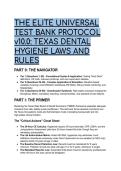
THE ELITE UNIVERSAL
TEST BANK PROTOCOL
v10.0: TEXAS DENTAL
HYGIENE LAWS AND
RULES
PART 0: THE NAVIGATOR
● Tier 1 (Questions 1–28) - Foundational Syntax & Application: Testing "Hard Deck"
definitions, CE math, licensure protocols, and core supervision statutes.
● Tier 2 (Questions 29–58) - Complex Application & Simulation: Situation-based
variables involving Local Infiltration Anesthesia (HB 3824), Nitrous Oxide monitoring, and
Teledentistry.
● Tier 3 (Questions 59–88) - Grandmaster Synthesis: High-stakes scenarios merging the
Disciplinary Matrix, mandatory reporting, exempt facilities, and standard-of-care failures.
PART I: THE PRIMER
Mastering the Texas State Board of Dental Examiners (TSBDE) framework separates adequate
clinicians from elite, liability-proof practitioners. This test bank forces absolute command over
the Texas Occupations Code and Administrative Code, translating bureaucratic text into
high-stakes clinical intuition.
The "Critical Axioms" Cheat Sheet
● The 24-Hour CE Calculus: Hygienists require 24 hours biennially. CPR, OSHA, and the
Jurisprudence Assessment yield zero (0) hours toward this total, though they are
mandatory prerequisites.
● The LIA Authorization Matrix: Under HB 3824, hygienists may administer Local
Infiltration Anesthesia exclusively under Direct Supervision to non-sedated (or N2O only)
patients strictly 18 years of age or older.
● The Baseline Record Retention Law: Records must be maintained for 5 years
minimum. Pediatric records are kept until age 21 or for 5 years, whichever is longer.
● The Mandated Reporter Law: Suspected child abuse must be reported by professionals
within 48 hours; this duty cannot be delegated.
, ● The Supervision Imperative: Direct Supervision demands the dentist is physically
present in the facility. General Supervision allows action without physical presence,
provided a prior exam occurred within 12 months.
TSBDE Continuing Education Category Framework
CE Category Statutory Limit / Requirement Application Rules
Total Hours 24 Hours Biennially Required for all active RDH
renewals.
Clinical/Technical 16 Hours Minimum Must be scientific/hands-on
clinical care.
Risk Management 8 Hours Maximum Includes ethics and
record-keeping.
Self-Study 8 Hours Maximum Asynchronous/video formatting
limit.
Human Trafficking Mandatory Requirement Must be HHSC-approved;
counts toward 24-hour total.
PART II: THE ELITE TEST BANK
Q1: A Texas dental hygienist submits their biennial license renewal. Their portfolio includes 18
hours of hands-on clinical scaling courses, 4 hours of Healthcare Provider BLS/CPR, 2 hours of
OSHA updates, and the TSBDE Jurisprudence Assessment. Based on TSBDE Continuing
Education requirements, what is the MOST ACCURATE status of this renewal? A) Approved;
the hygienist exceeded the 24-hour requirement with 24 total hours of applicable courses. B)
Denied; the hygienist is 6 hours short because BLS/CPR, OSHA, and Jurisprudence do not
count toward the 24-hour requirement. C) Denied; the hygienist is missing the mandatory 4-hour
pain management course required for all licensees. D) Approved; the Jurisprudence
Assessment satisfies the remaining elective requirements automatically.
● The Answer: B (Denied; the hygienist is 6 hours short because BLS/CPR, OSHA, and
Jurisprudence do not count toward the 24-hour requirement.)
● Distractor Analysis:
○ A is incorrect: The math includes non-qualifying prerequisites, falsely inflating the
count.
○ C is incorrect: The 4-hour pain management requirement targets prescribing
dentists, not hygienists.
○ D is incorrect: The Jurisprudence Assessment is mandatory every 4 years but
yields zero CE hours.
The Mentor's Analysis: Renewal calculations must strictly exclude non-qualifying prerequisites.
When tallying CE, the immediate priority is stripping out BLS, OSHA, and Jurisprudence. By
utilizing the zero-sum axiom for basic compliance courses, you bypass the common trap of audit
failure. Professional/Academic Intuition: Regulatory prerequisites (BLS, OSHA,
Jurisprudence) provide exactly zero (0) hours toward your 24-hour CE requirement.
Q2: A hygienist wants to apply site-specific subgingival medicaments to a patient's periodontal
pockets. The dentist is currently off-site at a conference. Based on TSBDE Rule 115.4, which
action is the MOST ACCURATE? A) Proceed; the procedure is authorized under General
Supervision following scaling and root planing. B) Halt; the procedure requires Direct
Supervision, mandating the dentist be physically present. C) Delegate; the hygienist may
,authorize a registered dental assistant to place the medicament. D) Halt; only a licensed dentist
may place subgingival medicaments in Texas.
● The Answer: A (Proceed; the procedure is authorized under General Supervision
following scaling and root planing.)
● Distractor Analysis:
○ B is incorrect: Rule 115.4 explicitly places this procedure under General
Supervision.
○ C is incorrect: The rule explicitly forbids delegating this task to a dental assistant.
○ D is incorrect: Hygienists are legally authorized to place these FDA-approved
topical agents.
The Mentor's Analysis: Subgingival medicaments bridge the gap between mechanical therapy
and pharmacological management. When facing pocket therapy, the immediate priority is
confirming prior mechanical debridement. By utilizing the General Supervision rule for
medicaments, you bypass the common trap of delaying critical adjunct therapy.
Professional/Academic Intuition: Site-specific medicaments are topical, delegable under
General Supervision, and strictly forbidden for dental assistants.
Q3: A patient requests their complete dental records, including radiographs. The patient was 14
years old during their last visit, which occurred 4 years ago. Based on TSBDE Rule 108.8
regarding record retention, what is the MOST ACCURATE timeline the clinic must adhere to for
keeping these original records? A) The records may be destroyed now, as 5 years is the
standard retention limit. B) The records must be kept until the patient is 18 years old. C) The
records must be kept until the patient reaches age 21. D) The records must be kept for 7 years
minimum, regardless of age.
● The Answer: C (The records must be kept until the patient reaches age 21.)
● Distractor Analysis:
○ A is incorrect: The 5-year rule is superseded by the minor clause.
○ B is incorrect: Age 18 is the legal age of majority, but TSBDE explicitly mandates
age 21 for dental records.
○ D is incorrect: 5 years or age 21 is the Texas mandate, not 7 years.
The Mentor's Analysis: Pediatric records carry extended liability tails. When facing pediatric file
purges, the immediate priority is calculating the patient's current age, not just the elapsed time.
By utilizing the "Age 21" mandate, you bypass the common trap of premature evidence
destruction. Professional/Academic Intuition: Retain pediatric records until the patient
turns 21, or 5 years from last treatment—whichever date is further in the future.
Q4: A hygienist renewing their license utilizes 12 hours of CE obtained via video self-study
courses from an ADA CERP provider. Why will the Board reject this renewal? A) Self-study
courses must be provided directly by the TSBDE. B) The hygienist exceeded the maximum
allowable 8 hours for self-study coursework. C) ADA CERP is not an approved provider for
Texas hygienists. D) Self-study is only permitted for dentists, not hygienists.
● The Answer: B (The hygienist exceeded the maximum allowable 8 hours for self-study
coursework.)
● Distractor Analysis:
○ A is incorrect: The Board approves outside providers; it does not issue the clinical
CE directly.
○ C is incorrect: ADA CERP is universally recognized under Rule 104.2.
○ D is incorrect: Hygienists are explicitly allowed self-study, but it is capped.
The Mentor's Analysis: The Board demands the majority of education be interactive or clinical.
When organizing a CE portfolio, the immediate priority is tracking category limits. By utilizing the
, 8-hour cap rule for self-study, you bypass the common trap of over-relying on asynchronous
learning. Professional/Academic Intuition: You may claim a maximum of 8 hours of
self-study CE per biennial renewal cycle.
Q5: A Texas dentist explicitly authorizes their employed hygienist to diagnose initial carious
lesions and prescribe a fluoride regimen. Based on Texas Occupations Code Section 262.151,
which conclusion is MOST ACCURATE? A) Lawful, because the dentist explicitly authorized it in
writing. B) Lawful, because fluoride is within the hygiene scope of practice. C) Unlawful; a
dentist cannot delegate the diagnosis of dental disease or prescription of treatment regimens.
D) Unlawful, unless the hygienist operates in a public health clinic.
● The Answer: C (Unlawful; a dentist cannot delegate the diagnosis of dental disease or
prescription of treatment regimens.)
● Distractor Analysis:
○ A is incorrect: A dentist cannot delegate tasks forbidden by statute, regardless of
written consent.
○ B is incorrect: Applying topical fluoride is legal; prescribing the regimen and
diagnosing the disease are solely dentist functions.
○ D is incorrect: Setting does not alter the fundamental ban on diagnosing and
prescribing.
The Mentor's Analysis: Delegation has absolute statutory limits protecting core physician-level
duties. When facing expansive delegation requests, the immediate priority is recognizing the
non-delegable hardlines. By utilizing the diagnostic prohibition rule, you bypass the common
trap of practicing dentistry without a license. Professional/Academic Intuition: Only a dentist
may diagnose disease, prescribe treatment, or permanently alter tissue; these are strictly
non-delegable.
Q6: Under TSBDE Rule 115.2, a hygienist is directed to monitor a patient receiving nitrous
oxide/oxygen inhalation conscious sedation. What is the FIRST prerequisite the hygienist must
meet to legally perform this duty? A) Ensure the patient is at least 18 years of age. B) Obtain a
nitrous oxide monitoring endorsement from the Board after completing an approved 8-hour
course. C) Administer the initial induction dosage to establish the baseline. D) Verify the dentist
is available by phone under General Supervision.
● The Answer: B (Obtain a nitrous oxide monitoring endorsement from the Board after
completing an approved 8-hour course.)
● Distractor Analysis:
○ A is incorrect: Nitrous monitoring by hygienists is not age-restricted like LIA.
○ C is incorrect: Hygienists strictly monitor; they never administer or induce the gas.
○ D is incorrect: Nitrous monitoring strictly requires Direct Supervision.
The Mentor's Analysis: Sedation monitoring requires formalized, specialized credentialing.
When facing nitrous delegation, the immediate priority is verifying the physical endorsement on
your license. By utilizing the endorsement mandate, you bypass the common trap of
unauthorized monitoring. Professional/Academic Intuition: Monitoring nitrous oxide
requires a specific Board endorsement and absolute Direct Supervision by the dentist.
Q7: A dental hygienist notices deep pit and fissure grooves on a pediatric patient and decides to
place sealants. The dentist has authorized this procedure. Under what supervision level is this
permitted in Texas? A) General Supervision. B) Direct Supervision. C) Personal Supervision. D)
Indirect Supervision.
● The Answer: A (General Supervision.)
● Distractor Analysis:
○ B is incorrect: Direct supervision is not legally required for hygienists placing
TEST BANK PROTOCOL
v10.0: TEXAS DENTAL
HYGIENE LAWS AND
RULES
PART 0: THE NAVIGATOR
● Tier 1 (Questions 1–28) - Foundational Syntax & Application: Testing "Hard Deck"
definitions, CE math, licensure protocols, and core supervision statutes.
● Tier 2 (Questions 29–58) - Complex Application & Simulation: Situation-based
variables involving Local Infiltration Anesthesia (HB 3824), Nitrous Oxide monitoring, and
Teledentistry.
● Tier 3 (Questions 59–88) - Grandmaster Synthesis: High-stakes scenarios merging the
Disciplinary Matrix, mandatory reporting, exempt facilities, and standard-of-care failures.
PART I: THE PRIMER
Mastering the Texas State Board of Dental Examiners (TSBDE) framework separates adequate
clinicians from elite, liability-proof practitioners. This test bank forces absolute command over
the Texas Occupations Code and Administrative Code, translating bureaucratic text into
high-stakes clinical intuition.
The "Critical Axioms" Cheat Sheet
● The 24-Hour CE Calculus: Hygienists require 24 hours biennially. CPR, OSHA, and the
Jurisprudence Assessment yield zero (0) hours toward this total, though they are
mandatory prerequisites.
● The LIA Authorization Matrix: Under HB 3824, hygienists may administer Local
Infiltration Anesthesia exclusively under Direct Supervision to non-sedated (or N2O only)
patients strictly 18 years of age or older.
● The Baseline Record Retention Law: Records must be maintained for 5 years
minimum. Pediatric records are kept until age 21 or for 5 years, whichever is longer.
● The Mandated Reporter Law: Suspected child abuse must be reported by professionals
within 48 hours; this duty cannot be delegated.
, ● The Supervision Imperative: Direct Supervision demands the dentist is physically
present in the facility. General Supervision allows action without physical presence,
provided a prior exam occurred within 12 months.
TSBDE Continuing Education Category Framework
CE Category Statutory Limit / Requirement Application Rules
Total Hours 24 Hours Biennially Required for all active RDH
renewals.
Clinical/Technical 16 Hours Minimum Must be scientific/hands-on
clinical care.
Risk Management 8 Hours Maximum Includes ethics and
record-keeping.
Self-Study 8 Hours Maximum Asynchronous/video formatting
limit.
Human Trafficking Mandatory Requirement Must be HHSC-approved;
counts toward 24-hour total.
PART II: THE ELITE TEST BANK
Q1: A Texas dental hygienist submits their biennial license renewal. Their portfolio includes 18
hours of hands-on clinical scaling courses, 4 hours of Healthcare Provider BLS/CPR, 2 hours of
OSHA updates, and the TSBDE Jurisprudence Assessment. Based on TSBDE Continuing
Education requirements, what is the MOST ACCURATE status of this renewal? A) Approved;
the hygienist exceeded the 24-hour requirement with 24 total hours of applicable courses. B)
Denied; the hygienist is 6 hours short because BLS/CPR, OSHA, and Jurisprudence do not
count toward the 24-hour requirement. C) Denied; the hygienist is missing the mandatory 4-hour
pain management course required for all licensees. D) Approved; the Jurisprudence
Assessment satisfies the remaining elective requirements automatically.
● The Answer: B (Denied; the hygienist is 6 hours short because BLS/CPR, OSHA, and
Jurisprudence do not count toward the 24-hour requirement.)
● Distractor Analysis:
○ A is incorrect: The math includes non-qualifying prerequisites, falsely inflating the
count.
○ C is incorrect: The 4-hour pain management requirement targets prescribing
dentists, not hygienists.
○ D is incorrect: The Jurisprudence Assessment is mandatory every 4 years but
yields zero CE hours.
The Mentor's Analysis: Renewal calculations must strictly exclude non-qualifying prerequisites.
When tallying CE, the immediate priority is stripping out BLS, OSHA, and Jurisprudence. By
utilizing the zero-sum axiom for basic compliance courses, you bypass the common trap of audit
failure. Professional/Academic Intuition: Regulatory prerequisites (BLS, OSHA,
Jurisprudence) provide exactly zero (0) hours toward your 24-hour CE requirement.
Q2: A hygienist wants to apply site-specific subgingival medicaments to a patient's periodontal
pockets. The dentist is currently off-site at a conference. Based on TSBDE Rule 115.4, which
action is the MOST ACCURATE? A) Proceed; the procedure is authorized under General
Supervision following scaling and root planing. B) Halt; the procedure requires Direct
Supervision, mandating the dentist be physically present. C) Delegate; the hygienist may
,authorize a registered dental assistant to place the medicament. D) Halt; only a licensed dentist
may place subgingival medicaments in Texas.
● The Answer: A (Proceed; the procedure is authorized under General Supervision
following scaling and root planing.)
● Distractor Analysis:
○ B is incorrect: Rule 115.4 explicitly places this procedure under General
Supervision.
○ C is incorrect: The rule explicitly forbids delegating this task to a dental assistant.
○ D is incorrect: Hygienists are legally authorized to place these FDA-approved
topical agents.
The Mentor's Analysis: Subgingival medicaments bridge the gap between mechanical therapy
and pharmacological management. When facing pocket therapy, the immediate priority is
confirming prior mechanical debridement. By utilizing the General Supervision rule for
medicaments, you bypass the common trap of delaying critical adjunct therapy.
Professional/Academic Intuition: Site-specific medicaments are topical, delegable under
General Supervision, and strictly forbidden for dental assistants.
Q3: A patient requests their complete dental records, including radiographs. The patient was 14
years old during their last visit, which occurred 4 years ago. Based on TSBDE Rule 108.8
regarding record retention, what is the MOST ACCURATE timeline the clinic must adhere to for
keeping these original records? A) The records may be destroyed now, as 5 years is the
standard retention limit. B) The records must be kept until the patient is 18 years old. C) The
records must be kept until the patient reaches age 21. D) The records must be kept for 7 years
minimum, regardless of age.
● The Answer: C (The records must be kept until the patient reaches age 21.)
● Distractor Analysis:
○ A is incorrect: The 5-year rule is superseded by the minor clause.
○ B is incorrect: Age 18 is the legal age of majority, but TSBDE explicitly mandates
age 21 for dental records.
○ D is incorrect: 5 years or age 21 is the Texas mandate, not 7 years.
The Mentor's Analysis: Pediatric records carry extended liability tails. When facing pediatric file
purges, the immediate priority is calculating the patient's current age, not just the elapsed time.
By utilizing the "Age 21" mandate, you bypass the common trap of premature evidence
destruction. Professional/Academic Intuition: Retain pediatric records until the patient
turns 21, or 5 years from last treatment—whichever date is further in the future.
Q4: A hygienist renewing their license utilizes 12 hours of CE obtained via video self-study
courses from an ADA CERP provider. Why will the Board reject this renewal? A) Self-study
courses must be provided directly by the TSBDE. B) The hygienist exceeded the maximum
allowable 8 hours for self-study coursework. C) ADA CERP is not an approved provider for
Texas hygienists. D) Self-study is only permitted for dentists, not hygienists.
● The Answer: B (The hygienist exceeded the maximum allowable 8 hours for self-study
coursework.)
● Distractor Analysis:
○ A is incorrect: The Board approves outside providers; it does not issue the clinical
CE directly.
○ C is incorrect: ADA CERP is universally recognized under Rule 104.2.
○ D is incorrect: Hygienists are explicitly allowed self-study, but it is capped.
The Mentor's Analysis: The Board demands the majority of education be interactive or clinical.
When organizing a CE portfolio, the immediate priority is tracking category limits. By utilizing the
, 8-hour cap rule for self-study, you bypass the common trap of over-relying on asynchronous
learning. Professional/Academic Intuition: You may claim a maximum of 8 hours of
self-study CE per biennial renewal cycle.
Q5: A Texas dentist explicitly authorizes their employed hygienist to diagnose initial carious
lesions and prescribe a fluoride regimen. Based on Texas Occupations Code Section 262.151,
which conclusion is MOST ACCURATE? A) Lawful, because the dentist explicitly authorized it in
writing. B) Lawful, because fluoride is within the hygiene scope of practice. C) Unlawful; a
dentist cannot delegate the diagnosis of dental disease or prescription of treatment regimens.
D) Unlawful, unless the hygienist operates in a public health clinic.
● The Answer: C (Unlawful; a dentist cannot delegate the diagnosis of dental disease or
prescription of treatment regimens.)
● Distractor Analysis:
○ A is incorrect: A dentist cannot delegate tasks forbidden by statute, regardless of
written consent.
○ B is incorrect: Applying topical fluoride is legal; prescribing the regimen and
diagnosing the disease are solely dentist functions.
○ D is incorrect: Setting does not alter the fundamental ban on diagnosing and
prescribing.
The Mentor's Analysis: Delegation has absolute statutory limits protecting core physician-level
duties. When facing expansive delegation requests, the immediate priority is recognizing the
non-delegable hardlines. By utilizing the diagnostic prohibition rule, you bypass the common
trap of practicing dentistry without a license. Professional/Academic Intuition: Only a dentist
may diagnose disease, prescribe treatment, or permanently alter tissue; these are strictly
non-delegable.
Q6: Under TSBDE Rule 115.2, a hygienist is directed to monitor a patient receiving nitrous
oxide/oxygen inhalation conscious sedation. What is the FIRST prerequisite the hygienist must
meet to legally perform this duty? A) Ensure the patient is at least 18 years of age. B) Obtain a
nitrous oxide monitoring endorsement from the Board after completing an approved 8-hour
course. C) Administer the initial induction dosage to establish the baseline. D) Verify the dentist
is available by phone under General Supervision.
● The Answer: B (Obtain a nitrous oxide monitoring endorsement from the Board after
completing an approved 8-hour course.)
● Distractor Analysis:
○ A is incorrect: Nitrous monitoring by hygienists is not age-restricted like LIA.
○ C is incorrect: Hygienists strictly monitor; they never administer or induce the gas.
○ D is incorrect: Nitrous monitoring strictly requires Direct Supervision.
The Mentor's Analysis: Sedation monitoring requires formalized, specialized credentialing.
When facing nitrous delegation, the immediate priority is verifying the physical endorsement on
your license. By utilizing the endorsement mandate, you bypass the common trap of
unauthorized monitoring. Professional/Academic Intuition: Monitoring nitrous oxide
requires a specific Board endorsement and absolute Direct Supervision by the dentist.
Q7: A dental hygienist notices deep pit and fissure grooves on a pediatric patient and decides to
place sealants. The dentist has authorized this procedure. Under what supervision level is this
permitted in Texas? A) General Supervision. B) Direct Supervision. C) Personal Supervision. D)
Indirect Supervision.
● The Answer: A (General Supervision.)
● Distractor Analysis:
○ B is incorrect: Direct supervision is not legally required for hygienists placing


