

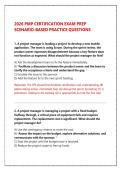
2026 PMP CERTIFICATION EXAM PREP
SCENARIO-BASED PRACTICE QUESTIONS
1. A project manager is leading a project to develop a new mobile
application. The team is using Scrum. During the sprint review, the
product owner expresses disappointment because a key feature does
not function as expected. What should the project manager do first?
A) Ask the development team to fix the feature immediately.
B) *Facilitate a discussion between the product owner and the team to
clarify the acceptance criteria and understand the gap. *
C) Escalate the issue to the sponsor.
D) Add the feature fix to the next sprint backlog.
Rationale: The PM should first facilitate clarification and understanding (B)
before taking action. Immediate fixes (A) disrupt the sprint. Escalating (C) is
premature. Adding to the backlog (D) is appropriate but not the first step.
2. A project manager is managing a project with a fixed budget.
Halfway through, a critical piece of equipment fails and requires
replacement. The replacement cost is significant. What should the
project manager do?
A) Use the contingency reserve to cover the cost.
B) *Assess the impact on the budget, explore alternative solutions, and
communicate with the sponsor. *
C) Stop the project until the budget issue is resolved.
D) Reduce the project scope to free up funds.
,Rationale: The PM should assess impact, explore alternatives, and
communicate (B). Using the contingency reserve (A) may be appropriate but
only after assessment. Stopping the project (C) is drastic. Reducing scope (D)
is a last resort after evaluation.
3. A project manager is leading a project where a team member is
consistently performing below expectations. The project manager has
already provided coaching and feedback. What should the project
manager do next?
A) Terminate the team member.
B) *Document the performance issues and escalate to human resources
or the functional manager. *
C) Ignore the issue and reassign the team member to less critical tasks.
D) Reduce the team member's workload.
Rationale: After coaching has failed, the PM should document and escalate
(B). Termination (A) is a last resort and may require HR involvement. Ignoring
(C) is irresponsible. Reducing workload (D) does not address the performance
issue.
4. A project manager is managing a project with multiple stakeholders
who have conflicting priorities. The project manager needs to
prioritize requirements. What should the project manager use as the
primary criterion?
A) The preference of the most senior stakeholder.
B) *The business value delivered to the organization and alignment
with strategic goals. *
,C) The ease of implementation.
D) The cost of each requirement.
Rationale: Business value and strategic alignment (B) are the primary
prioritization criteria. Senior preference (A) is subjective. Ease (C) and cost (D)
are secondary considerations.
5. A project manager is leading an agile project. The team has
completed three sprints, but the velocity is decreasing. What should
the project manager do?
A) Increase the story points per sprint to challenge the team.
B) *Facilitate a retrospective to identify impediments and improve the
team's process. *
C) Replace the product owner.
D) Extend the sprint duration.
Rationale: The PM should facilitate a retrospective to identify and remove
impediments (B). Increasing story points (A) worsens the problem. Replacing
the PO (C) is drastic. Extending sprints (D) avoids the root cause.
6. A project manager is preparing a project status report for the
steering committee. The project is slightly behind schedule but under
budget. How should the project manager present this information?
A) Focus only on the positive aspects and downplay the schedule delay.
B) *Present the facts objectively, highlighting the schedule delay, the
budget surplus, and the planned corrective actions. *
C) Blame the team for the schedule delay.
D) Omit the schedule delay from the report.
, Rationale: The PM should present facts objectively with corrective actions (B).
Downplaying (A) or omitting (D) is dishonest. Blaming (C) is unprofessional.
7. A project manager is leading a project where the project charter has
just been approved. What should the project manager do next?
A) Begin executing the project immediately.
B) *Hold a project kickoff meeting with the team and key
stakeholders. *
C) Develop the detailed project schedule.
D) Identify all project risks.
Rationale: A kickoff meeting (B) is the next step to align the team and
stakeholders. Execution (A) begins after planning. Schedule development (C)
and risk identification (D) are part of planning but occur after or during the
kickoff.
8. A project manager is managing a project where a vendor is
consistently delivering materials late. The delays are affecting the
project schedule. What should the project manager do?
A) Terminate the vendor contract immediately.
B) *Review the contract, meet with the vendor, and implement a
performance improvement plan with clear consequences. *
C) Accept the delays and adjust the project schedule.
D) Find a new vendor without notifying the current vendor.
Rationale: The PM should review, meet, and implement a performance
improvement plan (B). Termination (A) is a last resort. Accepting delays (C) is
passive. Finding a new vendor without notice (D) is unprofessional.
SCENARIO-BASED PRACTICE QUESTIONS
1. A project manager is leading a project to develop a new mobile
application. The team is using Scrum. During the sprint review, the
product owner expresses disappointment because a key feature does
not function as expected. What should the project manager do first?
A) Ask the development team to fix the feature immediately.
B) *Facilitate a discussion between the product owner and the team to
clarify the acceptance criteria and understand the gap. *
C) Escalate the issue to the sponsor.
D) Add the feature fix to the next sprint backlog.
Rationale: The PM should first facilitate clarification and understanding (B)
before taking action. Immediate fixes (A) disrupt the sprint. Escalating (C) is
premature. Adding to the backlog (D) is appropriate but not the first step.
2. A project manager is managing a project with a fixed budget.
Halfway through, a critical piece of equipment fails and requires
replacement. The replacement cost is significant. What should the
project manager do?
A) Use the contingency reserve to cover the cost.
B) *Assess the impact on the budget, explore alternative solutions, and
communicate with the sponsor. *
C) Stop the project until the budget issue is resolved.
D) Reduce the project scope to free up funds.
,Rationale: The PM should assess impact, explore alternatives, and
communicate (B). Using the contingency reserve (A) may be appropriate but
only after assessment. Stopping the project (C) is drastic. Reducing scope (D)
is a last resort after evaluation.
3. A project manager is leading a project where a team member is
consistently performing below expectations. The project manager has
already provided coaching and feedback. What should the project
manager do next?
A) Terminate the team member.
B) *Document the performance issues and escalate to human resources
or the functional manager. *
C) Ignore the issue and reassign the team member to less critical tasks.
D) Reduce the team member's workload.
Rationale: After coaching has failed, the PM should document and escalate
(B). Termination (A) is a last resort and may require HR involvement. Ignoring
(C) is irresponsible. Reducing workload (D) does not address the performance
issue.
4. A project manager is managing a project with multiple stakeholders
who have conflicting priorities. The project manager needs to
prioritize requirements. What should the project manager use as the
primary criterion?
A) The preference of the most senior stakeholder.
B) *The business value delivered to the organization and alignment
with strategic goals. *
,C) The ease of implementation.
D) The cost of each requirement.
Rationale: Business value and strategic alignment (B) are the primary
prioritization criteria. Senior preference (A) is subjective. Ease (C) and cost (D)
are secondary considerations.
5. A project manager is leading an agile project. The team has
completed three sprints, but the velocity is decreasing. What should
the project manager do?
A) Increase the story points per sprint to challenge the team.
B) *Facilitate a retrospective to identify impediments and improve the
team's process. *
C) Replace the product owner.
D) Extend the sprint duration.
Rationale: The PM should facilitate a retrospective to identify and remove
impediments (B). Increasing story points (A) worsens the problem. Replacing
the PO (C) is drastic. Extending sprints (D) avoids the root cause.
6. A project manager is preparing a project status report for the
steering committee. The project is slightly behind schedule but under
budget. How should the project manager present this information?
A) Focus only on the positive aspects and downplay the schedule delay.
B) *Present the facts objectively, highlighting the schedule delay, the
budget surplus, and the planned corrective actions. *
C) Blame the team for the schedule delay.
D) Omit the schedule delay from the report.
, Rationale: The PM should present facts objectively with corrective actions (B).
Downplaying (A) or omitting (D) is dishonest. Blaming (C) is unprofessional.
7. A project manager is leading a project where the project charter has
just been approved. What should the project manager do next?
A) Begin executing the project immediately.
B) *Hold a project kickoff meeting with the team and key
stakeholders. *
C) Develop the detailed project schedule.
D) Identify all project risks.
Rationale: A kickoff meeting (B) is the next step to align the team and
stakeholders. Execution (A) begins after planning. Schedule development (C)
and risk identification (D) are part of planning but occur after or during the
kickoff.
8. A project manager is managing a project where a vendor is
consistently delivering materials late. The delays are affecting the
project schedule. What should the project manager do?
A) Terminate the vendor contract immediately.
B) *Review the contract, meet with the vendor, and implement a
performance improvement plan with clear consequences. *
C) Accept the delays and adjust the project schedule.
D) Find a new vendor without notifying the current vendor.
Rationale: The PM should review, meet, and implement a performance
improvement plan (B). Termination (A) is a last resort. Accepting delays (C) is
passive. Finding a new vendor without notice (D) is unprofessional.


