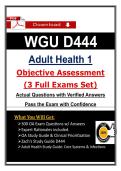
WGU D444
Adult Health 1
Objective Assessment
(3 Full Exams Set)
Actual Questions with Verified Answers
Pass the Exam with Confidence
What You Will Get:
➢300 OA Exam Questions w/ Answers
➢Expert Rationales included.
➢OA Study Guide & Clinical Prioritization
➢Zach's Study Guide D444
➢ Adult Health Study Guide: Core Systems & Infections
, Preview Pages Below
Get the Complete PDF After Purchase
"If you require further clarification or in need of any
study resources, feel free to Message me."
Digital preview sample
,Table of Contents
D444 OA EXAM 1 .............................................................................. 2
D444 OA EXAM 2 ............................................................................ 60
D444 OA EXAM 3 .......................................................................... 118
D444 OA Study Guide & Clinical Prioritization ........................................... 154
Zach's Study Guide D444 ............................................................................ 162
Adult Health Study Guide: Core Systems & Infections ............................... 178
D444 OA EXAM 1
1. A client with chronic cirrhosis has esophageal varices. It is most important for
the nurse to monitor the client for the onset of which problem?
A. Hematemesis (vomiting blood)
B. Jaundice
C. Ascites
D. Hepatic encephalopathy
Correct Answer: A
Rationale: Esophageal varices are dilated veins in the lower esophagus resulting from
portal hypertension in cirrhosis. These veins are fragile and can rupture, causing life-
threatening hemorrhage. Hematemesis (vomiting blood) indicates variceal rupture,
which is a medical emergency requiring immediate intervention. While jaundice, ascites,
and hepatic encephalopathy are complications of cirrhosis, variceal bleeding poses the
most immediate threat to life.
,2. The client is a 51-year-old male with pneumonia. The client has a history of
hypertension and takes enalapril and a multivitamin daily. His surgical history
includes adenoid removal at age 4 and a surgical repair of a fractured tibia at age
20. The nurse is preparing to set up oxygen administration and apply a simple
face mask. Mark whether the following assessment findings indicate that the
treatment was effective or ineffective:
Table
Assessment Finding Effective Ineffective
Ronchi in the right lung ☐ ☑
PaCO₂ 55 mm Hg on a blood gas ☐ ☑
Diminished breath sounds in the right lung ☐ ☑
Symmetric chest expansion ☑ ☐
Oxygen saturation greater than 94% ☑ ☐
Client ambulates without shortness of breath ☑ ☐
Rationale: Effective treatment for pneumonia should result in improved oxygenation
(SpO₂ >94%), symmetric chest expansion indicating equal lung ventilation, and the
ability to ambulate without dyspnea. Ineffective findings include persistent adventitious
sounds (ronchi), elevated PaCO₂ (normal 35–45 mm Hg), and diminished breath
sounds suggesting unresolved consolidation or atelectasis.
3. The client is a 51-year-old male with pneumonia (same scenario). Which
technique should the nurse use when assessing the client for early signs of
rheumatoid arthritis?
A. Observe the client's fingers
B. Assess the client's knee joints
, D444 OA EXAM 2
1. A client with glaucoma is preparing for discharge. Which instruction should the
nurse prioritize?
A. Avoid bending at the waist, coughing, or straining
B. Use miotic eye drops only when vision is blurry
C. Resume weightlifting gradually over 2 weeks
D. Sleep with the head of bed flat to reduce eye strain
Correct Answer: A
Rationale: Glaucoma is characterized by increased intraocular pressure (IOP).
Bending, coughing, and straining significantly elevate IOP, which can worsen optic
nerve damage and lead to vision loss. Option B is incorrect because miotics like
pilocarpine must be used as prescribed, not PRN. Option C is incorrect because lifting
increases IOP and is contraindicated. Option D is incorrect because elevating the HOB
actually helps reduce IOP; lying flat increases venous pressure in the eye.
2. A client returns from cataract surgery. Which discharge instruction is most
appropriate? (Select all that apply.)
, D444 OA EXAM 3
QUESTION 1 | Multiple Choice
Which instruction should the nurse include in the discharge teaching plan for an
adult client with hypernatremia?
A. Review food labels for sodium content
B. Increase fluid intake to 3 liters per day
C. Weigh daily and report weight gains
D. Avoid potassium-rich foods
✓ CORRECT ANSWER: A
EXPERT RATIONALE: Hypernatremia is defined as a serum sodium level greater than 145
mEq/L. The condition most commonly results from inadequate fluid intake, excessive
sodium intake, or impaired thirst mechanisms. Teaching the client to review food labels for
sodium content (A) is essential for identifying hidden sodium in processed foods and
maintaining sodium restriction. While increasing fluid intake (B) may be appropriate in some
cases of hypernatremia caused by dehydration, it is not universally recommended without
provider guidance, especially in clients with cardiac or renal compromise. Daily weights (C)
are more relevant for fluid overload states such as heart failure. Avoiding potassium-rich
foods (D) is unrelated to sodium management and is not appropriate teaching for
hypernatremia.
QUESTION 2 | Multiple Choice
A client who is experiencing respiratory distress is admitted with respiratory
acidosis. Which pathophysiological process supports the client's respiratory
acidosis?
A. Excessive bicarbonate (HCO₃⁻) has been lost through the kidneys
B. High levels of carbon dioxide have accumulated in the blood
C. The kidneys are retaining too much hydrogen ion
D. Hyperventilation has caused excessive CO₂ excretion
✓ CORRECT ANSWER: B
, D444 OA Study Guide & Clinical Prioritization
1. Glaucoma priority: Avoid anything that increases intraocular pressure; no bending,
coughing, or straining.
2. Cataracts post-op priority: Avoid bending, lifting, or straining to prevent increased eye
pressure.
3. Corneal Abrasions: Scratches on the cornea causing intense pain and photophobia;
treated with antibiotic ointment and sometimes patching.
4. Retinal Detachment: Separation of the retina from the epithelium; characterized by
flashing lights, floaters, and a "curtain" over the vision; an ocular emergency.
5. Meniere's Disease: Inner ear disorder characterized by vertigo, tinnitus, and hearing
loss; managed with low-sodium diet and diuretics.
6. Vertigo: Sensation of spinning or dizziness; nursing priority is safety and fall prevention.
7. Multiple sclerosis key features: Autoimmune demyelination causing fatigue, weakness,
vision problems, and heat sensitivity.
8. Myasthenia gravis key features: Muscle weakness that worsens with activity, improves
with rest, with ptosis and dysphagia.
9. Myasthenia gravis priority: Maintain airway and give pyridostigmine before meals.
10. Parkinson's Disease key features: Resting tremor, rigidity, slow movement, and shuffling
gait.
11. Parkinson's priority: Give levodopa on time and prevent falls.
12. Seizure Disorders Priority: Protect airway, turn patient on side, do not restrain.
13. Pulmonary embolism priority: Oxygen first, then anticoagulants.
14. Melanoma: Most aggressive skin cancer; identified by the ABCDE rule (Asymmetry,
Border, Color, Diameter, Evolving).
15. Herpes Zoster (Shingles): Reactivation of varicella-virus; presents as painful vesicles
along a dermatome; requires airborne/contact precautions if disseminated.
, Condition Key Points
topical antibiotic drops. Patient teaching: Avoid topical anesthetics at
home (delay healing); avoid contact lenses until healed
Summary of Eye Injuries
Table
Injury Treatment
Chemical burns Immediate copious irrigation, pH eye testing, eye shield, urgent
referral
Scratches Lubrication, antibiotics, cold compress, no rubbing
Corneal Cycloplegics for pain, antibiotics, avoid anesthetics at home, recheck
abrasions in 24 hrs
Nursing Priorities with All Eye Injuries
1. Immediate protection of vision by irrigation, shielding, preventing further trauma
2. Pain management using medications as prescribed
3. Patient teaching with necessary follow-up
4. Ensure medications are followed and eyewear is used to prevent recurrence
Pneumonia
Pathophysiology
Microorganisms enter alveoli → Inflammatory response → Alveolar edema and consolidation
→ Impaired gas exchange → Hypoxemia
S/Sx
• Fever, chills, productive cough, dyspnea, tachypnea
, Answer: Aging, genetics, diabetes, hypertension
11. What is a cataract?
Answer: Lens opacity that impairs vision due to deterioration and clumping of proteins in
the lens
12. What are the risk factors for developing cataracts?
Answer: Aging, trauma, family history, systemic diseases like diabetes
13. What are the signs and symptoms of cataracts?
Answer: Gradual, painless vision loss, complaints of blurry or double vision, pupil becomes
white or gray, absent red reflex upon examination
14. What is the primary treatment for cataracts?
Answer: Surgical removal of the cataract
15. What post-operative care is necessary after cataract surgery?
Answer: Use of antibiotic, steroid, and NSAID eye drops; wear dark sunglasses outside;
avoid activities that increase IOP
, DERMATOLOGY & INFECTIOUS DISEASE
16. What is tinea pedis?
Answer: Common fungal infection known as athlete's foot, caused by dermatophytes in
warm, moist environments
17. What are the signs and symptoms of tinea pedis?
Answer: Scaly, peeling, cracked skin, itchiness, burning sensation, bad smell, inflamed skin,
blisters
18. What is the treatment for tinea pedis?
Answer: Topical antifungal agents like clotrimazole, miconazole, ketoconazole; oral
antifungal agents may also be prescribed
19. What is psoriasis?
Answer: Chronic inflammatory disease causing thick, red patches with silver scales due to
autoimmune overproduction of skin cells
20. What are the types of psoriasis?
Answer: Plaque psoriasis, nail psoriasis, guttate psoriasis, inverse psoriasis, pustular
psoriasis, erythrodermic psoriasis
21. What are common treatments for psoriasis?
Answer: Topical medications (steroids, salicylic acid), systemic treatments (UVB therapy,
methotrexate, biologic agents)
22. What is candida and its common forms?
Answer: Fungal infection due to imbalance of local flora; common forms include oral thrush
and vaginal yeast infections
23. What are the signs and symptoms of a yeast infection?
Answer: Red and irritated skin with burning and itching
24. What are the treatments for candida infections?
Adult Health 1
Objective Assessment
(3 Full Exams Set)
Actual Questions with Verified Answers
Pass the Exam with Confidence
What You Will Get:
➢300 OA Exam Questions w/ Answers
➢Expert Rationales included.
➢OA Study Guide & Clinical Prioritization
➢Zach's Study Guide D444
➢ Adult Health Study Guide: Core Systems & Infections
, Preview Pages Below
Get the Complete PDF After Purchase
"If you require further clarification or in need of any
study resources, feel free to Message me."
Digital preview sample
,Table of Contents
D444 OA EXAM 1 .............................................................................. 2
D444 OA EXAM 2 ............................................................................ 60
D444 OA EXAM 3 .......................................................................... 118
D444 OA Study Guide & Clinical Prioritization ........................................... 154
Zach's Study Guide D444 ............................................................................ 162
Adult Health Study Guide: Core Systems & Infections ............................... 178
D444 OA EXAM 1
1. A client with chronic cirrhosis has esophageal varices. It is most important for
the nurse to monitor the client for the onset of which problem?
A. Hematemesis (vomiting blood)
B. Jaundice
C. Ascites
D. Hepatic encephalopathy
Correct Answer: A
Rationale: Esophageal varices are dilated veins in the lower esophagus resulting from
portal hypertension in cirrhosis. These veins are fragile and can rupture, causing life-
threatening hemorrhage. Hematemesis (vomiting blood) indicates variceal rupture,
which is a medical emergency requiring immediate intervention. While jaundice, ascites,
and hepatic encephalopathy are complications of cirrhosis, variceal bleeding poses the
most immediate threat to life.
,2. The client is a 51-year-old male with pneumonia. The client has a history of
hypertension and takes enalapril and a multivitamin daily. His surgical history
includes adenoid removal at age 4 and a surgical repair of a fractured tibia at age
20. The nurse is preparing to set up oxygen administration and apply a simple
face mask. Mark whether the following assessment findings indicate that the
treatment was effective or ineffective:
Table
Assessment Finding Effective Ineffective
Ronchi in the right lung ☐ ☑
PaCO₂ 55 mm Hg on a blood gas ☐ ☑
Diminished breath sounds in the right lung ☐ ☑
Symmetric chest expansion ☑ ☐
Oxygen saturation greater than 94% ☑ ☐
Client ambulates without shortness of breath ☑ ☐
Rationale: Effective treatment for pneumonia should result in improved oxygenation
(SpO₂ >94%), symmetric chest expansion indicating equal lung ventilation, and the
ability to ambulate without dyspnea. Ineffective findings include persistent adventitious
sounds (ronchi), elevated PaCO₂ (normal 35–45 mm Hg), and diminished breath
sounds suggesting unresolved consolidation or atelectasis.
3. The client is a 51-year-old male with pneumonia (same scenario). Which
technique should the nurse use when assessing the client for early signs of
rheumatoid arthritis?
A. Observe the client's fingers
B. Assess the client's knee joints
, D444 OA EXAM 2
1. A client with glaucoma is preparing for discharge. Which instruction should the
nurse prioritize?
A. Avoid bending at the waist, coughing, or straining
B. Use miotic eye drops only when vision is blurry
C. Resume weightlifting gradually over 2 weeks
D. Sleep with the head of bed flat to reduce eye strain
Correct Answer: A
Rationale: Glaucoma is characterized by increased intraocular pressure (IOP).
Bending, coughing, and straining significantly elevate IOP, which can worsen optic
nerve damage and lead to vision loss. Option B is incorrect because miotics like
pilocarpine must be used as prescribed, not PRN. Option C is incorrect because lifting
increases IOP and is contraindicated. Option D is incorrect because elevating the HOB
actually helps reduce IOP; lying flat increases venous pressure in the eye.
2. A client returns from cataract surgery. Which discharge instruction is most
appropriate? (Select all that apply.)
, D444 OA EXAM 3
QUESTION 1 | Multiple Choice
Which instruction should the nurse include in the discharge teaching plan for an
adult client with hypernatremia?
A. Review food labels for sodium content
B. Increase fluid intake to 3 liters per day
C. Weigh daily and report weight gains
D. Avoid potassium-rich foods
✓ CORRECT ANSWER: A
EXPERT RATIONALE: Hypernatremia is defined as a serum sodium level greater than 145
mEq/L. The condition most commonly results from inadequate fluid intake, excessive
sodium intake, or impaired thirst mechanisms. Teaching the client to review food labels for
sodium content (A) is essential for identifying hidden sodium in processed foods and
maintaining sodium restriction. While increasing fluid intake (B) may be appropriate in some
cases of hypernatremia caused by dehydration, it is not universally recommended without
provider guidance, especially in clients with cardiac or renal compromise. Daily weights (C)
are more relevant for fluid overload states such as heart failure. Avoiding potassium-rich
foods (D) is unrelated to sodium management and is not appropriate teaching for
hypernatremia.
QUESTION 2 | Multiple Choice
A client who is experiencing respiratory distress is admitted with respiratory
acidosis. Which pathophysiological process supports the client's respiratory
acidosis?
A. Excessive bicarbonate (HCO₃⁻) has been lost through the kidneys
B. High levels of carbon dioxide have accumulated in the blood
C. The kidneys are retaining too much hydrogen ion
D. Hyperventilation has caused excessive CO₂ excretion
✓ CORRECT ANSWER: B
, D444 OA Study Guide & Clinical Prioritization
1. Glaucoma priority: Avoid anything that increases intraocular pressure; no bending,
coughing, or straining.
2. Cataracts post-op priority: Avoid bending, lifting, or straining to prevent increased eye
pressure.
3. Corneal Abrasions: Scratches on the cornea causing intense pain and photophobia;
treated with antibiotic ointment and sometimes patching.
4. Retinal Detachment: Separation of the retina from the epithelium; characterized by
flashing lights, floaters, and a "curtain" over the vision; an ocular emergency.
5. Meniere's Disease: Inner ear disorder characterized by vertigo, tinnitus, and hearing
loss; managed with low-sodium diet and diuretics.
6. Vertigo: Sensation of spinning or dizziness; nursing priority is safety and fall prevention.
7. Multiple sclerosis key features: Autoimmune demyelination causing fatigue, weakness,
vision problems, and heat sensitivity.
8. Myasthenia gravis key features: Muscle weakness that worsens with activity, improves
with rest, with ptosis and dysphagia.
9. Myasthenia gravis priority: Maintain airway and give pyridostigmine before meals.
10. Parkinson's Disease key features: Resting tremor, rigidity, slow movement, and shuffling
gait.
11. Parkinson's priority: Give levodopa on time and prevent falls.
12. Seizure Disorders Priority: Protect airway, turn patient on side, do not restrain.
13. Pulmonary embolism priority: Oxygen first, then anticoagulants.
14. Melanoma: Most aggressive skin cancer; identified by the ABCDE rule (Asymmetry,
Border, Color, Diameter, Evolving).
15. Herpes Zoster (Shingles): Reactivation of varicella-virus; presents as painful vesicles
along a dermatome; requires airborne/contact precautions if disseminated.
, Condition Key Points
topical antibiotic drops. Patient teaching: Avoid topical anesthetics at
home (delay healing); avoid contact lenses until healed
Summary of Eye Injuries
Table
Injury Treatment
Chemical burns Immediate copious irrigation, pH eye testing, eye shield, urgent
referral
Scratches Lubrication, antibiotics, cold compress, no rubbing
Corneal Cycloplegics for pain, antibiotics, avoid anesthetics at home, recheck
abrasions in 24 hrs
Nursing Priorities with All Eye Injuries
1. Immediate protection of vision by irrigation, shielding, preventing further trauma
2. Pain management using medications as prescribed
3. Patient teaching with necessary follow-up
4. Ensure medications are followed and eyewear is used to prevent recurrence
Pneumonia
Pathophysiology
Microorganisms enter alveoli → Inflammatory response → Alveolar edema and consolidation
→ Impaired gas exchange → Hypoxemia
S/Sx
• Fever, chills, productive cough, dyspnea, tachypnea
, Answer: Aging, genetics, diabetes, hypertension
11. What is a cataract?
Answer: Lens opacity that impairs vision due to deterioration and clumping of proteins in
the lens
12. What are the risk factors for developing cataracts?
Answer: Aging, trauma, family history, systemic diseases like diabetes
13. What are the signs and symptoms of cataracts?
Answer: Gradual, painless vision loss, complaints of blurry or double vision, pupil becomes
white or gray, absent red reflex upon examination
14. What is the primary treatment for cataracts?
Answer: Surgical removal of the cataract
15. What post-operative care is necessary after cataract surgery?
Answer: Use of antibiotic, steroid, and NSAID eye drops; wear dark sunglasses outside;
avoid activities that increase IOP
, DERMATOLOGY & INFECTIOUS DISEASE
16. What is tinea pedis?
Answer: Common fungal infection known as athlete's foot, caused by dermatophytes in
warm, moist environments
17. What are the signs and symptoms of tinea pedis?
Answer: Scaly, peeling, cracked skin, itchiness, burning sensation, bad smell, inflamed skin,
blisters
18. What is the treatment for tinea pedis?
Answer: Topical antifungal agents like clotrimazole, miconazole, ketoconazole; oral
antifungal agents may also be prescribed
19. What is psoriasis?
Answer: Chronic inflammatory disease causing thick, red patches with silver scales due to
autoimmune overproduction of skin cells
20. What are the types of psoriasis?
Answer: Plaque psoriasis, nail psoriasis, guttate psoriasis, inverse psoriasis, pustular
psoriasis, erythrodermic psoriasis
21. What are common treatments for psoriasis?
Answer: Topical medications (steroids, salicylic acid), systemic treatments (UVB therapy,
methotrexate, biologic agents)
22. What is candida and its common forms?
Answer: Fungal infection due to imbalance of local flora; common forms include oral thrush
and vaginal yeast infections
23. What are the signs and symptoms of a yeast infection?
Answer: Red and irritated skin with burning and itching
24. What are the treatments for candida infections?