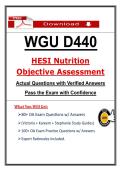
WGU D440
HESI Nutrition
Objective Assessment
Actual Questions with Verified Answers
Pass the Exam with Confidence
What You Will Get:
➢80+ OA Exam Questions w/ Answers
➢ (Victoria + Kareem + Stephanie Study Guides)
➢ 100+ OA Exam Practice Questions w/ Answers
➢ Expert Rationales included.
, Preview Pages Below
Get the Complete PDF After Purchase
"If you require further clarification or in need of any
study resources, feel free to Message me."
Digital preview sample
,Table of Contents
D440 HESI Nutrition OA Exam .............................................. 2
D440 HESI OA Exam Practice QS ......................................... 50
D440 HESI OA Exam Study Guide ....................................... 88
D440 HESI Nutrition OA Exam
1. A nurse is conducting a nutritional assessment for a healthy 35-year-old client.
Which guideline should the nurse use as the preferred reference for evaluating
whether the client’s diet meets optimal nutrient intake standards?
A. Recommended Dietary Allowances (RDA) alone
B. Dietary Reference Intakes (DRIs)
C. MyPlate daily checklist
D. Estimated Average Requirements (EAR)
Correct Answer: B
Rationale:
The Dietary Reference Intakes (DRIs) are the comprehensive set of reference
values used for assessing and planning diets in healthy people. They include the
RDA, EAR, Adequate Intake (AI), and Tolerable Upper Intake Level (UL), providing a
complete framework for evaluating nutrient adequacy and preventing both
deficiency and excess. While MyPlate offers practical food guidance, the DRIs are
the scientific standard for nutrient evaluation.
,2. A community health nurse is developing a nutrition education program for
adults over 50. At what age do the Dietary Reference Intakes indicate that
nutrient requirements begin to change for this population?
A. 40 years old
B. 50 years old
C. 60 years old
D. 65 years old
Correct Answer: B
Rationale:
The DRIs specify that nutrient requirements change at 50 years of age for adults.
This milestone triggers adjustments in recommendations for several nutrients,
including vitamin B12 absorption considerations and altered energy needs due to
metabolic shifts and decreased physical activity commonly seen in this age group.
3. A nursing student asks the clinical instructor for the correct term describing
the discipline that applies nutrition science to promote health and treat disease.
Which term should the instructor provide?
A. Nutrition science
B. Dietetics
C. Nutritional epidemiology
D. Food chemistry
Correct Answer: B
Rationale:
Dietetics is the professional discipline that applies the principles of nutrition
science to promote human health, prevent disease, and manage medical
conditions through therapeutic diets. Registered Dietitian Nutritionists (RDNs)
practice dietetics in clinical, community, and foodservice settings.
,4. An older adult client asks the nurse which nutrient becomes especially
important to include in her menu plan as she ages. Which recommendation is
most appropriate?
A. Foods fortified with vitamin D
B. Foods fortified with vitamin B12
C. Foods high in iron
D. Foods high in folic acid
Correct Answer: B
Rationale:
As adults age, particularly after 50 years, the ability to absorb naturally occurring
vitamin B12 from food declines due to reduced gastric acid production. The DRI
therefore recommends that older adults obtain vitamin B12 from fortified foods
or supplements to ensure adequate intake and prevent deficiency-related
neurological and hematological complications.
5. A nurse is explaining the evolution of dietary guidelines to a client. Which
statement best describes the rationale for creating the Dietary Reference Intakes
(DRIs)?
A. To establish minimum nutrient levels needed only to prevent deficiency
diseases
B. To replace the food guide pyramid with a simpler visual model
C. Public awareness shifted from deficiency prevention to maintaining optimal
health
D. To set maximum calorie limits for weight loss programs
Correct Answer: C
, D440 HESI OA Exam Practice QS
The nurse reports findings to the healthcare provider for a client who is admitted
to the intensive care unit today with chronic obstructive pulmonary disease
(COPD). When the nurse completes the report using the SBAR format, which
statement best supports the nurse's reason for calling the healthcare provider?
Admission today with difficulty breathing.
Presence of expiratory wheezes in the lower lobes
Prescription for an additional respiratory treatment.
History of COPD.
Prescription for an additional respiratory treatment.
The SBAR reporting format uses client information that includes the Situation,
Background, Assessment, Recommendation. The nurse should complete the report with
a recommendation, such as a prescription for an additional breathing treatment
A client with early breast cancer receives the results of a breast biopsy and asks
the nurse to explain the meaning of staging and the type of receptors found on
the cancer cells. Which explanation should the nurse provide?
Stage I indicates metastasis.
The tumor's estrogen receptor guides treatment options.
Lymph node involvement is not significant.
Small tumors are aggressive and indicate poor prognosis.
The tumor's estrogen receptor guides treatment options.
Treatment decisions and prediction of prognosis are related to the tumor's receptor
,status, such as estrogen and progesterone receptor status which commonly are well-
differentiated, have a lower chance of recurrence, and are receptive to hormonal
therapy. Tumor staging designates tumor size and spread of breast cancer cells into
axillary lymph nodes, which is one of the most important prognostic factors in early-
stage breast cancer.
The nurse is preparing to give a client dehydration IV fluids delivered at a
continuous rate of 175 mL/hour. Which infusion device should the nurse use?
Volumetric controller.
Cassette infusion pump.
Portable syringe pump.
Nonvolumetric controller.
Cassette infusion pump.
A cassette pump should be used to accurately deliver large volumes of fluid over longer
periods of time with extreme precision, such as mL/hour. A syringe pump is accurate for
low-dose continuous infusion of low-dose medication at a basal rate, but not large fluid
volume replacement. Volumetric and nonvolumetric controllers count drops/minute to
administer fluid volume and are inherently inaccurate because of variations in drop size.
A multigravida client at 35-weeks' gestation is diagnosed with pregnancy-induced
hypertension (PIH). Which symptom should the nurse instruct the client to report
immediately?
Blurred vision.
Constipation.
Increased urine output.
Backache.
Blurred vision.
Blurred vision, headache, visual changes, and epigastric discomfort are the most
common symptoms experienced by a client with PIH and may indicate impending
seizures and should be reported.
A client receives a prescription for psyllium for constipation. What instruction
should the registered nurse (RN) provide the client about taking this supplement?
A. Take medication in the evening before bedtime to reduce fullness.
B. Take supplement with 240 ml of liquid and follow with a second glass.
, D440 HESI OA Exam Study Guide
WGU HESI Nutrition - D440 (Victoria + Kareem + Stephanie Study Guides)
Know blood tests test nutritional status: ...
BMI and albumin
PT who has issues swallowing (dysphagia) will always be the most at risk for ...
nutrition deficiency.
Which patient would need more water?
(A. Breastfeeding)
know what diet for a pt who lost their dentures would be on
mechanical soft
Athletic patient complains with leg cramps due to low calcium, offer...
broccoli, cheese.
Know nutrient dense foods.
???
Folic acid Is found in ....
yogurt.
1 oz = ? mL
30 ml
1 cup = ? oz
,8 oz
BMI Ranges:
18.5-24.9 = normal
25-29.9 = overweight
30 and over = obese
(these values were on test)
Fat = ? per gram
Carbs = ? per gram
Protein = ? per gram
9
4
4
Glomerulonephritis diet: caused by untreated strep (a kidney disease)
Fluid restriction
Sodium restriction (salty meats & processed foods)
Decrease Protein
Increase carbs (Carbs provide energy and stop the breakdown of proteins)
Renal Disease diet
fluid restriction, Low sodium, Low protein, low potassium, high calcium
Urinary Tract infections (UTI) diet:
Cranberries, blueberries, raspberries, and other berries, probiotics (yogurt)
Avoid foods and drinks that cause bladder irritation, such as coffee, tea, soft drinks, and
chocolate, avoid smoking.
Diabetic needs to drink sugar-free cranberry juices
Heart Failure diet
Fluid restriction (spread out fluids during the day & suck on hard candy to decrease thirst)
Decrease sodium, fat, & cholesterol
Heart Health Diet:
, Decrease in saturated fats
Increase in Fiber
DASH Diet: aims to lower BP and LDL
Low sodium, low fat, high calcium, high potassium, high fiber
4-6 servings of fruits and veggies*
Celiac Disease diet:
Gluten free diet
No "BROW"
Barley Rye Oats Wheats
Ice cream, malted milk, prepared puddings, grains anything including made from wheat,
rye, oats, or barley, such as breads, rolls, cookies, cakes, crackers, cereal, spaghetti,
macaroni noodles, beer, and ale, oatmeal
Stomatitis diet: Inflammation of the oral mucous lining of the mouth
Soft and easy to eat foods, eat food at room temp., high protein & calorie, avoid alcohol and
spicy foods
Peritonitis diet: inflammation of the lining of stomach
Eat foods high in B-vitamins and calcium, such as almonds, beans, whole grains (if no
allergy), dark leafy greens (spinach and kale), and sea vegetables. Avoid refined foods, such
as white breads, pastas, and especially sugar. Use healthy oils in foods, such as olive oil or
vegetable oil
Cholecystitis diet:
low fat, high fiber and protein and carbs
avoid gassy foods like broccoli.
Diverticulitis:
High fiber, no nuts/seeds
Hemorrhoids diet:
Increase fiber and increase fluid intake.
Diabetes diet:
HESI Nutrition
Objective Assessment
Actual Questions with Verified Answers
Pass the Exam with Confidence
What You Will Get:
➢80+ OA Exam Questions w/ Answers
➢ (Victoria + Kareem + Stephanie Study Guides)
➢ 100+ OA Exam Practice Questions w/ Answers
➢ Expert Rationales included.
, Preview Pages Below
Get the Complete PDF After Purchase
"If you require further clarification or in need of any
study resources, feel free to Message me."
Digital preview sample
,Table of Contents
D440 HESI Nutrition OA Exam .............................................. 2
D440 HESI OA Exam Practice QS ......................................... 50
D440 HESI OA Exam Study Guide ....................................... 88
D440 HESI Nutrition OA Exam
1. A nurse is conducting a nutritional assessment for a healthy 35-year-old client.
Which guideline should the nurse use as the preferred reference for evaluating
whether the client’s diet meets optimal nutrient intake standards?
A. Recommended Dietary Allowances (RDA) alone
B. Dietary Reference Intakes (DRIs)
C. MyPlate daily checklist
D. Estimated Average Requirements (EAR)
Correct Answer: B
Rationale:
The Dietary Reference Intakes (DRIs) are the comprehensive set of reference
values used for assessing and planning diets in healthy people. They include the
RDA, EAR, Adequate Intake (AI), and Tolerable Upper Intake Level (UL), providing a
complete framework for evaluating nutrient adequacy and preventing both
deficiency and excess. While MyPlate offers practical food guidance, the DRIs are
the scientific standard for nutrient evaluation.
,2. A community health nurse is developing a nutrition education program for
adults over 50. At what age do the Dietary Reference Intakes indicate that
nutrient requirements begin to change for this population?
A. 40 years old
B. 50 years old
C. 60 years old
D. 65 years old
Correct Answer: B
Rationale:
The DRIs specify that nutrient requirements change at 50 years of age for adults.
This milestone triggers adjustments in recommendations for several nutrients,
including vitamin B12 absorption considerations and altered energy needs due to
metabolic shifts and decreased physical activity commonly seen in this age group.
3. A nursing student asks the clinical instructor for the correct term describing
the discipline that applies nutrition science to promote health and treat disease.
Which term should the instructor provide?
A. Nutrition science
B. Dietetics
C. Nutritional epidemiology
D. Food chemistry
Correct Answer: B
Rationale:
Dietetics is the professional discipline that applies the principles of nutrition
science to promote human health, prevent disease, and manage medical
conditions through therapeutic diets. Registered Dietitian Nutritionists (RDNs)
practice dietetics in clinical, community, and foodservice settings.
,4. An older adult client asks the nurse which nutrient becomes especially
important to include in her menu plan as she ages. Which recommendation is
most appropriate?
A. Foods fortified with vitamin D
B. Foods fortified with vitamin B12
C. Foods high in iron
D. Foods high in folic acid
Correct Answer: B
Rationale:
As adults age, particularly after 50 years, the ability to absorb naturally occurring
vitamin B12 from food declines due to reduced gastric acid production. The DRI
therefore recommends that older adults obtain vitamin B12 from fortified foods
or supplements to ensure adequate intake and prevent deficiency-related
neurological and hematological complications.
5. A nurse is explaining the evolution of dietary guidelines to a client. Which
statement best describes the rationale for creating the Dietary Reference Intakes
(DRIs)?
A. To establish minimum nutrient levels needed only to prevent deficiency
diseases
B. To replace the food guide pyramid with a simpler visual model
C. Public awareness shifted from deficiency prevention to maintaining optimal
health
D. To set maximum calorie limits for weight loss programs
Correct Answer: C
, D440 HESI OA Exam Practice QS
The nurse reports findings to the healthcare provider for a client who is admitted
to the intensive care unit today with chronic obstructive pulmonary disease
(COPD). When the nurse completes the report using the SBAR format, which
statement best supports the nurse's reason for calling the healthcare provider?
Admission today with difficulty breathing.
Presence of expiratory wheezes in the lower lobes
Prescription for an additional respiratory treatment.
History of COPD.
Prescription for an additional respiratory treatment.
The SBAR reporting format uses client information that includes the Situation,
Background, Assessment, Recommendation. The nurse should complete the report with
a recommendation, such as a prescription for an additional breathing treatment
A client with early breast cancer receives the results of a breast biopsy and asks
the nurse to explain the meaning of staging and the type of receptors found on
the cancer cells. Which explanation should the nurse provide?
Stage I indicates metastasis.
The tumor's estrogen receptor guides treatment options.
Lymph node involvement is not significant.
Small tumors are aggressive and indicate poor prognosis.
The tumor's estrogen receptor guides treatment options.
Treatment decisions and prediction of prognosis are related to the tumor's receptor
,status, such as estrogen and progesterone receptor status which commonly are well-
differentiated, have a lower chance of recurrence, and are receptive to hormonal
therapy. Tumor staging designates tumor size and spread of breast cancer cells into
axillary lymph nodes, which is one of the most important prognostic factors in early-
stage breast cancer.
The nurse is preparing to give a client dehydration IV fluids delivered at a
continuous rate of 175 mL/hour. Which infusion device should the nurse use?
Volumetric controller.
Cassette infusion pump.
Portable syringe pump.
Nonvolumetric controller.
Cassette infusion pump.
A cassette pump should be used to accurately deliver large volumes of fluid over longer
periods of time with extreme precision, such as mL/hour. A syringe pump is accurate for
low-dose continuous infusion of low-dose medication at a basal rate, but not large fluid
volume replacement. Volumetric and nonvolumetric controllers count drops/minute to
administer fluid volume and are inherently inaccurate because of variations in drop size.
A multigravida client at 35-weeks' gestation is diagnosed with pregnancy-induced
hypertension (PIH). Which symptom should the nurse instruct the client to report
immediately?
Blurred vision.
Constipation.
Increased urine output.
Backache.
Blurred vision.
Blurred vision, headache, visual changes, and epigastric discomfort are the most
common symptoms experienced by a client with PIH and may indicate impending
seizures and should be reported.
A client receives a prescription for psyllium for constipation. What instruction
should the registered nurse (RN) provide the client about taking this supplement?
A. Take medication in the evening before bedtime to reduce fullness.
B. Take supplement with 240 ml of liquid and follow with a second glass.
, D440 HESI OA Exam Study Guide
WGU HESI Nutrition - D440 (Victoria + Kareem + Stephanie Study Guides)
Know blood tests test nutritional status: ...
BMI and albumin
PT who has issues swallowing (dysphagia) will always be the most at risk for ...
nutrition deficiency.
Which patient would need more water?
(A. Breastfeeding)
know what diet for a pt who lost their dentures would be on
mechanical soft
Athletic patient complains with leg cramps due to low calcium, offer...
broccoli, cheese.
Know nutrient dense foods.
???
Folic acid Is found in ....
yogurt.
1 oz = ? mL
30 ml
1 cup = ? oz
,8 oz
BMI Ranges:
18.5-24.9 = normal
25-29.9 = overweight
30 and over = obese
(these values were on test)
Fat = ? per gram
Carbs = ? per gram
Protein = ? per gram
9
4
4
Glomerulonephritis diet: caused by untreated strep (a kidney disease)
Fluid restriction
Sodium restriction (salty meats & processed foods)
Decrease Protein
Increase carbs (Carbs provide energy and stop the breakdown of proteins)
Renal Disease diet
fluid restriction, Low sodium, Low protein, low potassium, high calcium
Urinary Tract infections (UTI) diet:
Cranberries, blueberries, raspberries, and other berries, probiotics (yogurt)
Avoid foods and drinks that cause bladder irritation, such as coffee, tea, soft drinks, and
chocolate, avoid smoking.
Diabetic needs to drink sugar-free cranberry juices
Heart Failure diet
Fluid restriction (spread out fluids during the day & suck on hard candy to decrease thirst)
Decrease sodium, fat, & cholesterol
Heart Health Diet:
, Decrease in saturated fats
Increase in Fiber
DASH Diet: aims to lower BP and LDL
Low sodium, low fat, high calcium, high potassium, high fiber
4-6 servings of fruits and veggies*
Celiac Disease diet:
Gluten free diet
No "BROW"
Barley Rye Oats Wheats
Ice cream, malted milk, prepared puddings, grains anything including made from wheat,
rye, oats, or barley, such as breads, rolls, cookies, cakes, crackers, cereal, spaghetti,
macaroni noodles, beer, and ale, oatmeal
Stomatitis diet: Inflammation of the oral mucous lining of the mouth
Soft and easy to eat foods, eat food at room temp., high protein & calorie, avoid alcohol and
spicy foods
Peritonitis diet: inflammation of the lining of stomach
Eat foods high in B-vitamins and calcium, such as almonds, beans, whole grains (if no
allergy), dark leafy greens (spinach and kale), and sea vegetables. Avoid refined foods, such
as white breads, pastas, and especially sugar. Use healthy oils in foods, such as olive oil or
vegetable oil
Cholecystitis diet:
low fat, high fiber and protein and carbs
avoid gassy foods like broccoli.
Diverticulitis:
High fiber, no nuts/seeds
Hemorrhoids diet:
Increase fiber and increase fluid intake.
Diabetes diet: