
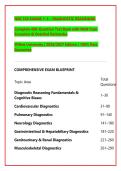
NSG 550 EXAMS 1–3 – DIAGNOSTIC REASONING
Complete 600-Question Test Bank with NGN Case
Scenarios & Detailed Rationales
Wilkes University | 2026/2027 Edition | 100% Pass
Guarantee
COMPREHENSIVE EXAM BLUEPRINT
Total
Topic Area
Questions
Diagnostic Reasoning Fundamentals &
1–30
Cognitive Biases
Cardiovascular Diagnostics 31–90
Pulmonary Diagnostics 91–140
Neurology Diagnostics 141–180
Gastrointestinal & Hepatobiliary Diagnostics 181–220
Genitourinary & Renal Diagnostics 221–260
Musculoskeletal Diagnostics 261–290
, Total
Topic Area
Questions
Endocrine & Metabolic Diagnostics 291–320
Infectious Disease & Hematology Diagnostics 321–360
Test Characteristics & Bayesian Reasoning 361–390
NGN Case Scenarios (Integrated) 391–600
SECTION 1: DIAGNOSTIC REASONING
FUNDAMENTALS & COGNITIVE BIASES (Questions 1–
30)
1. A nurse practitioner uses a dual-process model of
reasoning. Which scenario best describes the intuitive
(Type 1) process?
A) Calculating pre-test probability for pulmonary
embolism using the Wells score
B) Recognizing "sick vs. not sick" within seconds of
entering a patient's room
C) Listing all possible causes of fatigue and ruling each out
,systematically
D) Using a clinical decision rule to decide on imaging for
ankle trauma
Answer: B) Recognizing "sick vs. not sick" within seconds
of entering a patient's room
Rationale: Type 1 (intuitive) reasoning is rapid,
subconscious, and pattern-based. Recognizing illness
severity instantly is a hallmark of intuitive processing.
Options A, C, and D involve deliberate, analytical (Type 2)
reasoning.
2. A 45-year-old presents with epigastric pain. You
generate a differential that includes GERD, peptic ulcer
disease, biliary colic, and cardiac ischemia. This list
represents the:
A) Working diagnosis
B) Anatomical differential
C) Exhaustive differential
D) Pathophysiologic cascade
Answer: C) Exhaustive differential
Rationale: An exhaustive differential includes all
reasonable possibilities before narrowing. The working
diagnosis is the most likely after reasoning. Anatomical
differential organizes by organ system.
, 3. The "sensitivity" of a diagnostic test refers to its ability to:
A) Correctly identify those without the disease
B) Correctly identify those with the disease
C) Rule in disease
D) Determine disease severity
Answer: B) Correctly identify those with the disease
Rationale: Sensitivity = true positives / (true positives + false
negatives). A highly sensitive test rules out disease when
negative (SnNout). Specificity (A) correctly identifies those
without disease.
4. The "specificity" of a diagnostic test refers to its ability to:
A) Correctly identify those without the disease
B) Correctly identify those with the disease
C) Rule out disease
D) Determine disease severity
Answer: A) Correctly identify those without the disease
Rationale: Specificity = true negatives / (true negatives +
false positives). A highly specific test rules in disease when
positive (SpPin).
Complete 600-Question Test Bank with NGN Case
Scenarios & Detailed Rationales
Wilkes University | 2026/2027 Edition | 100% Pass
Guarantee
COMPREHENSIVE EXAM BLUEPRINT
Total
Topic Area
Questions
Diagnostic Reasoning Fundamentals &
1–30
Cognitive Biases
Cardiovascular Diagnostics 31–90
Pulmonary Diagnostics 91–140
Neurology Diagnostics 141–180
Gastrointestinal & Hepatobiliary Diagnostics 181–220
Genitourinary & Renal Diagnostics 221–260
Musculoskeletal Diagnostics 261–290
, Total
Topic Area
Questions
Endocrine & Metabolic Diagnostics 291–320
Infectious Disease & Hematology Diagnostics 321–360
Test Characteristics & Bayesian Reasoning 361–390
NGN Case Scenarios (Integrated) 391–600
SECTION 1: DIAGNOSTIC REASONING
FUNDAMENTALS & COGNITIVE BIASES (Questions 1–
30)
1. A nurse practitioner uses a dual-process model of
reasoning. Which scenario best describes the intuitive
(Type 1) process?
A) Calculating pre-test probability for pulmonary
embolism using the Wells score
B) Recognizing "sick vs. not sick" within seconds of
entering a patient's room
C) Listing all possible causes of fatigue and ruling each out
,systematically
D) Using a clinical decision rule to decide on imaging for
ankle trauma
Answer: B) Recognizing "sick vs. not sick" within seconds
of entering a patient's room
Rationale: Type 1 (intuitive) reasoning is rapid,
subconscious, and pattern-based. Recognizing illness
severity instantly is a hallmark of intuitive processing.
Options A, C, and D involve deliberate, analytical (Type 2)
reasoning.
2. A 45-year-old presents with epigastric pain. You
generate a differential that includes GERD, peptic ulcer
disease, biliary colic, and cardiac ischemia. This list
represents the:
A) Working diagnosis
B) Anatomical differential
C) Exhaustive differential
D) Pathophysiologic cascade
Answer: C) Exhaustive differential
Rationale: An exhaustive differential includes all
reasonable possibilities before narrowing. The working
diagnosis is the most likely after reasoning. Anatomical
differential organizes by organ system.
, 3. The "sensitivity" of a diagnostic test refers to its ability to:
A) Correctly identify those without the disease
B) Correctly identify those with the disease
C) Rule in disease
D) Determine disease severity
Answer: B) Correctly identify those with the disease
Rationale: Sensitivity = true positives / (true positives + false
negatives). A highly sensitive test rules out disease when
negative (SnNout). Specificity (A) correctly identifies those
without disease.
4. The "specificity" of a diagnostic test refers to its ability to:
A) Correctly identify those without the disease
B) Correctly identify those with the disease
C) Rule out disease
D) Determine disease severity
Answer: A) Correctly identify those without the disease
Rationale: Specificity = true negatives / (true negatives +
false positives). A highly specific test rules in disease when
positive (SpPin).


