
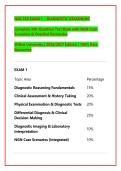
NSG 550 EXAM 1 – DIAGNOSTIC REASONING
Complete 200-Question Test Bank with NGN Case
Scenarios & Detailed Rationales
Wilkes University | 2026/2027 Edition | 100% Pass
Guarantee
EXAM 1
Topic Area Percentage
Diagnostic Reasoning Fundamentals 15%
Clinical Assessment & History Taking 20%
Physical Examination & Diagnostic Tests 20%
Differential Diagnosis & Clinical
25%
Decision-Making
Diagnostic Imaging & Laboratory
10%
Interpretation
NGN Case Scenarios (Integrated) 10%
,SECTION 1: DIAGNOSTIC REASONING
FUNDAMENTALS (Questions 1–30)
1. A 58-year-old male presents with substernal chest
pressure radiating to the jaw, worsened by exertion. What
is the most appropriate initial step?
A) Order a stat echocardiogram
B) Administer sublingual nitroglycerin
C) Obtain a focused history and vital signs
D) Refer to cardiology
Answer: C) Obtain a focused history and vital signs
Rationale: The initial step is always to stabilize and gather
critical data. History and vitals guide immediate
management; treatment (B) may follow but not before
assessment. Ordering tests (A) or referral (D) delays initial
assessment.
2. Which heuristic is most likely to cause premature
closure in diagnostic reasoning?
A) Availability heuristic
B) Anchoring
,C) Representativeness
D) Search satisfaction
Answer: D) Search satisfaction
Rationale: Search satisfaction (stopping after finding one
plausible diagnosis) is a direct cause of premature closure.
Anchoring (B) refers to sticking to an initial impression
despite new data.
3. Which type of reasoning uses a systematic, step-by-step
approach from known facts to a conclusion?
A) Inductive reasoning
B) Deductive reasoning
C) Intuitive reasoning
D) Pattern recognition
Answer: B) Deductive reasoning
Rationale: Deductive reasoning moves from general
principles to specific conclusions (e.g., all chest pain with
exertion → angina). Inductive (A) builds general rules from
specific cases. Intuitive reasoning (C) and pattern recognition
(D) are forms of non-analytic reasoning.
, 4. The "sensitivity" of a diagnostic test refers to:
A) The ability to rule in disease
B) The ability to rule out disease
C) The proportion of true positives among those with disease
D) The proportion of true negatives among those without
disease
Answer: C) The proportion of true positives among those
with disease
Rationale: Sensitivity = TP / (TP + FN). A highly sensitive test
(SnNOut) rules out disease when negative. Specificity (D)
rules in disease (SpPIn).
5. Which of the following best describes "Bayesian
reasoning" in diagnosis?
A) Treating based on the most common disease
B) Revising disease probability as new data arrives
C) Using intuition alone
D) Focusing only on life-threatening causes
Answer: B) Revising disease probability as new data arrives
Rationale: Bayesian reasoning updates pretest probability
to posttest probability using test characteristics (likelihood
ratios). It formalizes diagnostic reasoning.
Complete 200-Question Test Bank with NGN Case
Scenarios & Detailed Rationales
Wilkes University | 2026/2027 Edition | 100% Pass
Guarantee
EXAM 1
Topic Area Percentage
Diagnostic Reasoning Fundamentals 15%
Clinical Assessment & History Taking 20%
Physical Examination & Diagnostic Tests 20%
Differential Diagnosis & Clinical
25%
Decision-Making
Diagnostic Imaging & Laboratory
10%
Interpretation
NGN Case Scenarios (Integrated) 10%
,SECTION 1: DIAGNOSTIC REASONING
FUNDAMENTALS (Questions 1–30)
1. A 58-year-old male presents with substernal chest
pressure radiating to the jaw, worsened by exertion. What
is the most appropriate initial step?
A) Order a stat echocardiogram
B) Administer sublingual nitroglycerin
C) Obtain a focused history and vital signs
D) Refer to cardiology
Answer: C) Obtain a focused history and vital signs
Rationale: The initial step is always to stabilize and gather
critical data. History and vitals guide immediate
management; treatment (B) may follow but not before
assessment. Ordering tests (A) or referral (D) delays initial
assessment.
2. Which heuristic is most likely to cause premature
closure in diagnostic reasoning?
A) Availability heuristic
B) Anchoring
,C) Representativeness
D) Search satisfaction
Answer: D) Search satisfaction
Rationale: Search satisfaction (stopping after finding one
plausible diagnosis) is a direct cause of premature closure.
Anchoring (B) refers to sticking to an initial impression
despite new data.
3. Which type of reasoning uses a systematic, step-by-step
approach from known facts to a conclusion?
A) Inductive reasoning
B) Deductive reasoning
C) Intuitive reasoning
D) Pattern recognition
Answer: B) Deductive reasoning
Rationale: Deductive reasoning moves from general
principles to specific conclusions (e.g., all chest pain with
exertion → angina). Inductive (A) builds general rules from
specific cases. Intuitive reasoning (C) and pattern recognition
(D) are forms of non-analytic reasoning.
, 4. The "sensitivity" of a diagnostic test refers to:
A) The ability to rule in disease
B) The ability to rule out disease
C) The proportion of true positives among those with disease
D) The proportion of true negatives among those without
disease
Answer: C) The proportion of true positives among those
with disease
Rationale: Sensitivity = TP / (TP + FN). A highly sensitive test
(SnNOut) rules out disease when negative. Specificity (D)
rules in disease (SpPIn).
5. Which of the following best describes "Bayesian
reasoning" in diagnosis?
A) Treating based on the most common disease
B) Revising disease probability as new data arrives
C) Using intuition alone
D) Focusing only on life-threatening causes
Answer: B) Revising disease probability as new data arrives
Rationale: Bayesian reasoning updates pretest probability
to posttest probability using test characteristics (likelihood
ratios). It formalizes diagnostic reasoning.


