
Unit 1: Elements of Fiction
Grade 10 • English Literature and Composition — Detailed Study Notes
1. Plot
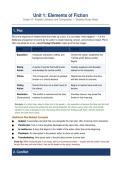
Plot is the sequence of related events that make up a story. It is not simply “what happens” — it is the
deliberate arrangement of events by the author to create meaning, tension, and emotional impact. Plot is
often visualized as an arc, called Freytag's Pyramid, made up of five key stages.
Stage Definition Purpose
Exposition Introduces characters, setting, and Orients the reader; establishes the
background information. "normal world" before conflict
begins.
Rising A series of events that build tension Creates suspense and develops
Action and develop the central conflict. stakes for the characters.
Climax The turning point; moment of greatest Determines the direction the story
tension or a critical decision. will take toward its outcome.
Falling Events that occur as a direct result of Begins to resolve loose ends and
Action the climax. tension.
Resolution The conflict is resolved and the story Provides closure; may reveal the
(Denouement) reaches its conclusion. theme or final meaning.
Example: In a short story about a hiker lost in the woods — the exposition introduces the hiker and the trail;
the rising action shows her getting lost and facing obstacles; the climax occurs when she must decide
whether to cross a dangerous river; the falling action shows her finding a path back; and the resolution
shows her safe return home.
Additional Plot-Related Concepts
● Subplot: A secondary storyline that runs alongside the main plot, often involving minor characters.
● Parallel plot: Two or more storylines developed at the same time, often intersecting.
● In medias res: A story that begins in the middle of the action rather than at the beginning.
● Flashback: An interruption in the present action to show an earlier event.
● Foreshadowing: Hints given early in the plot about events to come later.
Study tip: When analyzing plot in an essay, don't just summarize events — explain why the author structured
the plot this way and what effect it has on the reader or the story's meaning.
2. Conflict
Grade 10 • English Literature and Composition — Detailed Study Notes
1. Plot
Plot is the sequence of related events that make up a story. It is not simply “what happens” — it is the
deliberate arrangement of events by the author to create meaning, tension, and emotional impact. Plot is
often visualized as an arc, called Freytag's Pyramid, made up of five key stages.
Stage Definition Purpose
Exposition Introduces characters, setting, and Orients the reader; establishes the
background information. "normal world" before conflict
begins.
Rising A series of events that build tension Creates suspense and develops
Action and develop the central conflict. stakes for the characters.
Climax The turning point; moment of greatest Determines the direction the story
tension or a critical decision. will take toward its outcome.
Falling Events that occur as a direct result of Begins to resolve loose ends and
Action the climax. tension.
Resolution The conflict is resolved and the story Provides closure; may reveal the
(Denouement) reaches its conclusion. theme or final meaning.
Example: In a short story about a hiker lost in the woods — the exposition introduces the hiker and the trail;
the rising action shows her getting lost and facing obstacles; the climax occurs when she must decide
whether to cross a dangerous river; the falling action shows her finding a path back; and the resolution
shows her safe return home.
Additional Plot-Related Concepts
● Subplot: A secondary storyline that runs alongside the main plot, often involving minor characters.
● Parallel plot: Two or more storylines developed at the same time, often intersecting.
● In medias res: A story that begins in the middle of the action rather than at the beginning.
● Flashback: An interruption in the present action to show an earlier event.
● Foreshadowing: Hints given early in the plot about events to come later.
Study tip: When analyzing plot in an essay, don't just summarize events — explain why the author structured
the plot this way and what effect it has on the reader or the story's meaning.
2. Conflict


