
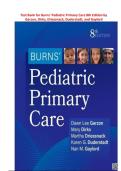
Burns' Pediatric Primary Care, 8th Edition, by Garzon, Dirks, Driessnack, Duderstadt, and Gaylord
Prepare for pediatric primary care coursework and strengthen your understanding of essential pediatric healthcare concepts with this comprehensive study resource based on **Burns' Pediatric Primary Care, 8th Edition**, by **Garzon, Dirks, Driessnack, Duderstadt, and Gaylord**. This resource is designed to support nursing and advanced practice nursing students as they review pediatric primary care concepts and prepare for quizzes, examinations, assignments, and clinical learning. Pediatric primary care is an important area of nursing and advanced practice education that requires students to understand the unique healthcare needs of infants, children, and adolescents. Caring for pediatric patients involves more than recognizing illness. Healthcare professionals must understand normal growth and development, perform age-appropriate assessments, promote wellness, provide preventive care, identify health concerns, educate families, and support children throughout different stages of development. This study resource provides an opportunity to reinforce your understanding of pediatric primary care and review important concepts through practice-based learning. Working through questions and reviewing key topics can help students identify areas that require additional attention while strengthening their ability to apply knowledge to pediatric clinical situations. One of the central areas of pediatric primary care is **growth and development**. Children experience significant physical, cognitive, emotional, and social changes throughout infancy, childhood, and adolescence. Healthcare professionals must understand expected developmental patterns and recognize findings that may indicate a need for further assessment. Reviewing developmental concepts can help students approach pediatric questions more systematically and understand how age and developmental stage influence patient care. **Pediatric health assessment** is another essential area of preparation. Assessing children requires an organized approach that takes into account the child's developmental level, communication abilities, physical condition, and family environment. Students must learn how to gather relevant information, interpret assessment findings, recognize abnormal signs, and determine appropriate priorities. Reviewing these concepts can help learners develop greater confidence when approaching pediatric assessment scenarios. **Health promotion and disease prevention** are fundamental components of pediatric primary care. Nurses and advanced practice providers play an important role in educating children and families about healthy behaviors, preventive services, nutrition, physical activity, safety, and other factors that contribute to lifelong health. Reviewing these areas can help students understand the importance of preventive care and anticipatory guidance in pediatric practice. Family involvement is an essential part of caring for pediatric patients. Parents and caregivers often provide important information about a child's health history, development, behaviors, and daily routines. They may also participate in decision-making and provide ongoing care at home. Students can benefit from reviewing principles of family-centered care and understanding how effective communication can support both the child and the family. Pediatric clinical reasoning requires students to interpret information within the context of the child's age and developmental stage. Signs and symptoms may present differently in children than in adults, and the significance of a finding may vary depending on the patient's developmental level. Practice-based study can help students develop a structured approach to analyzing pediatric health situations and determining appropriate priorities. This resource can also support review of common pediatric health concerns and conditions encountered in primary care settings. Students can use practice material to reinforce their understanding of assessment, diagnosis, treatment considerations, patient education, and follow-up care. The goal is to encourage learners to connect clinical findings with appropriate nursing and healthcare decisions. Another important component of pediatric primary care is **nutrition**. Adequate nutrition is essential for healthy growth and development, and nutritional needs change throughout childhood and adolescence. Students may need to understand age-appropriate nutrition, feeding practices, nutritional assessment, and common nutritional concerns. Reviewing these concepts can help learners develop a stronger understanding of how nutrition contributes to pediatric health. **Pediatric safety and injury prevention** are also important areas of primary care. Healthcare professionals have an opportunity to educate families about age-appropriate safety practices and identify potential risks in a child's environment. Understanding preventive strategies can help students appreciate the role of education and anticipatory guidance in reducing preventable injuries and promoting healthy development. Adolescent healthcare introduces additional considerations. Adolescents experience significant physical, emotional, psychological, and social changes and may have healthcare needs that differ from those of younger children. Effective communication, appropriate health education, respect for privacy, and awareness of adolescent health concerns are important components of comprehensive care. Reviewing adolescent primary care concepts can help students prepare for questions involving this unique stage of development. Students preparing for advanced practice nursing roles may also benefit from reviewing concepts related to clinical decision-making and patient management. Primary care providers must integrate patient history, physical assessment findings, developmental considerations, family information, and evidence-based knowledge when determining appropriate care. Developing these skills is an important part of preparing for future pediatric and family healthcare practice. This resource can be incorporated into different study strategies. Students may use it for independent revision, group study, or focused preparation before an assessment. For independent study, learners can attempt practice questions, review their responses, identify knowledge gaps, and return to relevant textbook chapters or lecture materials. For group study, students can discuss clinical scenarios and compare their reasoning to deepen their understanding. For the most effective preparation, students should avoid relying exclusively on memorization. Instead, focus on understanding why a particular answer or clinical decision is appropriate. When reviewing practice questions, consider the patient's age, developmental stage, presenting findings, safety concerns, and overall clinical priorities. This approach can help develop clinical reasoning skills that are useful beyond a single examination. Students can also use this study resource to identify topics that require additional attention. If you consistently struggle with a particular subject, such as growth and development, health assessment, health promotion, preventive care, or pediatric conditions, return to your textbook and course notes for a more detailed review. Combining practice with comprehensive study can improve knowledge retention and help reinforce difficult concepts. The resource is suitable for students studying pediatric nursing, pediatric primary care, family nurse practitioner programs, and advanced practice nursing courses. It may also be useful for learners who want additional review material as they prepare for academic assessments involving pediatric healthcare. Whether you are beginning your pediatric primary care course or completing your final examination review, organized preparation can help you approach your studies with greater confidence. Use this resource to reinforce important concepts, practice applying your knowledge, identify areas for improvement, and strengthen your understanding of pediatric patient care. The ultimate goal of pediatric primary care education is to prepare students to provide safe, effective, evidence-informed, and family-centered care
Document information
- Uploaded on
- July 26, 2026
- Number of pages
- 135
- Written in
- 2025/2026
- Type
- Exam (elaborations)
- Contains
- Questions & answers


