

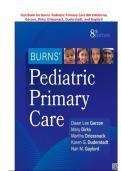
Test Bank for Burns’ Pediatric Primary Care, 8th Edition by Garzon, Dirks, Driessnack, Duderstadt & Gaylord
Strengthen your understanding of pediatric primary care with this comprehensive study resource based on Burns’ Pediatric Primary Care, 8th Edition, by Garzon, Dirks, Driessnack, Duderstadt, and Gaylord. Designed for nursing and advanced practice nursing students, this resource can support your preparation for coursework, quizzes, examinations, clinical discussions, and pediatric primary care review. Pediatric primary care requires a strong foundation in health assessment, growth and development, disease prevention, health promotion, diagnosis, treatment, and family-centered care. Students must learn how to approach pediatric patients at different stages of development while considering physical, psychological, social, cultural, and environmental factors. This study resource is intended to help learners reinforce these important concepts and develop a more organized approach to reviewing pediatric primary care. Using practice-based study material can make revision more active and engaging. Instead of simply reading chapters and attempting to memorize information, students can test their understanding of key concepts, identify areas that need additional attention, and return to their course materials for deeper review. This approach can help reinforce knowledge and improve confidence when preparing for nursing and advanced practice assessments. A major component of pediatric primary care is understanding normal growth and development. Children change rapidly throughout infancy, childhood, and adolescence, and healthcare professionals must recognize expected developmental patterns while identifying findings that may require further evaluation. Reviewing pediatric concepts across different developmental stages can help students understand how age and developmental level influence assessment, communication, health education, and clinical decision-making. The resource can also support review of pediatric health assessment. Effective assessment requires healthcare professionals to gather accurate information, recognize relevant findings, interpret patient history, and consider the child's overall health and development. Pediatric assessment may also involve communication with parents or caregivers, making family participation an important part of the healthcare process. Preventive care and health promotion are essential elements of pediatric primary care. Children and adolescents require age-appropriate health education, preventive services, screening, and guidance to support healthy development. Students preparing for pediatric primary care courses can benefit from reviewing concepts related to prevention, anticipatory guidance, wellness, nutrition, safety, and healthy lifestyle practices. Family-centered care is another important consideration in pediatric healthcare. Unlike adult patients, children often depend on parents or caregivers for information, decision-making, and daily care. Nurses and advanced practice providers must therefore communicate effectively with both the child and the family. Understanding how to involve families while maintaining appropriate communication with pediatric patients is an important part of providing comprehensive care. Pediatric primary care also involves recognizing and managing common health conditions affecting children and adolescents. Students need to develop the ability to connect patient findings with potential health problems and determine appropriate next steps. Practice questions and study materials can help learners strengthen their clinical reasoning by encouraging them to analyze patient information and consider appropriate assessment, diagnosis, intervention, and follow-up. Clinical reasoning is especially important when working with pediatric patients because symptoms and presentations may differ according to age and developmental stage. A finding that is expected in one age group may require additional assessment in another. Developing a structured approach to pediatric clinical scenarios can help students become more confident in recognizing important information and determining appropriate priorities. The study resource can also be useful for reviewing pediatric pharmacology and medication-related considerations. Medication administration in pediatric populations requires careful attention to patient characteristics, appropriate dosing, safety considerations, and monitoring. Students should always use their official course materials and current clinical references when studying medication-related information and preparing for clinical practice. Nutrition is another important aspect of pediatric health. Adequate nutrition supports growth, development, immune function, and overall well-being. Students may benefit from reviewing age-appropriate nutritional needs, feeding considerations, nutritional assessment, and common concerns affecting children and adolescents. Safety and injury prevention are also central to pediatric primary care. Healthcare professionals play an important role in educating families about age-appropriate safety practices and identifying risks that may affect children. Reviewing safety concepts can help students understand the importance of preventive education and the role of healthcare professionals in reducing preventable harm. Adolescent health is an additional area that requires thoughtful consideration. Adolescents may experience unique physical, emotional, behavioral, and social challenges. Effective healthcare requires appropriate communication, respect for privacy, health education, and awareness of issues that may influence adolescent well-being. Students preparing for pediatric primary care assessments can benefit from reviewing these concepts as part of their overall preparation. This resource can be used for both independent and group study. For independent revision, students can work through practice material at their own pace, record topics that are difficult, and return to their textbook or lecture notes for additional review. For group study, classmates can discuss questions, compare reasoning, and identify areas that require further clarification. For best results, students should combine this resource with the official Burns’ Pediatric Primary Care, 8th Edition textbook, course lectures, instructor materials, clinical guidelines, and other authorized educational resources. Practice questions are most valuable when used to reinforce understanding rather than replace comprehensive study. A useful revision strategy is to begin by reviewing the relevant topic, then attempt practice questions without immediately checking the answers. Afterward, carefully review the explanations and identify why an answer is appropriate. If you miss a question, focus on understanding the underlying concept rather than simply memorizing the correct option. This approach can help strengthen long-term retention and clinical reasoning. This study resource may be particularly helpful for students enrolled in pediatric nursing, family nurse practitioner, pediatric primary care, or advanced practice nursing programs. It can support preparation for classroom assessments and provide an additional opportunity to review important pediatric healthcare concepts. Whether you are beginning your pediatric primary care studies or completing your final examination review, consistent practice and active revision can help strengthen your knowledge and confidence. Use the material to identify knowledge gaps, reinforce important concepts, and develop a more systematic approach to pediatric clinical scenarios. The goal of effective preparation is not simply to memorize answers but to understand the reasoning behind pediatric assessment, health promotion, disease prevention, clinical decision-making, and patient-centered care. By combining structured practice with thorough textbook review and instructor guidance, students can build a stronger foundation for academic success and future clinical practice. Important Note: This resource is intended for educational and study purposes and should be used as a supplementary learning aid alongside the official textbook and course materials. It is not affiliated with, sponsored by, or endorsed by the authors, publisher, or any examination provider. No specific examination score or academic outcome is guaranteed.
Document information
- Uploaded on
- July 26, 2026
- Number of pages
- 135
- Written in
- 2025/2026
- Type
- Exam (elaborations)
- Contains
- Questions & answers


