
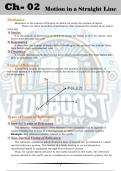
Ch- 02 Motion in a Straight Line
Mechanics
Mechanic is the branch of Physics in which we study the motion of object.
There are three branches of mechanics that examine the motion of an object
such age
1) Statics
It is the branch of mechanics in which we study the object at rest. In statics, time
factor does not play any role.
2) Kinematics
It describes the motion of object without looking at the cause of the motion. Here,
time factor plays an important role.
3) Dynamics
It relates the motion of object to the force which causes them. The time factor also
play an important role.
Frame of Reference
A reference system is required to express the position of a moving particle. A
reference system is a system relative to which the motion of a particle of a particle can
be determined.
𝑌
𝑃 (𝑥, 𝑦, 𝑧)
𝑋
𝑂
𝑍
Types of Frame of Reference
1) Inertial Frame of Reference
The reference system which obeys Newton’s laws of motion and is capable of
understanding the motion of a moving body is called inertial reference system.
Example- Any reference system related to the earth.
2) Non-inertial Frame of Reference
The reference system in which Newton’s laws of motion are not followed is called
inertial reference system. The motion of a body moving at an accelerated or
decelerated speed is explained through this reference system.
Thus, for small objects (relative to the earth) located on the earth, the reference
system related to the earth can be considered as an inertial reference system, but for
1
, celestial bodies such as the sun, planets and satellites, the earth is an non-inertial
reference system.
State of Rest
If the position of an object does not change with time, then this position of the
object is called rest. Example- A book placed on the table is at rest, because the position
of the book relative to the table does not change with time.
State of Motion
If the position of an object changes with respect to time, then this position of the
object is called dynamic state and this phenomenon is called motion.
Example- moving person, flowing water, motion of celestial bodies relative to the
sun etc. Motion is classified as follows
Motion
Depending on the nature Based on required
of the path coordinates
Rectilinear Circular Oscillatory One-dimensional Three-dimensional
Motion Motion Motion Motion Motion
Two-dimensional
Motion
Depending on the nature of the path
1) Rectilinear and Translatory Motion
When a particle moves along a straight line, then such motion of the particle
is called rectilinear motion and when an object (not a particle) moves in a straight
line, then its motion is called translational motion.
Example- Motion of an object on an inclined plane, motion of a train moving
on a straight track.
2) Circular and Rotatory Motion
If a particle moves on a circular path, then this type of motion of the particle
is called circular motion and when an object moves around a fixed axis in such a
way that every particle of the object moves on a circular path and the center of all
circular paths is on its axis, then the motion of the object is called rotational
motion. Example- wheel, rotation of the earth around its axis.
2
, 3) Oscillatory and Vibratory Motion
When a particle moves around a point in a point in a periodic motion, up
and down or to and fro motion, this type of motion of the object is called
oscillatory motion.
The maximum displacement of the oscillating particle towards its mean
position is called amplitude. If the amplitude is less, then its motion is called
vibratory motion. Example- Motion of a clock oscillator.
Based on required coordinates
1) One-dimensional Motion
The motion of an object is considered as 1-D if only one coordinate is needed to
specify the position of the object.
𝑂
−𝑋 𝑋
𝑥
In 1-D motion, the object moves along a straight line. In this type of motion, there are
only two directions (backward and forward, upward and downward) in which an object
moves and these directions are specified by and – signs.
Example- A boy running on a straight road, etc.
2) Two-dimensional Motion
The motion of an object is considered as 2-D if two coordinates are needed to
specify the position of the object. In 2-D motion, the object moves in a plane.
Example- A satellite revolving around the earth, etc.
𝑌
𝑀
(𝑥, 𝑦)
𝑋
3) Three-dimensional Motion
The motion of an object is considered as 3-D if all the three coordinates are needed
to specify the position of the object. This type of motion takes place in three-
dimensional space. Example- Butterfly flying in garden, the motion of water
molecules, etc.
𝑌
𝑀
(𝑥, 𝑦, 𝑧)
𝑋
𝑍
3
Mechanics
Mechanic is the branch of Physics in which we study the motion of object.
There are three branches of mechanics that examine the motion of an object
such age
1) Statics
It is the branch of mechanics in which we study the object at rest. In statics, time
factor does not play any role.
2) Kinematics
It describes the motion of object without looking at the cause of the motion. Here,
time factor plays an important role.
3) Dynamics
It relates the motion of object to the force which causes them. The time factor also
play an important role.
Frame of Reference
A reference system is required to express the position of a moving particle. A
reference system is a system relative to which the motion of a particle of a particle can
be determined.
𝑌
𝑃 (𝑥, 𝑦, 𝑧)
𝑋
𝑂
𝑍
Types of Frame of Reference
1) Inertial Frame of Reference
The reference system which obeys Newton’s laws of motion and is capable of
understanding the motion of a moving body is called inertial reference system.
Example- Any reference system related to the earth.
2) Non-inertial Frame of Reference
The reference system in which Newton’s laws of motion are not followed is called
inertial reference system. The motion of a body moving at an accelerated or
decelerated speed is explained through this reference system.
Thus, for small objects (relative to the earth) located on the earth, the reference
system related to the earth can be considered as an inertial reference system, but for
1
, celestial bodies such as the sun, planets and satellites, the earth is an non-inertial
reference system.
State of Rest
If the position of an object does not change with time, then this position of the
object is called rest. Example- A book placed on the table is at rest, because the position
of the book relative to the table does not change with time.
State of Motion
If the position of an object changes with respect to time, then this position of the
object is called dynamic state and this phenomenon is called motion.
Example- moving person, flowing water, motion of celestial bodies relative to the
sun etc. Motion is classified as follows
Motion
Depending on the nature Based on required
of the path coordinates
Rectilinear Circular Oscillatory One-dimensional Three-dimensional
Motion Motion Motion Motion Motion
Two-dimensional
Motion
Depending on the nature of the path
1) Rectilinear and Translatory Motion
When a particle moves along a straight line, then such motion of the particle
is called rectilinear motion and when an object (not a particle) moves in a straight
line, then its motion is called translational motion.
Example- Motion of an object on an inclined plane, motion of a train moving
on a straight track.
2) Circular and Rotatory Motion
If a particle moves on a circular path, then this type of motion of the particle
is called circular motion and when an object moves around a fixed axis in such a
way that every particle of the object moves on a circular path and the center of all
circular paths is on its axis, then the motion of the object is called rotational
motion. Example- wheel, rotation of the earth around its axis.
2
, 3) Oscillatory and Vibratory Motion
When a particle moves around a point in a point in a periodic motion, up
and down or to and fro motion, this type of motion of the object is called
oscillatory motion.
The maximum displacement of the oscillating particle towards its mean
position is called amplitude. If the amplitude is less, then its motion is called
vibratory motion. Example- Motion of a clock oscillator.
Based on required coordinates
1) One-dimensional Motion
The motion of an object is considered as 1-D if only one coordinate is needed to
specify the position of the object.
𝑂
−𝑋 𝑋
𝑥
In 1-D motion, the object moves along a straight line. In this type of motion, there are
only two directions (backward and forward, upward and downward) in which an object
moves and these directions are specified by and – signs.
Example- A boy running on a straight road, etc.
2) Two-dimensional Motion
The motion of an object is considered as 2-D if two coordinates are needed to
specify the position of the object. In 2-D motion, the object moves in a plane.
Example- A satellite revolving around the earth, etc.
𝑌
𝑀
(𝑥, 𝑦)
𝑋
3) Three-dimensional Motion
The motion of an object is considered as 3-D if all the three coordinates are needed
to specify the position of the object. This type of motion takes place in three-
dimensional space. Example- Butterfly flying in garden, the motion of water
molecules, etc.
𝑌
𝑀
(𝑥, 𝑦, 𝑧)
𝑋
𝑍
3


