

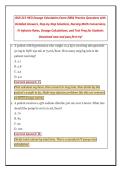
BSN 215 HESI Dosage Calculation Exam 200Q Practice Questions with
Detailed Answers, Step-by-Step Solutions, Nursing Math Conversions,
IV Infusion Rates, Dosage Calculations, and Test Prep for Students
Download now and pass first try!
1. A patient with hypertension who weighs 72.4 kg is receiving nitroprusside
50 mg in D5W 250 mL at 75 mL/hour. How many mcg/kg/min is the
patient receiving?
A. 2.1
B. 2.8
C. 3.5
D. 4.0
Correct answer: C.
First calculate mg/hour, then convert to mcg/min, then divide by the
patient’s weight in kg. Multi-step infusion problems like this are common
on HESI dosage exams.
2. A patient receives 0.45% sodium chloride 500 mL over 6 hours. What rate
should the pump be set to in mL/hour?
A. 70
B. 83
C. 92
D. 100
Correct answer: B.
Divide total volume by total time. This is a standard IV pump-rate
calculation.
,3. How many mL/hour should be infused if 1000 mL is ordered over 8 hours?
A. 100
B. 110
C. 125
D. 150
Correct answer: C.
1000 divided by 8 equals 125 mL/hour. Straight infusion-rate questions
are a core HESI skill.
4. How many mL/hour should be infused if 250 mL is ordered over 5 hours?
A. 40
B. 45
C. 50
D. 60
Correct answer: C.
250 divided by 5 equals 50 mL/hour. This is a direct pump-rate
calculation.
5. The provider orders 500 mg of a medication. The vial contains 250 mg per
5 mL. How many mL should the nurse give?
A. 5
B. 8
C. 10
D. 12
Correct answer: C.
500 mg is twice 250 mg, so the volume is twice 5 mL. Ratio and
proportion questions like this are frequent on HESI exams.
6. The order is 1 gram of a medication. The supply is 500 mg per tablet. How
many tablets should be given?
, A. 1
B. 2
C. 3
D. 4
Correct answer: B.
Convert 1 gram to 1000 mg, then divide by 500 mg per tablet. Unit
conversion before dose calculation is essential.
7. The nurse must give 0.5 g of a drug. The available dose is 250 mg per tablet.
How many tablets are needed?
A. 1
B. 2
C. 3
D. 4
Correct answer: B.
0.5 g equals 500 mg, and 500 divided by 250 equals 2 tablets. This is a
common conversion-based question.
8. A medication order reads 750 mg. The available concentration is 250 mg
per 5 mL. How many mL are needed?
A. 10
B. 12.5
C. 15
D. 20
Correct answer: C.
750 mg is three times 250 mg, so multiply 5 mL by 3. This is a standard
proportional calculation.
9. The order is 20 mg. The vial contains 10 mg/mL. How many mL should be
given?
, A. 1
B. 2
C. 3
D. 4
Correct answer: B.
Divide the ordered dose by the concentration. This simple conversion
appears often on dosage exams.
10. A patient is prescribed 2.5 mg of a medication. The available solution
is 5 mg/mL. How many mL should be administered?
A. 0.25
B. 0.5
C. 1
D. 2
Correct answer: B.
2.5 mg divided by 5 mg/mL equals 0.5 mL. Decimal-dose questions are
common in HESI math.
11. The nurse is asked to administer 125 mg. The supply is 50 mg per 2 mL.
How many mL are required?
A. 3
B. 4
C. 5
D. 6
Correct answer: C.
125 mg is 2.5 times 50 mg, so multiply 2 mL by 2.5. Ratio reasoning is a
major part of dosage calculations.
12. A patient receives 2 liters of fluid over 10 hours. What is the infusion rate in
mL/hour?
Detailed Answers, Step-by-Step Solutions, Nursing Math Conversions,
IV Infusion Rates, Dosage Calculations, and Test Prep for Students
Download now and pass first try!
1. A patient with hypertension who weighs 72.4 kg is receiving nitroprusside
50 mg in D5W 250 mL at 75 mL/hour. How many mcg/kg/min is the
patient receiving?
A. 2.1
B. 2.8
C. 3.5
D. 4.0
Correct answer: C.
First calculate mg/hour, then convert to mcg/min, then divide by the
patient’s weight in kg. Multi-step infusion problems like this are common
on HESI dosage exams.
2. A patient receives 0.45% sodium chloride 500 mL over 6 hours. What rate
should the pump be set to in mL/hour?
A. 70
B. 83
C. 92
D. 100
Correct answer: B.
Divide total volume by total time. This is a standard IV pump-rate
calculation.
,3. How many mL/hour should be infused if 1000 mL is ordered over 8 hours?
A. 100
B. 110
C. 125
D. 150
Correct answer: C.
1000 divided by 8 equals 125 mL/hour. Straight infusion-rate questions
are a core HESI skill.
4. How many mL/hour should be infused if 250 mL is ordered over 5 hours?
A. 40
B. 45
C. 50
D. 60
Correct answer: C.
250 divided by 5 equals 50 mL/hour. This is a direct pump-rate
calculation.
5. The provider orders 500 mg of a medication. The vial contains 250 mg per
5 mL. How many mL should the nurse give?
A. 5
B. 8
C. 10
D. 12
Correct answer: C.
500 mg is twice 250 mg, so the volume is twice 5 mL. Ratio and
proportion questions like this are frequent on HESI exams.
6. The order is 1 gram of a medication. The supply is 500 mg per tablet. How
many tablets should be given?
, A. 1
B. 2
C. 3
D. 4
Correct answer: B.
Convert 1 gram to 1000 mg, then divide by 500 mg per tablet. Unit
conversion before dose calculation is essential.
7. The nurse must give 0.5 g of a drug. The available dose is 250 mg per tablet.
How many tablets are needed?
A. 1
B. 2
C. 3
D. 4
Correct answer: B.
0.5 g equals 500 mg, and 500 divided by 250 equals 2 tablets. This is a
common conversion-based question.
8. A medication order reads 750 mg. The available concentration is 250 mg
per 5 mL. How many mL are needed?
A. 10
B. 12.5
C. 15
D. 20
Correct answer: C.
750 mg is three times 250 mg, so multiply 5 mL by 3. This is a standard
proportional calculation.
9. The order is 20 mg. The vial contains 10 mg/mL. How many mL should be
given?
, A. 1
B. 2
C. 3
D. 4
Correct answer: B.
Divide the ordered dose by the concentration. This simple conversion
appears often on dosage exams.
10. A patient is prescribed 2.5 mg of a medication. The available solution
is 5 mg/mL. How many mL should be administered?
A. 0.25
B. 0.5
C. 1
D. 2
Correct answer: B.
2.5 mg divided by 5 mg/mL equals 0.5 mL. Decimal-dose questions are
common in HESI math.
11. The nurse is asked to administer 125 mg. The supply is 50 mg per 2 mL.
How many mL are required?
A. 3
B. 4
C. 5
D. 6
Correct answer: C.
125 mg is 2.5 times 50 mg, so multiply 2 mL by 2.5. Ratio reasoning is a
major part of dosage calculations.
12. A patient receives 2 liters of fluid over 10 hours. What is the infusion rate in
mL/hour?


