

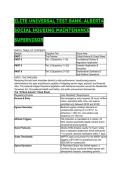
ELITE UNIVERSAL TEST BANK: ALBERTA
SOCIAL HOUSING MAINTENANCE
SUPERVISOR
PART 0: TABLE OF CONTENTS
Section Cognitive Tier Focus Area
PART I The Preview Critical Axioms & Cheat Sheet
PART II Tier 1 (Questions 1–10) Foundational Syntax &
Regulatory Application
PART II Tier 2 (Questions 11–20) Complex Application &
Simulation
PART II Tier 3 (Questions 21–30) Grandmaster Synthesis &
High-Stakes Operations
PART I: THE PREVIEW
Mastering this test bank translates directly to elite performance, transforming passive
administrators into apex practitioners capable of mitigating severe legal, physical, and financial
risks. The material bridges theoretical legislation with field-level execution across the Residential
Tenancies Act, Occupational Health and Safety, and public procurement frameworks.
The "Critical Axioms" Cheat Sheet
Regulatory Domain Core Standard / Requirement
Access & Entry Non-emergency entry requires 24 hours' written
notice, specifying date, time, and reason,
permitted only between 08:00 and 20:00.
Egress Geometry Bedroom egress windows demand an
unobstructed opening of ≥ 0.35 m², no
dimension < 380 mm, and window well
clearance of ≥ 760 mm.
Altitude Triggers Fall protection is mandated at 3 metres (10
feet); passive guardrails legally outrank active
personal fall arrest systems.
Toxic Protocols Alberta OHS dictates exactly 72 hours' notice
prior to asbestos abatement; blood lead levels
> 0.5 µmol/L demand notification within 7 days.
Trade Thresholds NWPTA open procurement for the MASH sector
triggers at $75,000 for goods/services and
$200,000 for construction.
Space Dynamics A Restricted Space has limited egress; a
Confined Space combines limited egress with
atmospheric hazards, mandating permits.
,PART II: THE ELITE TEST BANK
Q1: A tenant in a subsidized social housing complex submits a written complaint that their
bedroom is uncomfortably cold during winter nights. Based on the Alberta Minimum Housing
and Health Standards, what is the MOST ACCURATE legal temperature requirement the
heating system must satisfy? A) The system must maintain a minimum of 20°C across all living
spaces during winter months. B) The system must be capable of heating all living spaces to
22°C, though it may drop to 16°C if the primary furnace fails during extreme weather. C) The
system must be capable of safely maintaining a minimum indoor temperature of 22°C at all
times. D) The system must maintain 24°C in bedrooms and 20°C in common areas to comply
with adult care housing guidelines.
● The Answer: C (The system must be capable of safely maintaining a minimum indoor
temperature of 22°C at all times.)
● Distractor Analysis:
○ A is incorrect: 20°C falls below the provincial statutory requirement established by
the Public Health Act.
○ B is incorrect: While 16°C is cited as an extreme-weather survival baseline for
failing systems, the legal requirement for the heating system's baseline capability is
unequivocally 22°C.
○ D is incorrect: The legislation applies a uniform 22°C standard across the entire
living space, devoid of variable temperature zones for different rooms.
The Mentor's Analysis: Alberta's extreme winters dictate that heating is a critical life-safety
parameter, not a comfort amenity. The Public Health Act and Minimum Housing Standards draw
an absolute line at 22°C. By enforcing this threshold, the practitioner avoids tenant disputes and
Environmental Public Health interventions. Professional/Academic Intuition: Never negotiate
the 22°C threshold; if the HVAC cannot sustain it, the system is legally non-compliant
and requires immediate capital intervention.
Q2: A contractor installs new egress windows in a family housing complex basement. The new
windows feature an unobstructed opening of 0.36 m², with a height of 350 mm and a width of
1030 mm. Based on the National Building Code (Alberta Edition), which conclusion is MOST
ACCURATE? A) The window is compliant because the total area (0.36 m²) exceeds the 0.35 m²
minimum requirement. B) The window is compliant because horizontal slider windows are
exempt from minimum height requirements as long as the area is sufficient. C) The window is
non-compliant because no single clear dimension can be less than 380 mm, regardless of the
total open area. D) The window is non-compliant because egress windows must have a total
unobstructed area of at least 0.50 m².
● The Answer: C (The window is non-compliant because no single clear dimension can be
less than 380 mm, regardless of the total open area.)
● Distractor Analysis:
○ A is incorrect: Meeting the total area requirement is insufficient if the minimum
dimension rule is violated.
○ B is incorrect: There are no architectural exemptions for slider windows regarding
the rigid 380 mm dimension rule.
○ D is incorrect: The statutory minimum required area is precisely 0.35 m², not 0.50
m².
The Mentor's Analysis: Egress mathematics require both gross area and strict dimensional
geometry to function. A window can fulfill the square footage requirement but fail egress if it is
too narrow to allow a fully equipped firefighter to pass through.
| Egress Parameter | Alberta Statutory Minimum |
, | :--- | :--- | | Unobstructed Area | 0.35 m² (3.77 sq. ft.) | | Minimum Dimension | 380 mm (15
inches) | | Window Well Clearance | 760 mm (30 inches) |
Professional/Academic Intuition: Egress compliance operates as a dual-lock system:
Area ≥ 0.35 m² AND Minimum Dimension ≥ 380 mm. A failure in either metric renders the
installation illegal.
Q3: A Housing Management Body (HMB) initiates a project to replace the roofs on four
community housing townhomes. The estimated cost is $215,000. Under the New West
Partnership Trade Agreement (NWPTA), what is the MOST APPROPRIATE procurement
action? A) The project must be publicly tendered on the Alberta Purchasing Connection (APC)
because it exceeds the $200,000 construction threshold for the MASH sector. B) The project
can be sole-sourced to a local vendor because it falls under the $250,000 inter-provincial trade
limit for municipalities. C) The project must be publicly tendered because it exceeds the $75,000
general services threshold. D) The project requires three verbal quotes because NWPTA does
not apply to social housing bodies.
● The Answer: A (The project must be publicly tendered on the Alberta Purchasing
Connection (APC) because it exceeds the $200,000 construction threshold for the MASH
sector.)
● Distractor Analysis:
○ B is incorrect: The NWPTA construction threshold for the MASH sector
(Municipalities, Academic, Schools, Health, encompassing HMBs) is strictly
$200,000, not $250,000.
○ C is incorrect: Roofing constitutes a construction contract, which carries a $200,000
threshold, overriding the $75,000 threshold applied to basic goods and services.
○ D is incorrect: HMBs are heavily regulated under the MASH sector rules of NWPTA
and are bound to open procurement laws.
The Mentor's Analysis: Public funds demand public transparency. Categorizing the
procurement type accurately is the fundamental step in applying the correct NWPTA threshold.
Misclassifying construction as a general service, or failing to tender above the threshold,
exposes the organization to bid protests and audits. Professional/Academic Intuition: MASH
Sector NWPTA Rule: Goods/Services trigger at $75,000; Construction triggers at
$200,000. When thresholds are breached, open tendering is non-negotiable.
Q4: According to the Residential Tenancies Act (RTA) in Alberta, a landlord must provide proper
notice to enter a unit for non-emergency repairs. Which of the following notices is legally
VALID? A) A written notice served 12 hours in advance, stating entry between 09:00 and 11:00
to fix a dripping faucet. B) A written notice served 48 hours in advance, stating entry between
08:00 and 17:00 on a Sunday, unless the tenant's day of worship is Saturday. C) A written notice
served 24 hours in advance, stating entry between 10:00 and 14:00 on a Tuesday to repair a
broken window latch. D) A verbal notice given 24 hours in advance, confirmed via text message,
stating entry between 13:00 and 15:00 on a Wednesday.
● The Answer: C (A written notice served 24 hours in advance, stating entry between
10:00 and 14:00 on a Tuesday to repair a broken window latch.)
● Distractor Analysis:
○ A is incorrect: The statutory notice period requires a minimum of 24 hours,
rendering 12 hours legally void.
○ B is incorrect: The RTA expressly forbids entry on a holiday or the tenant's day of
worship. Sunday is the default day of worship unless the tenant provides written
notice otherwise.
○ D is incorrect: The RTA strictly demands formal written notice bearing a signature;
SOCIAL HOUSING MAINTENANCE
SUPERVISOR
PART 0: TABLE OF CONTENTS
Section Cognitive Tier Focus Area
PART I The Preview Critical Axioms & Cheat Sheet
PART II Tier 1 (Questions 1–10) Foundational Syntax &
Regulatory Application
PART II Tier 2 (Questions 11–20) Complex Application &
Simulation
PART II Tier 3 (Questions 21–30) Grandmaster Synthesis &
High-Stakes Operations
PART I: THE PREVIEW
Mastering this test bank translates directly to elite performance, transforming passive
administrators into apex practitioners capable of mitigating severe legal, physical, and financial
risks. The material bridges theoretical legislation with field-level execution across the Residential
Tenancies Act, Occupational Health and Safety, and public procurement frameworks.
The "Critical Axioms" Cheat Sheet
Regulatory Domain Core Standard / Requirement
Access & Entry Non-emergency entry requires 24 hours' written
notice, specifying date, time, and reason,
permitted only between 08:00 and 20:00.
Egress Geometry Bedroom egress windows demand an
unobstructed opening of ≥ 0.35 m², no
dimension < 380 mm, and window well
clearance of ≥ 760 mm.
Altitude Triggers Fall protection is mandated at 3 metres (10
feet); passive guardrails legally outrank active
personal fall arrest systems.
Toxic Protocols Alberta OHS dictates exactly 72 hours' notice
prior to asbestos abatement; blood lead levels
> 0.5 µmol/L demand notification within 7 days.
Trade Thresholds NWPTA open procurement for the MASH sector
triggers at $75,000 for goods/services and
$200,000 for construction.
Space Dynamics A Restricted Space has limited egress; a
Confined Space combines limited egress with
atmospheric hazards, mandating permits.
,PART II: THE ELITE TEST BANK
Q1: A tenant in a subsidized social housing complex submits a written complaint that their
bedroom is uncomfortably cold during winter nights. Based on the Alberta Minimum Housing
and Health Standards, what is the MOST ACCURATE legal temperature requirement the
heating system must satisfy? A) The system must maintain a minimum of 20°C across all living
spaces during winter months. B) The system must be capable of heating all living spaces to
22°C, though it may drop to 16°C if the primary furnace fails during extreme weather. C) The
system must be capable of safely maintaining a minimum indoor temperature of 22°C at all
times. D) The system must maintain 24°C in bedrooms and 20°C in common areas to comply
with adult care housing guidelines.
● The Answer: C (The system must be capable of safely maintaining a minimum indoor
temperature of 22°C at all times.)
● Distractor Analysis:
○ A is incorrect: 20°C falls below the provincial statutory requirement established by
the Public Health Act.
○ B is incorrect: While 16°C is cited as an extreme-weather survival baseline for
failing systems, the legal requirement for the heating system's baseline capability is
unequivocally 22°C.
○ D is incorrect: The legislation applies a uniform 22°C standard across the entire
living space, devoid of variable temperature zones for different rooms.
The Mentor's Analysis: Alberta's extreme winters dictate that heating is a critical life-safety
parameter, not a comfort amenity. The Public Health Act and Minimum Housing Standards draw
an absolute line at 22°C. By enforcing this threshold, the practitioner avoids tenant disputes and
Environmental Public Health interventions. Professional/Academic Intuition: Never negotiate
the 22°C threshold; if the HVAC cannot sustain it, the system is legally non-compliant
and requires immediate capital intervention.
Q2: A contractor installs new egress windows in a family housing complex basement. The new
windows feature an unobstructed opening of 0.36 m², with a height of 350 mm and a width of
1030 mm. Based on the National Building Code (Alberta Edition), which conclusion is MOST
ACCURATE? A) The window is compliant because the total area (0.36 m²) exceeds the 0.35 m²
minimum requirement. B) The window is compliant because horizontal slider windows are
exempt from minimum height requirements as long as the area is sufficient. C) The window is
non-compliant because no single clear dimension can be less than 380 mm, regardless of the
total open area. D) The window is non-compliant because egress windows must have a total
unobstructed area of at least 0.50 m².
● The Answer: C (The window is non-compliant because no single clear dimension can be
less than 380 mm, regardless of the total open area.)
● Distractor Analysis:
○ A is incorrect: Meeting the total area requirement is insufficient if the minimum
dimension rule is violated.
○ B is incorrect: There are no architectural exemptions for slider windows regarding
the rigid 380 mm dimension rule.
○ D is incorrect: The statutory minimum required area is precisely 0.35 m², not 0.50
m².
The Mentor's Analysis: Egress mathematics require both gross area and strict dimensional
geometry to function. A window can fulfill the square footage requirement but fail egress if it is
too narrow to allow a fully equipped firefighter to pass through.
| Egress Parameter | Alberta Statutory Minimum |
, | :--- | :--- | | Unobstructed Area | 0.35 m² (3.77 sq. ft.) | | Minimum Dimension | 380 mm (15
inches) | | Window Well Clearance | 760 mm (30 inches) |
Professional/Academic Intuition: Egress compliance operates as a dual-lock system:
Area ≥ 0.35 m² AND Minimum Dimension ≥ 380 mm. A failure in either metric renders the
installation illegal.
Q3: A Housing Management Body (HMB) initiates a project to replace the roofs on four
community housing townhomes. The estimated cost is $215,000. Under the New West
Partnership Trade Agreement (NWPTA), what is the MOST APPROPRIATE procurement
action? A) The project must be publicly tendered on the Alberta Purchasing Connection (APC)
because it exceeds the $200,000 construction threshold for the MASH sector. B) The project
can be sole-sourced to a local vendor because it falls under the $250,000 inter-provincial trade
limit for municipalities. C) The project must be publicly tendered because it exceeds the $75,000
general services threshold. D) The project requires three verbal quotes because NWPTA does
not apply to social housing bodies.
● The Answer: A (The project must be publicly tendered on the Alberta Purchasing
Connection (APC) because it exceeds the $200,000 construction threshold for the MASH
sector.)
● Distractor Analysis:
○ B is incorrect: The NWPTA construction threshold for the MASH sector
(Municipalities, Academic, Schools, Health, encompassing HMBs) is strictly
$200,000, not $250,000.
○ C is incorrect: Roofing constitutes a construction contract, which carries a $200,000
threshold, overriding the $75,000 threshold applied to basic goods and services.
○ D is incorrect: HMBs are heavily regulated under the MASH sector rules of NWPTA
and are bound to open procurement laws.
The Mentor's Analysis: Public funds demand public transparency. Categorizing the
procurement type accurately is the fundamental step in applying the correct NWPTA threshold.
Misclassifying construction as a general service, or failing to tender above the threshold,
exposes the organization to bid protests and audits. Professional/Academic Intuition: MASH
Sector NWPTA Rule: Goods/Services trigger at $75,000; Construction triggers at
$200,000. When thresholds are breached, open tendering is non-negotiable.
Q4: According to the Residential Tenancies Act (RTA) in Alberta, a landlord must provide proper
notice to enter a unit for non-emergency repairs. Which of the following notices is legally
VALID? A) A written notice served 12 hours in advance, stating entry between 09:00 and 11:00
to fix a dripping faucet. B) A written notice served 48 hours in advance, stating entry between
08:00 and 17:00 on a Sunday, unless the tenant's day of worship is Saturday. C) A written notice
served 24 hours in advance, stating entry between 10:00 and 14:00 on a Tuesday to repair a
broken window latch. D) A verbal notice given 24 hours in advance, confirmed via text message,
stating entry between 13:00 and 15:00 on a Wednesday.
● The Answer: C (A written notice served 24 hours in advance, stating entry between
10:00 and 14:00 on a Tuesday to repair a broken window latch.)
● Distractor Analysis:
○ A is incorrect: The statutory notice period requires a minimum of 24 hours,
rendering 12 hours legally void.
○ B is incorrect: The RTA expressly forbids entry on a holiday or the tenant's day of
worship. Sunday is the default day of worship unless the tenant provides written
notice otherwise.
○ D is incorrect: The RTA strictly demands formal written notice bearing a signature;


