

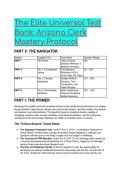
The Elite Universal Test
Bank: Arizona Clerk
Mastery Protocol
PART 0: THE NAVIGATOR
Section Cognitive Tier Focus Area Question Range
PART I The Primer Critical Axioms, N/A
Statutory Matrices, &
Baseline Heuristics
PART II Tier 1: Foundational Core Statutory Q1 – Q10
Syntax Definitions (A.R.S.,
ACJA, Rule 123, OML)
PART II Tier 2: Complex Variable Shifts in Q11 – Q20
Application Elections, Time
Computation, and
Public Records
PART II Tier 3: Grandmaster Multi-Jurisdictional Q21 – Q30
Synthesis Crises & Competing
Statute Scenarios
PART I: THE PRIMER
Mastering this specific test bank translates directly to elite professional performance by bridging
the gap between rigid Arizona statutory law and the high-stakes, rapid-fire realities of municipal
and superior court administration. This gauntlet forges an analytical intuition capable of
navigating complex public records mandates, strict electoral timelines, and the unforgiving
mechanics of the Arizona Open Meeting Law (OML) and judicial codes of conduct.
The "Critical Axioms" Cheat Sheet
● The Signature Preemption Law: Under A.R.S. § 16-311, a candidate's Statement of
Interest MUST be filed before a single nomination petition signature is collected; any
signature collected prior to this filing is legally void and subject to challenge.
● The Commercial PRR Mandate: Under A.R.S. § 39-121.03, obtaining public records for
a commercial purpose without disclosing it is a Class 6 felony, triggering civil damages
equal to three times the actual/charged costs.
● The Rule 123 Redaction Shield: In Arizona Superior Courts, the responsibility for
identifying and sealing confidential documents rests solely with the filer, not the Clerk of
the Court, though the Clerk enforces broad access exceptions for social security and
, financial data.
● The Rule 6(a) Time Paradox: When calculating court deadlines under Arizona Rules of
Civil Procedure Rule 6(a), if the prescribed period is less than 11 days, intermediate
Saturdays, Sundays, and legal holidays are strictly excluded from the computation.
● The OML 3/24 Rule: Public meeting agendas must be posted at least 24 hours in
advance (excluding Sundays and holidays). Draft minutes or a recording MUST be
available within three working days post-meeting.
Arizona Clerk Statutory Deadline Matrix
Statute / Rule Event Trigger Mandatory Deadline Jurisdictional
Applicability
A.R.S. § 38-431.02 Finalized Meeting 24 Hours prior Municipal / Public
Agenda (excluding Bodies
Sundays/Holidays)
A.R.S. § 38-431.01 Meeting Adjournment 3 Working Days (for Municipal / Public
draft minutes/audio) Bodies
A.R.S. § 9-471 Annexation Blank 30-Day Waiting Period Municipal Clerks
Petition Filed (Hearing in last 10
days)
A.R.S. § 16-311 Election Nomination 150 to 120 Days prior Municipal & County
Window to the Primary Election Clerks
ARCP Rule 6(b) Late Notice of 30 Days post-expiry Superior Court Clerks
Judgment OR 7 Days post-notice
PART II: THE ELITE TEST BANK
Q1: A municipal council in Arizona adjourns its regular public meeting at 10:00 PM on a
Thursday. The following Monday is a recognized state holiday. Based on the principles of A.R.S.
§ 38-431.01 regarding Open Meeting Law, which deadline for public inspection of the meeting
minutes is the MOST ACCURATE? A) The clerk must provide approved, finalized minutes by
the end of business on Monday. B) The clerk must make a recording or draft minutes available
by the end of business on Wednesday. C) The clerk must make a recording or draft minutes
available by the end of business on Tuesday. D) The clerk has ten working days to provide a
summarized statement of legal actions.
● The Answer: B (The clerk must make a recording or draft minutes available by the end of
business on Wednesday.)
● Distractor Analysis:
○ A is incorrect: The statute requires draft minutes or a recording, not necessarily
approved minutes within this window. Furthermore, weekends and holidays are
strictly excluded from the "working days" calculation.
○ C is incorrect: Tuesday would only be the second working day. Friday is day one,
Monday is a holiday, Tuesday is day two, making Wednesday the third working day.
○ D is incorrect: The ten-working-day metric applies specifically to subcommittees or
advisory committees posting statements of legal action, not the primary public
body's minutes.
The Mentor's Analysis: The "Three Working Day" rule is the absolute hard deck for public
accountability under the Open Meeting Law. When calculating post-meeting deliverables,
, immediately isolate and remove weekends and state holidays from the timeline. By utilizing the
working day computation protocol, you bypass the common trap of missing statutory
transparency deadlines. Professional/Academic Intuition: Clock the working days strictly;
Friday is day one, Tuesday is two, Wednesday is three.
Q2: A private investigative firm requests thousands of civil case files from the Clerk of the
Superior Court to compile a database for resale to background check agencies. Based on the
principles of Arizona Supreme Court Rule 123, which action by the Clerk is MOST
APPROPRIATE? A) Fulfill the request immediately at no charge, as civil case files are
inherently public records. B) Deny the request entirely, as Rule 123 strictly prohibits the resale of
court data by third parties. C) Require a verified statement of commercial purpose and charge a
fee covering redaction, equipment, and staff time. D) Route the request to the governor's office
to determine if the resale constitutes an abuse of public records under A.R.S. § 39-121.
● The Answer: C (Require a verified statement of commercial purpose and charge a fee
covering redaction, equipment, and staff time.)
● Distractor Analysis:
○ A is incorrect: This is a commercial request. Rule 123 draws a rigid distinction;
commercial requests permit the Clerk to charge for search, redaction, and
reproduction costs, unlike non-commercial requests.
○ B is incorrect: Rule 123 does not prohibit commercial use; it regulates it and
ensures the court recovers the administrative costs of bulk data dissemination.
○ D is incorrect: While A.R.S. § 39-121.03 allows municipal/state agencies to apply to
the governor for commercial misuse determinations , Rule 123 independently
governs the judicial branch and empowers the Clerk to assess commercial fees
directly without executive branch intervention.
The Mentor's Analysis: The judicial branch operates on a separate axis from standard
municipal agencies regarding public records. When facing a massive data request destined for
resale, the immediate priority is statutory cost recovery. By utilizing the commercial purpose fee
matrix of Rule 123, you bypass the common trap of subsidizing private enterprise with
taxpayer-funded court resources. Professional/Academic Intuition: Rule 123 governs the
courts; commercial requests demand verified statements and full administrative cost
recovery.
Q3: A mayoral candidate files their Statement of Interest with the City Clerk on June 5th. The
candidate subsequently submits nomination petitions containing 500 signatures on July 10th.
During validation, the Clerk notes that 150 of those signatures were dated between June 1st
and June 4th. Based on the principles of A.R.S. § 16-311, what is the MOST LOGICAL
outcome? A) All 500 signatures are accepted because they were submitted together during the
official 150-120 day filing window. B) The 150 signatures are invalidated because they were
collected prior to the filing of the Statement of Interest. C) The Clerk must notify the candidate
and grant a 10-day cure period to re-collect the 150 signatures. D) The entire nomination
petition is rejected outright for containing fraudulent dates.
● The Answer: B (The 150 signatures are invalidated because they were collected prior to
the filing of the Statement of Interest.)
● Distractor Analysis:
○ A is incorrect: Signatures gathered before the Statement of Interest is officially filed
are explicitly invalid and subject to challenge under Arizona election law.
○ C is incorrect: There is no statutory "cure period" for signatures collected
prematurely; they are simply stricken from the total valid count.
○ D is incorrect: The premature signatures do not inherently invalidate the remaining
Bank: Arizona Clerk
Mastery Protocol
PART 0: THE NAVIGATOR
Section Cognitive Tier Focus Area Question Range
PART I The Primer Critical Axioms, N/A
Statutory Matrices, &
Baseline Heuristics
PART II Tier 1: Foundational Core Statutory Q1 – Q10
Syntax Definitions (A.R.S.,
ACJA, Rule 123, OML)
PART II Tier 2: Complex Variable Shifts in Q11 – Q20
Application Elections, Time
Computation, and
Public Records
PART II Tier 3: Grandmaster Multi-Jurisdictional Q21 – Q30
Synthesis Crises & Competing
Statute Scenarios
PART I: THE PRIMER
Mastering this specific test bank translates directly to elite professional performance by bridging
the gap between rigid Arizona statutory law and the high-stakes, rapid-fire realities of municipal
and superior court administration. This gauntlet forges an analytical intuition capable of
navigating complex public records mandates, strict electoral timelines, and the unforgiving
mechanics of the Arizona Open Meeting Law (OML) and judicial codes of conduct.
The "Critical Axioms" Cheat Sheet
● The Signature Preemption Law: Under A.R.S. § 16-311, a candidate's Statement of
Interest MUST be filed before a single nomination petition signature is collected; any
signature collected prior to this filing is legally void and subject to challenge.
● The Commercial PRR Mandate: Under A.R.S. § 39-121.03, obtaining public records for
a commercial purpose without disclosing it is a Class 6 felony, triggering civil damages
equal to three times the actual/charged costs.
● The Rule 123 Redaction Shield: In Arizona Superior Courts, the responsibility for
identifying and sealing confidential documents rests solely with the filer, not the Clerk of
the Court, though the Clerk enforces broad access exceptions for social security and
, financial data.
● The Rule 6(a) Time Paradox: When calculating court deadlines under Arizona Rules of
Civil Procedure Rule 6(a), if the prescribed period is less than 11 days, intermediate
Saturdays, Sundays, and legal holidays are strictly excluded from the computation.
● The OML 3/24 Rule: Public meeting agendas must be posted at least 24 hours in
advance (excluding Sundays and holidays). Draft minutes or a recording MUST be
available within three working days post-meeting.
Arizona Clerk Statutory Deadline Matrix
Statute / Rule Event Trigger Mandatory Deadline Jurisdictional
Applicability
A.R.S. § 38-431.02 Finalized Meeting 24 Hours prior Municipal / Public
Agenda (excluding Bodies
Sundays/Holidays)
A.R.S. § 38-431.01 Meeting Adjournment 3 Working Days (for Municipal / Public
draft minutes/audio) Bodies
A.R.S. § 9-471 Annexation Blank 30-Day Waiting Period Municipal Clerks
Petition Filed (Hearing in last 10
days)
A.R.S. § 16-311 Election Nomination 150 to 120 Days prior Municipal & County
Window to the Primary Election Clerks
ARCP Rule 6(b) Late Notice of 30 Days post-expiry Superior Court Clerks
Judgment OR 7 Days post-notice
PART II: THE ELITE TEST BANK
Q1: A municipal council in Arizona adjourns its regular public meeting at 10:00 PM on a
Thursday. The following Monday is a recognized state holiday. Based on the principles of A.R.S.
§ 38-431.01 regarding Open Meeting Law, which deadline for public inspection of the meeting
minutes is the MOST ACCURATE? A) The clerk must provide approved, finalized minutes by
the end of business on Monday. B) The clerk must make a recording or draft minutes available
by the end of business on Wednesday. C) The clerk must make a recording or draft minutes
available by the end of business on Tuesday. D) The clerk has ten working days to provide a
summarized statement of legal actions.
● The Answer: B (The clerk must make a recording or draft minutes available by the end of
business on Wednesday.)
● Distractor Analysis:
○ A is incorrect: The statute requires draft minutes or a recording, not necessarily
approved minutes within this window. Furthermore, weekends and holidays are
strictly excluded from the "working days" calculation.
○ C is incorrect: Tuesday would only be the second working day. Friday is day one,
Monday is a holiday, Tuesday is day two, making Wednesday the third working day.
○ D is incorrect: The ten-working-day metric applies specifically to subcommittees or
advisory committees posting statements of legal action, not the primary public
body's minutes.
The Mentor's Analysis: The "Three Working Day" rule is the absolute hard deck for public
accountability under the Open Meeting Law. When calculating post-meeting deliverables,
, immediately isolate and remove weekends and state holidays from the timeline. By utilizing the
working day computation protocol, you bypass the common trap of missing statutory
transparency deadlines. Professional/Academic Intuition: Clock the working days strictly;
Friday is day one, Tuesday is two, Wednesday is three.
Q2: A private investigative firm requests thousands of civil case files from the Clerk of the
Superior Court to compile a database for resale to background check agencies. Based on the
principles of Arizona Supreme Court Rule 123, which action by the Clerk is MOST
APPROPRIATE? A) Fulfill the request immediately at no charge, as civil case files are
inherently public records. B) Deny the request entirely, as Rule 123 strictly prohibits the resale of
court data by third parties. C) Require a verified statement of commercial purpose and charge a
fee covering redaction, equipment, and staff time. D) Route the request to the governor's office
to determine if the resale constitutes an abuse of public records under A.R.S. § 39-121.
● The Answer: C (Require a verified statement of commercial purpose and charge a fee
covering redaction, equipment, and staff time.)
● Distractor Analysis:
○ A is incorrect: This is a commercial request. Rule 123 draws a rigid distinction;
commercial requests permit the Clerk to charge for search, redaction, and
reproduction costs, unlike non-commercial requests.
○ B is incorrect: Rule 123 does not prohibit commercial use; it regulates it and
ensures the court recovers the administrative costs of bulk data dissemination.
○ D is incorrect: While A.R.S. § 39-121.03 allows municipal/state agencies to apply to
the governor for commercial misuse determinations , Rule 123 independently
governs the judicial branch and empowers the Clerk to assess commercial fees
directly without executive branch intervention.
The Mentor's Analysis: The judicial branch operates on a separate axis from standard
municipal agencies regarding public records. When facing a massive data request destined for
resale, the immediate priority is statutory cost recovery. By utilizing the commercial purpose fee
matrix of Rule 123, you bypass the common trap of subsidizing private enterprise with
taxpayer-funded court resources. Professional/Academic Intuition: Rule 123 governs the
courts; commercial requests demand verified statements and full administrative cost
recovery.
Q3: A mayoral candidate files their Statement of Interest with the City Clerk on June 5th. The
candidate subsequently submits nomination petitions containing 500 signatures on July 10th.
During validation, the Clerk notes that 150 of those signatures were dated between June 1st
and June 4th. Based on the principles of A.R.S. § 16-311, what is the MOST LOGICAL
outcome? A) All 500 signatures are accepted because they were submitted together during the
official 150-120 day filing window. B) The 150 signatures are invalidated because they were
collected prior to the filing of the Statement of Interest. C) The Clerk must notify the candidate
and grant a 10-day cure period to re-collect the 150 signatures. D) The entire nomination
petition is rejected outright for containing fraudulent dates.
● The Answer: B (The 150 signatures are invalidated because they were collected prior to
the filing of the Statement of Interest.)
● Distractor Analysis:
○ A is incorrect: Signatures gathered before the Statement of Interest is officially filed
are explicitly invalid and subject to challenge under Arizona election law.
○ C is incorrect: There is no statutory "cure period" for signatures collected
prematurely; they are simply stricken from the total valid count.
○ D is incorrect: The premature signatures do not inherently invalidate the remaining


