

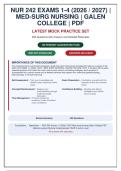
NUR 242 EXAMS 1-4 () |
MED-SURG NURSING | GALEN
COLLEGE | PDF
LATEST MOCK PRACTICE SET
250 Questions with Answers and Detailed Rationales
100 PERCENT GUARANTEED PASS
INSTANT DOWNLOAD ANSWERS INCLUDED
IMPORTANCE OF THIS DOCUMENT
This comprehensive examination preparation guide has been meticulously developed to help you succeed in the
NUR 242 EXAMS 1-4 () | MED-SURG NURSING | GALEN COLLEGE | PDF. It contains 250 carefully
selected questions that reflect the most current exam content and testing strategies. Each question is
accompanied by a correct answer and a detailed rationale that explains the underlying pathophysiology,
pharmacology, or clinical reasoning.
Self-Assessment – Test your knowledge and Exam Preparation – Familiarize yourself with the
identify areas requiring further question format and content
study areas
Concept Reinforcement – Deepen your Confidence Building – Develop test-taking
understanding through strategies and reduce
evidence-based exam anxiety
rationales
Time Management – Practice answering
questions under simulated
exam conditions
Review Summary 250 Questions
Foundations - Application - NUR 242 Exams 1 4 Med-surg Nursing Galen College PDF
Medical-surgical Nursing Undergraduate YEAR 3 Junior Level
All answers with rationales
,Table of Contents
Section A - Perioperative Nursing Section B - Fluid Electrolyte AND
Questions 1 to 63 Acid-base Balance
Questions 64 to 126
Section C - PAIN Management Section D - Respiratory Disorders
Questions 127 to 189 Questions 190 to 250
,Section A - Perioperative Nursing
Q1.
In a patient with chronic kidney disease stage 4, which combination of lab findings most
reliably indicates the need to initiate dialysis before symptoms occur?
A. Glomerular filtration rate (GFR) 20 B. GFR 15 mL/min/1.73m², serum
mL/min/1.73m², serum creatinine 4.5 creatinine 6.0 mg/dL, potassium 5.5 mEq/L
mg/dL, potassium 5.0 mEq/L
C. GFR 12 mL/min/1.73m², serum D. GFR 8 mL/min/1.73m², serum creatinine
creatinine 5.0 mg/dL, potassium 4.8 mEq/L, 7.0 mg/dL, potassium 5.2 mEq/L,
hemoglobin 9 g/dL bicarbonate 18 mEq/L
Correct: D - GFR 8 mL/min/1.73m², serum creatinine 7.0 mg/dL, potassium 5.2 mEq/L,
bicarbonate 18 mEq/L
Rationale:Dialysis is typically indicated when GFR falls below 10 mL/min/1.73m² or when
uremic symptoms, refractory hyperkalemia, or severe acidosis occur. Option D shows the
lowest GFR and the presence of metabolic acidosis (bicarbonate 18 mEq/L), meeting criteria.
Option A and B have higher GFRs; option C lacks acidosis or severe hyperkalemia.
Q2.
A patient with septic shock requires vasopressor support. Which hemodynamic profile
best indicates that adding an inotrope (e.g., dobutamine) is necessary?
A. Mean arterial pressure (MAP) 65 mmHg, B. MAP 60 mmHg, CI 2.0 L/min/m², SVR
cardiac index (CI) 3.0 L/min/m², systemic 900 dyn-s/cm
vascular resistance (SVR) 600 dyn-s/cm
C. MAP 70 mmHg, CI 2.5 L/min/m², SVR D. MAP 55 mmHg, CI 3.5 L/min/m², SVR
800 dyn-s/cm 400 dyn-s/cm
Correct: B - MAP 60 mmHg, CI 2.0 L/min/m², SVR 900 dyn-s/cm
Rationale:Addition of an inotrope is indicated when there is low cardiac output (CI < 2.2
L/min/m²) despite adequate MAP. Option B shows low CI (2.0) and high SVR
(vasoconstriction), suggesting pump failure. Option A has normal CI; option C has borderline
CI; option D shows distributive shock with low SVR and high CI, which typically requires
vasopressors alone.
Q3.
Which of the following best explains why angiotensin-converting enzyme inhibitors
(ACEIs) are preferred over angiotensin II receptor blockers (ARBs) in patients with heart
failure with reduced ejection fraction (HFrEF) and concomitant chronic kidney disease?
Page 3
, Section A - Perioperative Nursing
A. ACEIs provide greater reduction in blood B. ACEIs have a more favorable side effect
pressure. profile regarding hyperkalemia.
C. ACEIs increase bradykinin levels, which D. ARBs are contraindicated in patients with
may offer additional cardiorenal protection. renal impairment.
Correct: C - ACEIs increase bradykinin levels, which may offer additional cardiorenal
protection.
Rationale:ACEIs inhibit the breakdown of bradykinin, leading to increased levels that promote
vasodilation and have antiproliferative effects, potentially offering additional cardiorenal
protection beyond blood pressure control. ARBs do not affect bradykinin. While ACEIs may
cause cough, they are not necessarily better at reducing BP; hyperkalemia risk is similar;
ARBs are not contraindicated in renal impairment.
Q4.
A patient with acute respiratory distress syndrome (ARDS) is on volume-controlled
ventilation with plateau pressure 32 cmHO and PaO/FiO ratio 150. Which intervention is
most likely to improve oxygenation without increasing ventilator-induced lung injury?
A. Increase positive end-expiratory pressure B. Increase tidal volume to 8 mL/kg
(PEEP) to recruit alveoli. predicted body weight.
C. Switch to pressure-controlled ventilation D. Administer a neuromuscular blocking
with same mean airway pressure. agent without changing settings.
Correct: A - Increase positive end-expiratory pressure (PEEP) to recruit alveoli.
Rationale:In ARDS, lung-protective ventilation uses low tidal volumes (6 mL/kg) and
adequate PEEP to prevent atelectrauma. Increasing PEEP can improve oxygenation by
recruiting collapsed alveoli, without increasing plateau pressure if compliance improves.
Increasing tidal volume (B) increases risk of volutrauma. Switching modes (C) does not
necessarily reduce injury. Neuromuscular blockers (D) may improve synchrony but do not
directly improve oxygenation.
Q5.
A patient with cirrhosis and ascites develops spontaneous bacterial peritonitis (SBP).
Which of the following findings is most consistent with this diagnosis?
A. Ascitic fluid absolute neutrophil count 150 B. Ascitic fluid absolute neutrophil count 350
cells/µL, protein 2.5 g/dL, culture negative. cells/µL, protein 1.0 g/dL, culture positive for
Escherichia coli.
C. Ascitic fluid absolute neutrophil count 50 D. Ascitic fluid absolute neutrophil count 500
cells/µL, protein 3.0 g/dL, culture negative. cells/µL, protein 2.0 g/dL, culture positive for
Bacteroides fragilis.
Correct: B - Ascitic fluid absolute neutrophil count 350 cells/µL, protein 1.0 g/dL, culture
Page 4
MED-SURG NURSING | GALEN
COLLEGE | PDF
LATEST MOCK PRACTICE SET
250 Questions with Answers and Detailed Rationales
100 PERCENT GUARANTEED PASS
INSTANT DOWNLOAD ANSWERS INCLUDED
IMPORTANCE OF THIS DOCUMENT
This comprehensive examination preparation guide has been meticulously developed to help you succeed in the
NUR 242 EXAMS 1-4 () | MED-SURG NURSING | GALEN COLLEGE | PDF. It contains 250 carefully
selected questions that reflect the most current exam content and testing strategies. Each question is
accompanied by a correct answer and a detailed rationale that explains the underlying pathophysiology,
pharmacology, or clinical reasoning.
Self-Assessment – Test your knowledge and Exam Preparation – Familiarize yourself with the
identify areas requiring further question format and content
study areas
Concept Reinforcement – Deepen your Confidence Building – Develop test-taking
understanding through strategies and reduce
evidence-based exam anxiety
rationales
Time Management – Practice answering
questions under simulated
exam conditions
Review Summary 250 Questions
Foundations - Application - NUR 242 Exams 1 4 Med-surg Nursing Galen College PDF
Medical-surgical Nursing Undergraduate YEAR 3 Junior Level
All answers with rationales
,Table of Contents
Section A - Perioperative Nursing Section B - Fluid Electrolyte AND
Questions 1 to 63 Acid-base Balance
Questions 64 to 126
Section C - PAIN Management Section D - Respiratory Disorders
Questions 127 to 189 Questions 190 to 250
,Section A - Perioperative Nursing
Q1.
In a patient with chronic kidney disease stage 4, which combination of lab findings most
reliably indicates the need to initiate dialysis before symptoms occur?
A. Glomerular filtration rate (GFR) 20 B. GFR 15 mL/min/1.73m², serum
mL/min/1.73m², serum creatinine 4.5 creatinine 6.0 mg/dL, potassium 5.5 mEq/L
mg/dL, potassium 5.0 mEq/L
C. GFR 12 mL/min/1.73m², serum D. GFR 8 mL/min/1.73m², serum creatinine
creatinine 5.0 mg/dL, potassium 4.8 mEq/L, 7.0 mg/dL, potassium 5.2 mEq/L,
hemoglobin 9 g/dL bicarbonate 18 mEq/L
Correct: D - GFR 8 mL/min/1.73m², serum creatinine 7.0 mg/dL, potassium 5.2 mEq/L,
bicarbonate 18 mEq/L
Rationale:Dialysis is typically indicated when GFR falls below 10 mL/min/1.73m² or when
uremic symptoms, refractory hyperkalemia, or severe acidosis occur. Option D shows the
lowest GFR and the presence of metabolic acidosis (bicarbonate 18 mEq/L), meeting criteria.
Option A and B have higher GFRs; option C lacks acidosis or severe hyperkalemia.
Q2.
A patient with septic shock requires vasopressor support. Which hemodynamic profile
best indicates that adding an inotrope (e.g., dobutamine) is necessary?
A. Mean arterial pressure (MAP) 65 mmHg, B. MAP 60 mmHg, CI 2.0 L/min/m², SVR
cardiac index (CI) 3.0 L/min/m², systemic 900 dyn-s/cm
vascular resistance (SVR) 600 dyn-s/cm
C. MAP 70 mmHg, CI 2.5 L/min/m², SVR D. MAP 55 mmHg, CI 3.5 L/min/m², SVR
800 dyn-s/cm 400 dyn-s/cm
Correct: B - MAP 60 mmHg, CI 2.0 L/min/m², SVR 900 dyn-s/cm
Rationale:Addition of an inotrope is indicated when there is low cardiac output (CI < 2.2
L/min/m²) despite adequate MAP. Option B shows low CI (2.0) and high SVR
(vasoconstriction), suggesting pump failure. Option A has normal CI; option C has borderline
CI; option D shows distributive shock with low SVR and high CI, which typically requires
vasopressors alone.
Q3.
Which of the following best explains why angiotensin-converting enzyme inhibitors
(ACEIs) are preferred over angiotensin II receptor blockers (ARBs) in patients with heart
failure with reduced ejection fraction (HFrEF) and concomitant chronic kidney disease?
Page 3
, Section A - Perioperative Nursing
A. ACEIs provide greater reduction in blood B. ACEIs have a more favorable side effect
pressure. profile regarding hyperkalemia.
C. ACEIs increase bradykinin levels, which D. ARBs are contraindicated in patients with
may offer additional cardiorenal protection. renal impairment.
Correct: C - ACEIs increase bradykinin levels, which may offer additional cardiorenal
protection.
Rationale:ACEIs inhibit the breakdown of bradykinin, leading to increased levels that promote
vasodilation and have antiproliferative effects, potentially offering additional cardiorenal
protection beyond blood pressure control. ARBs do not affect bradykinin. While ACEIs may
cause cough, they are not necessarily better at reducing BP; hyperkalemia risk is similar;
ARBs are not contraindicated in renal impairment.
Q4.
A patient with acute respiratory distress syndrome (ARDS) is on volume-controlled
ventilation with plateau pressure 32 cmHO and PaO/FiO ratio 150. Which intervention is
most likely to improve oxygenation without increasing ventilator-induced lung injury?
A. Increase positive end-expiratory pressure B. Increase tidal volume to 8 mL/kg
(PEEP) to recruit alveoli. predicted body weight.
C. Switch to pressure-controlled ventilation D. Administer a neuromuscular blocking
with same mean airway pressure. agent without changing settings.
Correct: A - Increase positive end-expiratory pressure (PEEP) to recruit alveoli.
Rationale:In ARDS, lung-protective ventilation uses low tidal volumes (6 mL/kg) and
adequate PEEP to prevent atelectrauma. Increasing PEEP can improve oxygenation by
recruiting collapsed alveoli, without increasing plateau pressure if compliance improves.
Increasing tidal volume (B) increases risk of volutrauma. Switching modes (C) does not
necessarily reduce injury. Neuromuscular blockers (D) may improve synchrony but do not
directly improve oxygenation.
Q5.
A patient with cirrhosis and ascites develops spontaneous bacterial peritonitis (SBP).
Which of the following findings is most consistent with this diagnosis?
A. Ascitic fluid absolute neutrophil count 150 B. Ascitic fluid absolute neutrophil count 350
cells/µL, protein 2.5 g/dL, culture negative. cells/µL, protein 1.0 g/dL, culture positive for
Escherichia coli.
C. Ascitic fluid absolute neutrophil count 50 D. Ascitic fluid absolute neutrophil count 500
cells/µL, protein 3.0 g/dL, culture negative. cells/µL, protein 2.0 g/dL, culture positive for
Bacteroides fragilis.
Correct: B - Ascitic fluid absolute neutrophil count 350 cells/µL, protein 1.0 g/dL, culture
Page 4


