
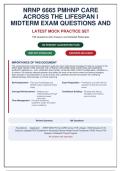
NRNP 6665 PMHNP CARE
ACROSS THE LIFESPAN I
MIDTERM EXAM QUESTIONS AND
LATEST MOCK PRACTICE SET
199 Questions with Answers and Detailed Rationales
100 PERCENT GUARANTEED PASS
INSTANT DOWNLOAD ANSWERS INCLUDED
IMPORTANCE OF THIS DOCUMENT
This comprehensive examination preparation guide has been meticulously developed to help you succeed in the
NRNP 6665 PMHNP CARE ACROSS THE LIFESPAN I MIDTERM EXAM QUESTIONS AND ANSWERS
ALREADY GRADED A+. 100% VERIFIED SOLUTIONS | UPDATED PER LATEST GUIDELINES | GRADED A+.
It contains 199 carefully selected questions that reflect the most current exam content and testing strategies.
Each question is accompanied by a correct answer and a detailed rationale that explains the underlying
pathophysiology, pharmacology, or clinical reasoning.
Self-Assessment – Test your knowledge and Exam Preparation – Familiarize yourself with the
identify areas requiring further question format and content
study areas
Concept Reinforcement – Deepen your Confidence Building – Develop test-taking
understanding through strategies and reduce
evidence-based exam anxiety
rationales
Time Management – Practice answering
questions under simulated
exam conditions
Review Summary 199 Questions
Foundations - Application - NRNP 6665 Pmhnp CARE Across THE Lifespan I AND Already A 100
Solutions Updated PER Guidelines A Psychiatric Mental Health Nurse Practitioner CARE Across THE
Lifespan I Graduate Pmhnp Program
All answers with rationales
,Table of Contents
Section A - Disorder Section B - Appropriate
Questions 1 to 50 Questions 51 to 100
Section C - Bipolar Section D - Evidence
Questions 101 to 150 Questions 151 to 199
,Section A - Disorder
Q1.
Which neurobiological mechanism best explains the delayed onset of therapeutic
response to SSRIs in major depressive disorder?
A. Immediate blockade of serotonin B. Desensitization of presynaptic 5-HT1A
reuptake leads to rapid increase in synaptic autoreceptors and downstream
serotonin. neuroplasticity.
C. Upregulation of postsynaptic serotonin D. Inhibition of monoamine oxidase A
receptors within 24 hours. causing serotonin accumulation.
Correct: B - Desensitization of presynaptic 5-HT1A autoreceptors and downstream
neuroplasticity.
Rationale:SSRIs block SERT, but the therapeutic lag is due to the time required for
desensitization of presynaptic 5-HT1A autoreceptors, which then allows sustained serotonin
release and neuroplastic changes. Options A and C are incorrect because immediate effects
do not correlate with clinical response; D describes MAOIs, not SSRIs.
Q2.
A patient with no cardiac history requires rapid tranquilization for acute agitation. Which
combination of medications is safest given the risk of QTc prolongation?
A. Haloperidol 5 mg IM plus lorazepam 2 mg B. Olanzapine 10 mg IM plus lorazepam 2
IM mg IM
C. Ziprasidone 20 mg IM plus benztropine 1 D. Droperidol 2.5 mg IM plus midazolam 5
mg IM mg IM
Correct: A - Haloperidol 5 mg IM plus lorazepam 2 mg IM
Rationale:Haloperidol has a lower risk of QTc prolongation compared to ziprasidone and
droperidol, and lorazepam does not affect QTc. Olanzapine IM is not recommended with
benzodiazepines due to risk of hypotension and excessive sedation. Droperidol has a black
box warning for QTc prolongation.
Q3.
In a patient with bipolar I disorder experiencing a mixed episode, which mood stabilizer is
most appropriate as monotherapy?
A. Lithium carbonate B. Valproate semisodium (divalproex)
C. Carbamazepine D. Lamotrigine
Page 3
, Section A - Disorder
Correct: B - Valproate semisodium (divalproex)
Rationale:Valproate is first-line for mixed episodes due to its efficacy in both manic and
depressive symptoms. Lithium is more effective for classic euphoric mania, lamotrigine is
primarily for maintenance and bipolar depression, and carbamazepine is second-line due to
drug interactions and side effects.
Q4.
Which pharmacokinetic change associated with aging most significantly impacts the
dosing of psychotropic medications in older adults?
A. Increased renal clearance of B. Decreased hepatic first-pass metabolism
water-soluble drugs leading to higher bioavailability
C. Reduced volume of distribution for D. Increased albumin levels reducing free
lipophilic drugs drug concentration
Correct: B - Decreased hepatic first-pass metabolism leading to higher bioavailability
Rationale:Aging reduces hepatic blood flow and enzyme activity, decreasing first-pass
metabolism and increasing bioavailability of drugs like benzodiazepines and antidepressants.
Renal clearance decreases (not increases), volume of distribution for lipophilic drugs
increases (not decreases), and albumin decreases (not increases).
Q5.
A patient with treatment-resistant schizophrenia has failed adequate trials of two
antipsychotics. Which augmentation strategy has the strongest evidence?
A. Adding a benzodiazepine such as B. Switching to clozapine monotherapy
clonazepam
C. Adding valproate to current antipsychotic D. Augmenting with lamotrigine
Correct: B - Switching to clozapine monotherapy
Rationale:Clozapine is the gold standard for treatment-resistant schizophrenia, with superior
efficacy over other antipsychotics. Augmentation with benzodiazepines, valproate, or
lamotrigine has limited evidence and is not first-line after inadequate response to two
antipsychotics.
Q6.
A patient on long-term lithium therapy develops polyuria and polydipsia. Which
intervention is most appropriate?
A. Switch to sustained-release lithium B. Add hydrochlorothiazide 25 mg daily
formulation
Page 4
ACROSS THE LIFESPAN I
MIDTERM EXAM QUESTIONS AND
LATEST MOCK PRACTICE SET
199 Questions with Answers and Detailed Rationales
100 PERCENT GUARANTEED PASS
INSTANT DOWNLOAD ANSWERS INCLUDED
IMPORTANCE OF THIS DOCUMENT
This comprehensive examination preparation guide has been meticulously developed to help you succeed in the
NRNP 6665 PMHNP CARE ACROSS THE LIFESPAN I MIDTERM EXAM QUESTIONS AND ANSWERS
ALREADY GRADED A+. 100% VERIFIED SOLUTIONS | UPDATED PER LATEST GUIDELINES | GRADED A+.
It contains 199 carefully selected questions that reflect the most current exam content and testing strategies.
Each question is accompanied by a correct answer and a detailed rationale that explains the underlying
pathophysiology, pharmacology, or clinical reasoning.
Self-Assessment – Test your knowledge and Exam Preparation – Familiarize yourself with the
identify areas requiring further question format and content
study areas
Concept Reinforcement – Deepen your Confidence Building – Develop test-taking
understanding through strategies and reduce
evidence-based exam anxiety
rationales
Time Management – Practice answering
questions under simulated
exam conditions
Review Summary 199 Questions
Foundations - Application - NRNP 6665 Pmhnp CARE Across THE Lifespan I AND Already A 100
Solutions Updated PER Guidelines A Psychiatric Mental Health Nurse Practitioner CARE Across THE
Lifespan I Graduate Pmhnp Program
All answers with rationales
,Table of Contents
Section A - Disorder Section B - Appropriate
Questions 1 to 50 Questions 51 to 100
Section C - Bipolar Section D - Evidence
Questions 101 to 150 Questions 151 to 199
,Section A - Disorder
Q1.
Which neurobiological mechanism best explains the delayed onset of therapeutic
response to SSRIs in major depressive disorder?
A. Immediate blockade of serotonin B. Desensitization of presynaptic 5-HT1A
reuptake leads to rapid increase in synaptic autoreceptors and downstream
serotonin. neuroplasticity.
C. Upregulation of postsynaptic serotonin D. Inhibition of monoamine oxidase A
receptors within 24 hours. causing serotonin accumulation.
Correct: B - Desensitization of presynaptic 5-HT1A autoreceptors and downstream
neuroplasticity.
Rationale:SSRIs block SERT, but the therapeutic lag is due to the time required for
desensitization of presynaptic 5-HT1A autoreceptors, which then allows sustained serotonin
release and neuroplastic changes. Options A and C are incorrect because immediate effects
do not correlate with clinical response; D describes MAOIs, not SSRIs.
Q2.
A patient with no cardiac history requires rapid tranquilization for acute agitation. Which
combination of medications is safest given the risk of QTc prolongation?
A. Haloperidol 5 mg IM plus lorazepam 2 mg B. Olanzapine 10 mg IM plus lorazepam 2
IM mg IM
C. Ziprasidone 20 mg IM plus benztropine 1 D. Droperidol 2.5 mg IM plus midazolam 5
mg IM mg IM
Correct: A - Haloperidol 5 mg IM plus lorazepam 2 mg IM
Rationale:Haloperidol has a lower risk of QTc prolongation compared to ziprasidone and
droperidol, and lorazepam does not affect QTc. Olanzapine IM is not recommended with
benzodiazepines due to risk of hypotension and excessive sedation. Droperidol has a black
box warning for QTc prolongation.
Q3.
In a patient with bipolar I disorder experiencing a mixed episode, which mood stabilizer is
most appropriate as monotherapy?
A. Lithium carbonate B. Valproate semisodium (divalproex)
C. Carbamazepine D. Lamotrigine
Page 3
, Section A - Disorder
Correct: B - Valproate semisodium (divalproex)
Rationale:Valproate is first-line for mixed episodes due to its efficacy in both manic and
depressive symptoms. Lithium is more effective for classic euphoric mania, lamotrigine is
primarily for maintenance and bipolar depression, and carbamazepine is second-line due to
drug interactions and side effects.
Q4.
Which pharmacokinetic change associated with aging most significantly impacts the
dosing of psychotropic medications in older adults?
A. Increased renal clearance of B. Decreased hepatic first-pass metabolism
water-soluble drugs leading to higher bioavailability
C. Reduced volume of distribution for D. Increased albumin levels reducing free
lipophilic drugs drug concentration
Correct: B - Decreased hepatic first-pass metabolism leading to higher bioavailability
Rationale:Aging reduces hepatic blood flow and enzyme activity, decreasing first-pass
metabolism and increasing bioavailability of drugs like benzodiazepines and antidepressants.
Renal clearance decreases (not increases), volume of distribution for lipophilic drugs
increases (not decreases), and albumin decreases (not increases).
Q5.
A patient with treatment-resistant schizophrenia has failed adequate trials of two
antipsychotics. Which augmentation strategy has the strongest evidence?
A. Adding a benzodiazepine such as B. Switching to clozapine monotherapy
clonazepam
C. Adding valproate to current antipsychotic D. Augmenting with lamotrigine
Correct: B - Switching to clozapine monotherapy
Rationale:Clozapine is the gold standard for treatment-resistant schizophrenia, with superior
efficacy over other antipsychotics. Augmentation with benzodiazepines, valproate, or
lamotrigine has limited evidence and is not first-line after inadequate response to two
antipsychotics.
Q6.
A patient on long-term lithium therapy develops polyuria and polydipsia. Which
intervention is most appropriate?
A. Switch to sustained-release lithium B. Add hydrochlorothiazide 25 mg daily
formulation
Page 4


