

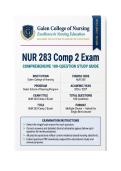
,NUR 283 Comp 2 Exam – Transition to RN Practice
– Actual Q&A (GCN) (Updated PDF)
1. The nurse receives hand-off report on four clients. Which client should the
nurse assess first?
A) A client who had an ERCP 30 minutes ago and reports difficulty swallowing
B) A client with COPD on 2 L oxygen with SpO₂ 93%
C) A client with diabetes mellitus awaiting pre-meal insulin
D) A client scheduled for discharge teaching about warfarin
Correct Answer: A) A client who had an ERCP 30 minutes ago and reports
difficulty swallowing
Rationale: The ABC framework prioritizes airway. After an ERCP, the gag reflex
may be absent, posing a risk for aspiration. Difficulty swallowing indicates
potential airway compromise, requiring immediate assessment. Other clients
have less urgent needs.
2. A pediatric nurse is reviewing assignments. Which client should the nurse see
first?
A) A toddler with bronchiolitis on room air and mild wheezing
B) An infant with pertussis receiving oxygen via nasal cannula
C) A preschooler with otitis media awaiting discharge
D) A school-age child in a cast for a simple fracture
Correct Answer: B) An infant with pertussis receiving oxygen via nasal cannula
,Rationale: Infants with pertussis are at high risk for apnea and severe
respiratory compromise. Any child on supplemental oxygen with a respiratory
diagnosis takes priority over stable conditions. Airway and breathing needs
come first.
3. The charge nurse is making assignments for the day. Which task is most
appropriate to delegate to a certified nursing assistant (CNA)?
A) Administering oral medications to a stable client
B) Performing a sterile wound dressing change
C) One-on-one client observation for safety
D) Assessing a client’s lung sounds after a thoracentesis
Correct Answer: C) One-on-one client observation for safety
Rationale: Safety observation is within the CNA/UAP scope of practice.
Medication administration, sterile procedures, and physical assessments require
nursing judgment and are not delegable to unlicensed personnel.
4. A student nurse is preparing to administer medications. The nurse should
intervene if the student plans to administer Maalox at the same time as:
A) Metoprolol
B) Furosemide
C) Iron
D) Levothyroxine
Correct Answer: C) Iron
, Rationale: Antacids like Maalox decrease the absorption of iron when taken
simultaneously. The doses should be separated by at least one to two hours.
Administering them together would interfere with iron efficacy and is an error.
5. A client with terminal cancer says, “If God could only let me live long enough
to see my daughter graduate, I would not complain about the pain.” This
statement reflects which stage of grieving?
A) Denial
B) Anger
C) Bargaining
D) Depression
Correct Answer: C) Bargaining
Rationale: Bargaining is an attempt to negotiate for more time or a reprieve,
often with a higher power. The client’s statement expresses a deal with God to
reach a milestone. It is distinct from denial or depression.
6. Four clients recently returned from invasive diagnostic testing. The nurse
should immediately intervene for which client?
A) A client resting quietly after a liver biopsy
B) A client flexing and extending the legs two hours after a cardiac
catheterization
C) A client reporting mild discomfort at the bronchoscopy site
D) A client with blood pressure 118/76 after a thoracentesis
– Actual Q&A (GCN) (Updated PDF)
1. The nurse receives hand-off report on four clients. Which client should the
nurse assess first?
A) A client who had an ERCP 30 minutes ago and reports difficulty swallowing
B) A client with COPD on 2 L oxygen with SpO₂ 93%
C) A client with diabetes mellitus awaiting pre-meal insulin
D) A client scheduled for discharge teaching about warfarin
Correct Answer: A) A client who had an ERCP 30 minutes ago and reports
difficulty swallowing
Rationale: The ABC framework prioritizes airway. After an ERCP, the gag reflex
may be absent, posing a risk for aspiration. Difficulty swallowing indicates
potential airway compromise, requiring immediate assessment. Other clients
have less urgent needs.
2. A pediatric nurse is reviewing assignments. Which client should the nurse see
first?
A) A toddler with bronchiolitis on room air and mild wheezing
B) An infant with pertussis receiving oxygen via nasal cannula
C) A preschooler with otitis media awaiting discharge
D) A school-age child in a cast for a simple fracture
Correct Answer: B) An infant with pertussis receiving oxygen via nasal cannula
,Rationale: Infants with pertussis are at high risk for apnea and severe
respiratory compromise. Any child on supplemental oxygen with a respiratory
diagnosis takes priority over stable conditions. Airway and breathing needs
come first.
3. The charge nurse is making assignments for the day. Which task is most
appropriate to delegate to a certified nursing assistant (CNA)?
A) Administering oral medications to a stable client
B) Performing a sterile wound dressing change
C) One-on-one client observation for safety
D) Assessing a client’s lung sounds after a thoracentesis
Correct Answer: C) One-on-one client observation for safety
Rationale: Safety observation is within the CNA/UAP scope of practice.
Medication administration, sterile procedures, and physical assessments require
nursing judgment and are not delegable to unlicensed personnel.
4. A student nurse is preparing to administer medications. The nurse should
intervene if the student plans to administer Maalox at the same time as:
A) Metoprolol
B) Furosemide
C) Iron
D) Levothyroxine
Correct Answer: C) Iron
, Rationale: Antacids like Maalox decrease the absorption of iron when taken
simultaneously. The doses should be separated by at least one to two hours.
Administering them together would interfere with iron efficacy and is an error.
5. A client with terminal cancer says, “If God could only let me live long enough
to see my daughter graduate, I would not complain about the pain.” This
statement reflects which stage of grieving?
A) Denial
B) Anger
C) Bargaining
D) Depression
Correct Answer: C) Bargaining
Rationale: Bargaining is an attempt to negotiate for more time or a reprieve,
often with a higher power. The client’s statement expresses a deal with God to
reach a milestone. It is distinct from denial or depression.
6. Four clients recently returned from invasive diagnostic testing. The nurse
should immediately intervene for which client?
A) A client resting quietly after a liver biopsy
B) A client flexing and extending the legs two hours after a cardiac
catheterization
C) A client reporting mild discomfort at the bronchoscopy site
D) A client with blood pressure 118/76 after a thoracentesis


