

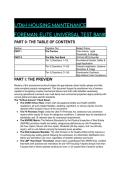
UTAH HOUSING MAINTENANCE
FOREMAN: ELITE UNIVERSAL TEST BANK
PART 0: THE TABLE OF CONTENTS
Section Cognitive Tier Subject Focus
PART I The Preview Core Axioms, Legal
Thresholds, & Strategy
PART II The Elite Test Bank 30-Point MCQ Gauntlet
- Tier 1 (Questions 1–10) Foundational Syntax, Safety &
Legal Application
- Tier 2 (Questions 11–20) Complex Application, Systems
Simulation & Triage
- Tier 3 (Questions 21–30) Grandmaster Synthesis,
High-Stakes Code Compliance
PART I: THE PREVIEW
Mastery of this assessment protocol bridges the gap between basic facility upkeep and elite,
code-compliant property management. This document forges the practitioner into a foreman
capable of navigating complex mechanical failures and strict state liabilities seamlessly,
ensuring operational command over multi-family and commercial properties aligns perfectly with
current global and state-specific standards.
The "Critical Axioms" Cheat Sheet:
● The UOSH 8-Hour Rule: Under Utah Occupational Safety and Health (UOSH)
regulations, all work-related fatalities, disabling, significant, or serious injuries must be
reported within exactly 8 hours of the occurrence.
● The Fit Premises Triad: Under the Utah Fit Premises Act, landlords must commence
repairs within exactly 24 hours for dangerous conditions, 3 calendar days for standards of
habitability, and 10 calendar days for contractual requirements.
● The NSPIRE Matrix: The National Standards for the Physical Inspection of Real Estate
(NSPIRE) prioritizes health and safety, categorizing deficiencies as Life-Threatening
(24-hour repair), Severe (24-hour repair), Moderate (30-day repair), and Low (60-day
repair), with in-unit defects carrying the heaviest score penalties.
● The DAQ Asbestos Mandate: The Utah Division of Air Quality (DAQ) strictly requires a
10-working-day waiting period following the submission of a Demolition Notification form
before any demolition can occur, regardless of whether asbestos was found.
● The LBP "Hard Deck" Threshold: Under Utah's Lead-Based Paint (RRP) Rule, certified
lead-safe work practices are mandatory for pre-1978 housing if repairs disrupt more than
6 square feet of interior painted surface per room, or 20 square feet of exterior surface.
,Legal/Regulatory Framework Triggering Event Mandatory Statutory Action /
Deadline
UOSH Compliance Serious Injury or Fatality Notify UOSH within 8 hours of
occurrence.
Utah Fit Premises Act Imminent Life-Safety Threat Commence remedial action
within 24 hours.
Utah Fit Premises Act Plumbing/Heating/Electrical Corrective period is 3 calendar
Failure days.
EPA/DAQ RRP Rule Pre-1978 Interior Disruption Mandatory containment if
exceeding 6 sq. ft..
DAQ Asbestos Rule Commercial/Regulated Submit notice and wait 10
Demolition working days.
Utah Eviction Law Tenant Defaults on Rent Issue 3-business-day notice to
pay or vacate.
PART II: THE ELITE TEST BANK
Tier 1 - Foundational Syntax & Application
Q1: A maintenance technician working on a multi-family property suffers an amputation from an
improperly guarded shop machine. According to Utah Occupational Safety and Health (UOSH)
regulations, what is the MAXIMUM allowable timeframe for the foreman or employer to report
this incident to UOSH? A) 24 hours B) 48 hours C) 8 hours D) Immediately, prior to securing the
scene
● The Answer: C (8 hours)
● Distractor Analysis:
○ A is incorrect: While Federal OSHA allows 24 hours for in-patient hospitalizations
and amputations, Utah operates under a State Plan (UOSH) that strictly requires
reporting of disabling, serious, or significant injuries within 8 hours.
○ B is incorrect: 48 hours is an outdated legacy standard that has no current legal
standing in occupational safety reporting.
○ D is incorrect: While rapid reporting is required, the primary duty of an employee or
supervisor is to first make the area safe and seek emergency medical help.
Reporting must occur within 8 hours, not instantaneously at the expense of triage.
The Mentor's Analysis: State Plans often supersede federal baselines with stricter timelines.
Under UOSH, the threshold for 8-hour reporting includes any injury where a body part is made
functionally useless or requires immediate hospital admittance. The regulatory apparatus is
designed to allow state inspectors immediate access to investigate severe machinery failures
before evidence is moved or destroyed. Professional/Academic Intuition: Always default to
the most stringent local authority having jurisdiction; in Utah, the UOSH 8-hour reporting window
is an absolute hard deck for serious injuries.
Q2: A tenant submits a written notice that their unit has completely lost plumbing function and
heating during a severe winter storm. Under the Utah Fit Premises Act, this constitutes a breach
of the standards of habitability. How long does the owner have to commence substantial
corrective action before the tenant can exercise a statutory renter remedy? A) 24 hours B) 3
calendar days C) 5 business days D) 10 calendar days
● The Answer: B (3 calendar days)
, ● Distractor Analysis:
○ A is incorrect: 24 hours is the corrective period exclusively reserved for a
dangerous condition, defined statutorily as a condition posing a substantial risk of
imminent loss of life or significant physical harm.
○ C is incorrect: 5 business days is the timeline required for an owner to return a
prospective tenant's money if they demand it before signing a lease, not for
habitability repairs.
○ D is incorrect: 10 calendar days is the corrective period for a requirement imposed
strictly by the rental agreement, not for statutory standards of habitability like
plumbing and heating.
The Mentor's Analysis: The Utah Fit Premises Act neatly divides repair timelines into three
tiers based on severity: 24 hours for dangerous conditions, 3 calendar days for habitability
standards, and 10 calendar days for contractual requirements. Loss of basic plumbing and
heating falls squarely into the statutory habitability tier, mandating a rapid but measured
response from property management. Professional/Academic Intuition: Habitability equals 3
calendar days. Mastery of this timeline is critical, as failure to comply triggers the tenant's right
to rent abatement or repair and deduct remedies.
Q3: HUD's National Standards for the Physical Inspection of Real Estate (NSPIRE) reclassifies
property deficiencies into prioritized categories. If a foreman identifies an exposed electrical wire
near a water source inside a unit, how will NSPIRE MOST LIKELY categorize this deficiency
and what is the required mitigation timeframe? A) Exigent Health and Safety (EH&S); 72 hours
B) Severe; 30 days C) Life-Threatening (LT); 24 hours D) Level 3 Deficiency; 24 hours
● The Answer: C (Life-Threatening (LT); 24 hours)
● Distractor Analysis:
○ A is incorrect: Exigent Health and Safety (EH&S) is legacy terminology from the
older UPCS/REAC protocols. NSPIRE replaced this with Life-Threatening and
Severe classifications.
○ B is incorrect: Severe deficiencies require a 24-hour response under NSPIRE, while
Moderate deficiencies require a 30-day response.
○ D is incorrect: Level 1, 2, and 3 are outdated UPCS severity tiers that NSPIRE has
entirely abolished in favor of impact-based categories.
The Mentor's Analysis: The NSPIRE protocol was designed to shift focus from cosmetic visual
appeal to actual resident safety. Exposed wiring near water is a textbook Life-Threatening
condition, presenting a high risk of death, which mandates immediate correction within 24
hours. Property foremen must understand that NSPIRE prioritizes defects based on their
potential to cause bodily harm. Professional/Academic Intuition: Under NSPIRE,
Life-Threatening and Severe issues both share a strict 24-hour mitigation deadline, establishing
a zero-tolerance policy for critical safety hazards.
Q4: A maintenance technician reports a loud banging noise in the domestic water lines
immediately after a valve is closed. Based on plumbing mechanics, what is the MOST
APPROPRIATE intervention to eliminate this water hammer phenomenon? A) Install a reducing
coupling B) Increase the hydrostatic pressure C) Install an air chamber D) Replace the gate
valve with a check valve
● The Answer: C (Install an air chamber)
● Distractor Analysis:
○ A is incorrect: A reducing coupling is used to connect pipes of two different
diameters; it has no dampening effect on hydraulic shock.
○ B is incorrect: Increasing hydrostatic pressure will exacerbate the kinetic energy of
FOREMAN: ELITE UNIVERSAL TEST BANK
PART 0: THE TABLE OF CONTENTS
Section Cognitive Tier Subject Focus
PART I The Preview Core Axioms, Legal
Thresholds, & Strategy
PART II The Elite Test Bank 30-Point MCQ Gauntlet
- Tier 1 (Questions 1–10) Foundational Syntax, Safety &
Legal Application
- Tier 2 (Questions 11–20) Complex Application, Systems
Simulation & Triage
- Tier 3 (Questions 21–30) Grandmaster Synthesis,
High-Stakes Code Compliance
PART I: THE PREVIEW
Mastery of this assessment protocol bridges the gap between basic facility upkeep and elite,
code-compliant property management. This document forges the practitioner into a foreman
capable of navigating complex mechanical failures and strict state liabilities seamlessly,
ensuring operational command over multi-family and commercial properties aligns perfectly with
current global and state-specific standards.
The "Critical Axioms" Cheat Sheet:
● The UOSH 8-Hour Rule: Under Utah Occupational Safety and Health (UOSH)
regulations, all work-related fatalities, disabling, significant, or serious injuries must be
reported within exactly 8 hours of the occurrence.
● The Fit Premises Triad: Under the Utah Fit Premises Act, landlords must commence
repairs within exactly 24 hours for dangerous conditions, 3 calendar days for standards of
habitability, and 10 calendar days for contractual requirements.
● The NSPIRE Matrix: The National Standards for the Physical Inspection of Real Estate
(NSPIRE) prioritizes health and safety, categorizing deficiencies as Life-Threatening
(24-hour repair), Severe (24-hour repair), Moderate (30-day repair), and Low (60-day
repair), with in-unit defects carrying the heaviest score penalties.
● The DAQ Asbestos Mandate: The Utah Division of Air Quality (DAQ) strictly requires a
10-working-day waiting period following the submission of a Demolition Notification form
before any demolition can occur, regardless of whether asbestos was found.
● The LBP "Hard Deck" Threshold: Under Utah's Lead-Based Paint (RRP) Rule, certified
lead-safe work practices are mandatory for pre-1978 housing if repairs disrupt more than
6 square feet of interior painted surface per room, or 20 square feet of exterior surface.
,Legal/Regulatory Framework Triggering Event Mandatory Statutory Action /
Deadline
UOSH Compliance Serious Injury or Fatality Notify UOSH within 8 hours of
occurrence.
Utah Fit Premises Act Imminent Life-Safety Threat Commence remedial action
within 24 hours.
Utah Fit Premises Act Plumbing/Heating/Electrical Corrective period is 3 calendar
Failure days.
EPA/DAQ RRP Rule Pre-1978 Interior Disruption Mandatory containment if
exceeding 6 sq. ft..
DAQ Asbestos Rule Commercial/Regulated Submit notice and wait 10
Demolition working days.
Utah Eviction Law Tenant Defaults on Rent Issue 3-business-day notice to
pay or vacate.
PART II: THE ELITE TEST BANK
Tier 1 - Foundational Syntax & Application
Q1: A maintenance technician working on a multi-family property suffers an amputation from an
improperly guarded shop machine. According to Utah Occupational Safety and Health (UOSH)
regulations, what is the MAXIMUM allowable timeframe for the foreman or employer to report
this incident to UOSH? A) 24 hours B) 48 hours C) 8 hours D) Immediately, prior to securing the
scene
● The Answer: C (8 hours)
● Distractor Analysis:
○ A is incorrect: While Federal OSHA allows 24 hours for in-patient hospitalizations
and amputations, Utah operates under a State Plan (UOSH) that strictly requires
reporting of disabling, serious, or significant injuries within 8 hours.
○ B is incorrect: 48 hours is an outdated legacy standard that has no current legal
standing in occupational safety reporting.
○ D is incorrect: While rapid reporting is required, the primary duty of an employee or
supervisor is to first make the area safe and seek emergency medical help.
Reporting must occur within 8 hours, not instantaneously at the expense of triage.
The Mentor's Analysis: State Plans often supersede federal baselines with stricter timelines.
Under UOSH, the threshold for 8-hour reporting includes any injury where a body part is made
functionally useless or requires immediate hospital admittance. The regulatory apparatus is
designed to allow state inspectors immediate access to investigate severe machinery failures
before evidence is moved or destroyed. Professional/Academic Intuition: Always default to
the most stringent local authority having jurisdiction; in Utah, the UOSH 8-hour reporting window
is an absolute hard deck for serious injuries.
Q2: A tenant submits a written notice that their unit has completely lost plumbing function and
heating during a severe winter storm. Under the Utah Fit Premises Act, this constitutes a breach
of the standards of habitability. How long does the owner have to commence substantial
corrective action before the tenant can exercise a statutory renter remedy? A) 24 hours B) 3
calendar days C) 5 business days D) 10 calendar days
● The Answer: B (3 calendar days)
, ● Distractor Analysis:
○ A is incorrect: 24 hours is the corrective period exclusively reserved for a
dangerous condition, defined statutorily as a condition posing a substantial risk of
imminent loss of life or significant physical harm.
○ C is incorrect: 5 business days is the timeline required for an owner to return a
prospective tenant's money if they demand it before signing a lease, not for
habitability repairs.
○ D is incorrect: 10 calendar days is the corrective period for a requirement imposed
strictly by the rental agreement, not for statutory standards of habitability like
plumbing and heating.
The Mentor's Analysis: The Utah Fit Premises Act neatly divides repair timelines into three
tiers based on severity: 24 hours for dangerous conditions, 3 calendar days for habitability
standards, and 10 calendar days for contractual requirements. Loss of basic plumbing and
heating falls squarely into the statutory habitability tier, mandating a rapid but measured
response from property management. Professional/Academic Intuition: Habitability equals 3
calendar days. Mastery of this timeline is critical, as failure to comply triggers the tenant's right
to rent abatement or repair and deduct remedies.
Q3: HUD's National Standards for the Physical Inspection of Real Estate (NSPIRE) reclassifies
property deficiencies into prioritized categories. If a foreman identifies an exposed electrical wire
near a water source inside a unit, how will NSPIRE MOST LIKELY categorize this deficiency
and what is the required mitigation timeframe? A) Exigent Health and Safety (EH&S); 72 hours
B) Severe; 30 days C) Life-Threatening (LT); 24 hours D) Level 3 Deficiency; 24 hours
● The Answer: C (Life-Threatening (LT); 24 hours)
● Distractor Analysis:
○ A is incorrect: Exigent Health and Safety (EH&S) is legacy terminology from the
older UPCS/REAC protocols. NSPIRE replaced this with Life-Threatening and
Severe classifications.
○ B is incorrect: Severe deficiencies require a 24-hour response under NSPIRE, while
Moderate deficiencies require a 30-day response.
○ D is incorrect: Level 1, 2, and 3 are outdated UPCS severity tiers that NSPIRE has
entirely abolished in favor of impact-based categories.
The Mentor's Analysis: The NSPIRE protocol was designed to shift focus from cosmetic visual
appeal to actual resident safety. Exposed wiring near water is a textbook Life-Threatening
condition, presenting a high risk of death, which mandates immediate correction within 24
hours. Property foremen must understand that NSPIRE prioritizes defects based on their
potential to cause bodily harm. Professional/Academic Intuition: Under NSPIRE,
Life-Threatening and Severe issues both share a strict 24-hour mitigation deadline, establishing
a zero-tolerance policy for critical safety hazards.
Q4: A maintenance technician reports a loud banging noise in the domestic water lines
immediately after a valve is closed. Based on plumbing mechanics, what is the MOST
APPROPRIATE intervention to eliminate this water hammer phenomenon? A) Install a reducing
coupling B) Increase the hydrostatic pressure C) Install an air chamber D) Replace the gate
valve with a check valve
● The Answer: C (Install an air chamber)
● Distractor Analysis:
○ A is incorrect: A reducing coupling is used to connect pipes of two different
diameters; it has no dampening effect on hydraulic shock.
○ B is incorrect: Increasing hydrostatic pressure will exacerbate the kinetic energy of


