

FINA 3332 EXAM 3 COMPLETE PREPARATION
GUIDE WITH NPV, IRR, AND CASH FLOW
ANALYSIS REVIEW
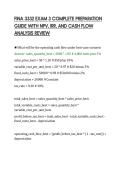
◉ What will be the operating cash flow under best-case scenario
Answer: sales_quantity_best = 4000 * 1.05 # 4,000 units plus 5%
sales_price_best = 50 * 1.10 # $50 plus 10%
variable_cost_per_unit_best = 20 * 0.97 # $20 minus 3%
fixed_costs_best = 50000 * 0.98 # $50,000 minus 2%
depreciation = 20000 # Constant
tax_rate = 0.30 # 30%
total_sales_best = sales_quantity_best * sales_price_best
total_variable_costs_best = sales_quantity_best *
variable_cost_per_unit_best
profit_before_tax_best = total_sales_best - total_variable_costs_best -
fixed_costs_best - depreciation
operating_cash_flow_best = (profit_before_tax_best * (1 - tax_rate)) +
depreciation
,Operating Cash Flow=(231000−81480
−49,000−20,000)×(1−.3)+20000
◉ Worst Case Scene
Answer: sales_quantity_worst = 4000 * 0.95 # 4,000 units minus 5%
sales_price_worst = 50 * 0.90 # $50 minus 10%
variable_cost_per_unit_worst = 20 * 1.03 # $20 plus 3%
fixed_costs_worst = 50000 * 1.02 # $50,000 plus 2%
total_sales_worst = sales_quantity_worst * sales_price_worst
total_variable_costs_worst = sales_quantity_worst *
variable_cost_per_unit_worst profit_before_tax_worst =
total_sales_worst - total_variable_costs_worst - fixed_costs_worst -
depreciation
operating_cash_flow_worst = (profit_before_tax_worst * (1 -
tax_rate)) + depreciation
◉ 6.1 Incremental Cash Flows
Answer: Cash flows matter—not accounting earnings.
Sunk costs do not matter.
Incremental cash flows matter.
Opportunity costs matter.
Side effects like synergy and erosion matter.
,Taxes matter: We want incremental after-tax cash flows.
Inflation matters.
◉ Incremental Cash Flows
Answer: Sunk costs are not relevant
•Just because "we have come this far" does not mean that we should
continue to throw good money after bad.
Opportunity costs do matter. Just because a project has a positive N
P V, that does not mean that it should also have automatic
acceptance. Specifically, if another project with a higher N P V would
have to be passed up, then we should not proceed.
Side effects matter.
•Erosion is a "bad" thing. If our new product causes existing
customers to demand less of our current products, we need to
recognize that.
•If, however, synergies result that create increased demand of
existing products, we also need to recognize this gain.
◉ Estimating Cash Flows
Answer: Cash Flow from Operations
•Recall that: OCF = EBIT − Taxes + Depreciation.
, Net Capital Spending
•Do not forget salvage value (after tax, of course).
Changes in Net Working Capital
•Recall that when the project winds down, we enjoy a return of net
working capital.
◉ 6.2 The Baldwin Company
Answer: Costs of test marketing (already spent): $250,000
Current market value of proposed factory site (which we own):
$150,000
Cost of bowling ball machine: $100,000 (depreciated according to 5-
year MACRS)
Increase in net working capital: $10,000
Production (in units) by year during 5-year life of the machine:
5,000, 8,000, 12,000, 10,000, 6,000
Price during first year is $20; price increases 2 percent per year
thereafter.
Production costs during first year are $10 per unit and increase 10
percent per year thereafter.
Annual inflation rate: 5 percent
Working Capital: initial $10,000 changes with sales
GUIDE WITH NPV, IRR, AND CASH FLOW
ANALYSIS REVIEW
◉ What will be the operating cash flow under best-case scenario
Answer: sales_quantity_best = 4000 * 1.05 # 4,000 units plus 5%
sales_price_best = 50 * 1.10 # $50 plus 10%
variable_cost_per_unit_best = 20 * 0.97 # $20 minus 3%
fixed_costs_best = 50000 * 0.98 # $50,000 minus 2%
depreciation = 20000 # Constant
tax_rate = 0.30 # 30%
total_sales_best = sales_quantity_best * sales_price_best
total_variable_costs_best = sales_quantity_best *
variable_cost_per_unit_best
profit_before_tax_best = total_sales_best - total_variable_costs_best -
fixed_costs_best - depreciation
operating_cash_flow_best = (profit_before_tax_best * (1 - tax_rate)) +
depreciation
,Operating Cash Flow=(231000−81480
−49,000−20,000)×(1−.3)+20000
◉ Worst Case Scene
Answer: sales_quantity_worst = 4000 * 0.95 # 4,000 units minus 5%
sales_price_worst = 50 * 0.90 # $50 minus 10%
variable_cost_per_unit_worst = 20 * 1.03 # $20 plus 3%
fixed_costs_worst = 50000 * 1.02 # $50,000 plus 2%
total_sales_worst = sales_quantity_worst * sales_price_worst
total_variable_costs_worst = sales_quantity_worst *
variable_cost_per_unit_worst profit_before_tax_worst =
total_sales_worst - total_variable_costs_worst - fixed_costs_worst -
depreciation
operating_cash_flow_worst = (profit_before_tax_worst * (1 -
tax_rate)) + depreciation
◉ 6.1 Incremental Cash Flows
Answer: Cash flows matter—not accounting earnings.
Sunk costs do not matter.
Incremental cash flows matter.
Opportunity costs matter.
Side effects like synergy and erosion matter.
,Taxes matter: We want incremental after-tax cash flows.
Inflation matters.
◉ Incremental Cash Flows
Answer: Sunk costs are not relevant
•Just because "we have come this far" does not mean that we should
continue to throw good money after bad.
Opportunity costs do matter. Just because a project has a positive N
P V, that does not mean that it should also have automatic
acceptance. Specifically, if another project with a higher N P V would
have to be passed up, then we should not proceed.
Side effects matter.
•Erosion is a "bad" thing. If our new product causes existing
customers to demand less of our current products, we need to
recognize that.
•If, however, synergies result that create increased demand of
existing products, we also need to recognize this gain.
◉ Estimating Cash Flows
Answer: Cash Flow from Operations
•Recall that: OCF = EBIT − Taxes + Depreciation.
, Net Capital Spending
•Do not forget salvage value (after tax, of course).
Changes in Net Working Capital
•Recall that when the project winds down, we enjoy a return of net
working capital.
◉ 6.2 The Baldwin Company
Answer: Costs of test marketing (already spent): $250,000
Current market value of proposed factory site (which we own):
$150,000
Cost of bowling ball machine: $100,000 (depreciated according to 5-
year MACRS)
Increase in net working capital: $10,000
Production (in units) by year during 5-year life of the machine:
5,000, 8,000, 12,000, 10,000, 6,000
Price during first year is $20; price increases 2 percent per year
thereafter.
Production costs during first year are $10 per unit and increase 10
percent per year thereafter.
Annual inflation rate: 5 percent
Working Capital: initial $10,000 changes with sales


