

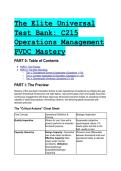
The Elite Universal
Test Bank: C215
Operations Management
PVDC Mastery
PART 0: Table of Contents
● PART I: The Preview
● PART II: The Elite Test Bank
○ Tier 1: Foundational Syntax & Application (Questions 1–10)
○ Tier 2: Complex Application & Simulation (Questions 11–20)
○ Tier 3: Grandmaster Synthesis (Questions 21–30)
PART I: The Preview
Mastery of this test bank translates directly to elite operational competence by bridging the gap
between theoretical frameworks and high-stakes, real-world supply chain and quality execution.
Continuous engagement with these rigorously structured scenarios forges an analytical mindset
capable of optimizing capacity, eliminating variance, and directing global processes with
absolute precision.
The "Critical Axioms" Cheat Sheet
Core Concept Operational Definition & Strategic Application
Formula
Quality Imperative Fitness for use: How well a Supersedes subjective
product performs its intendedpsychological criteria. If it
functional purpose. meets specs but fails in the
field, quality is zero.
Capacity Hierarchy Design Capacity: Theoretical Planners must differentiate
max under ideal conditions. between theoretical limits and
Effective Capacity: Max operational reality to allocate
output under normal capital.
constraints. Utilization:
\frac{\text{Actual
Output}}{\text{Design
Capacity}}.
,Core Concept Operational Definition & Strategic Application
Formula
Performance Metrics Process Velocity: Determines if a system is
\frac{\text{Throughput performing at, above, or below
Time}}{\text{Value-Added standardized labor and
Time}} Efficiency: temporal benchmarks.
\frac{\text{Actual
Output}}{\text{Standard
Output}}.
Variation Doctrine Assignable Cause: Identifiable Never adjust a stable process
and erasable (e.g., broken for common cause noise;
tool). Common Cause: surgically eliminate assignable
Random, systemic noise. causes immediately.
Make vs. Buy (Break-Even) \text{Total Cost} = \text{Fixed High fixed/low variable models
Cost} + (\text{Variable Cost} win at high volumes; low
\times \text{Volume}). fixed/high variable models win
at low volumes.
PART II: The Elite Test Bank
Tier 1: Foundational Syntax & Application (Questions 1–10)
Q1: A global aerospace manufacturer implements a rigorous quality management system for its
new turbine blade production line. The Chief Operating Officer insists that the primary metric for
the blade's quality must focus entirely on how reliably the blade performs its structural and
aerodynamic role under extreme conditions. Based on the principles of Total Quality
Management (TQM), which definition of quality is MOST ACCURATE in this context? A)
Conformance to specifications B) Value for price paid C) Fitness for use D) Psychological
criteria
● Answer: C (Fitness for use)
● Distractor Analysis:
○ A is incorrect: While conformance to specifications is a critical manufacturing
metric, it strictly measures adherence to a blueprint rather than the ultimate
functional success of the product in the field.
○ B is incorrect: Value for price paid evaluates quality from an economic return
perspective, which is secondary when the primary concern is operational reliability.
○ D is incorrect: Psychological criteria relate to brand perception, aesthetics, and user
prestige, which have no bearing on the mechanical performance of an aerospace
turbine blade.
The Mentor's Analysis: The absolute core of product quality in high-stakes operations is its
ability to perform its intended function seamlessly. When evaluating quality frameworks, the
ultimate test is whether the end-user can utilize the product exactly as required without failure.
Professional/Academic Intuition: Always define functional quality as fitness for use; a
product that meets specifications but fails in the field is a fundamentally defective
operation.
Q2: A multinational pharmaceutical firm is attempting to shift its corporate culture away from
mere defect detection and toward a proactive, systemic approach to quality. The board of
directors wishes to implement a foundational philosophy that explicitly stresses executive
, management’s ultimate responsibility for systemic quality. Which Total Quality Management
(TQM) framework is the MOST APPROPRIATE recommendation? A) The 14 points for quality
improvement B) Statistical quality control charts C) ISO 9000 certification standards D) The
continuous improvement (Kaizen) doctrine
● Answer: A (The 14 points for quality improvement)
● Distractor Analysis:
○ B is incorrect: Statistical quality control charts are tactical, mathematical tools used
to track process variation, not comprehensive philosophical frameworks outlining
executive management responsibilities.
○ C is incorrect: ISO 9000 is a set of 13 published international standards focusing on
quality management documentation and assurance, rather than W. Edwards
Deming’s specific philosophical mandate regarding management's internal
obligations.
○ D is incorrect: Continuous improvement (Kaizen) emphasizes ongoing, incremental
changes involving all employees, but it does not specifically isolate and mandate
executive leadership's foundational responsibility as distinctly as Deming's
framework.
The Mentor's Analysis: True operational excellence dictates that quality failures are rarely the
fault of the frontline worker; they are systemic failures engineered by management. W. Edwards
Deming developed his framework precisely to force leadership to take ownership of the systems
they design. Professional/Academic Intuition: Deming’s 14 points for quality improvement
is the definitive academic framework establishing that management bears the ultimate
burden for systemic quality.
Q3: The floor manager of a semiconductor fabrication plant observes that the thickness of
silicon wafers varies slightly from batch to batch. The manager needs to determine if this
variation is part of the normal, expected operational tolerance or if a machine calibration error
has caused the process to drift out of acceptable parameters. Which quality control tool FIRST
must be utilized? A) Scatter diagram B) Pareto chart C) Control chart D) Cause-and-effect
(fishbone) diagram
● Answer: C (Control chart)
● Distractor Analysis:
○ A is incorrect: A scatter diagram plots two distinct variables to identify if a
correlation exists between them, rather than tracking a single variable's
performance against control limits over time.
○ B is incorrect: A Pareto chart is utilized to isolate the most frequent causes of
defects based on the 80/20 rule, which is a prioritization tool, not a process
variation monitor.
○ D is incorrect: A cause-and-effect diagram is utilized for root cause analysis after a
specific defect or drift has been identified, not for the real-time monitoring of
statistical variation.
The Mentor's Analysis: Operations management relies heavily on distinguishing between
common cause (random) variation and assignable cause variation. The visual representation of
data points over time against upper and lower control limits provides an immediate,
mathematical confirmation of process stability. Professional/Academic Intuition: A Control
chart is the singular, definitive tool for monitoring process drift and determining if a
sample of data falls within the normal range of variation.
Q4: An automotive assembly plant operates a highly automated robotics line designed to
spot-weld vehicle chassis. The facility managers calculate the maximum theoretical output rate
Test Bank: C215
Operations Management
PVDC Mastery
PART 0: Table of Contents
● PART I: The Preview
● PART II: The Elite Test Bank
○ Tier 1: Foundational Syntax & Application (Questions 1–10)
○ Tier 2: Complex Application & Simulation (Questions 11–20)
○ Tier 3: Grandmaster Synthesis (Questions 21–30)
PART I: The Preview
Mastery of this test bank translates directly to elite operational competence by bridging the gap
between theoretical frameworks and high-stakes, real-world supply chain and quality execution.
Continuous engagement with these rigorously structured scenarios forges an analytical mindset
capable of optimizing capacity, eliminating variance, and directing global processes with
absolute precision.
The "Critical Axioms" Cheat Sheet
Core Concept Operational Definition & Strategic Application
Formula
Quality Imperative Fitness for use: How well a Supersedes subjective
product performs its intendedpsychological criteria. If it
functional purpose. meets specs but fails in the
field, quality is zero.
Capacity Hierarchy Design Capacity: Theoretical Planners must differentiate
max under ideal conditions. between theoretical limits and
Effective Capacity: Max operational reality to allocate
output under normal capital.
constraints. Utilization:
\frac{\text{Actual
Output}}{\text{Design
Capacity}}.
,Core Concept Operational Definition & Strategic Application
Formula
Performance Metrics Process Velocity: Determines if a system is
\frac{\text{Throughput performing at, above, or below
Time}}{\text{Value-Added standardized labor and
Time}} Efficiency: temporal benchmarks.
\frac{\text{Actual
Output}}{\text{Standard
Output}}.
Variation Doctrine Assignable Cause: Identifiable Never adjust a stable process
and erasable (e.g., broken for common cause noise;
tool). Common Cause: surgically eliminate assignable
Random, systemic noise. causes immediately.
Make vs. Buy (Break-Even) \text{Total Cost} = \text{Fixed High fixed/low variable models
Cost} + (\text{Variable Cost} win at high volumes; low
\times \text{Volume}). fixed/high variable models win
at low volumes.
PART II: The Elite Test Bank
Tier 1: Foundational Syntax & Application (Questions 1–10)
Q1: A global aerospace manufacturer implements a rigorous quality management system for its
new turbine blade production line. The Chief Operating Officer insists that the primary metric for
the blade's quality must focus entirely on how reliably the blade performs its structural and
aerodynamic role under extreme conditions. Based on the principles of Total Quality
Management (TQM), which definition of quality is MOST ACCURATE in this context? A)
Conformance to specifications B) Value for price paid C) Fitness for use D) Psychological
criteria
● Answer: C (Fitness for use)
● Distractor Analysis:
○ A is incorrect: While conformance to specifications is a critical manufacturing
metric, it strictly measures adherence to a blueprint rather than the ultimate
functional success of the product in the field.
○ B is incorrect: Value for price paid evaluates quality from an economic return
perspective, which is secondary when the primary concern is operational reliability.
○ D is incorrect: Psychological criteria relate to brand perception, aesthetics, and user
prestige, which have no bearing on the mechanical performance of an aerospace
turbine blade.
The Mentor's Analysis: The absolute core of product quality in high-stakes operations is its
ability to perform its intended function seamlessly. When evaluating quality frameworks, the
ultimate test is whether the end-user can utilize the product exactly as required without failure.
Professional/Academic Intuition: Always define functional quality as fitness for use; a
product that meets specifications but fails in the field is a fundamentally defective
operation.
Q2: A multinational pharmaceutical firm is attempting to shift its corporate culture away from
mere defect detection and toward a proactive, systemic approach to quality. The board of
directors wishes to implement a foundational philosophy that explicitly stresses executive
, management’s ultimate responsibility for systemic quality. Which Total Quality Management
(TQM) framework is the MOST APPROPRIATE recommendation? A) The 14 points for quality
improvement B) Statistical quality control charts C) ISO 9000 certification standards D) The
continuous improvement (Kaizen) doctrine
● Answer: A (The 14 points for quality improvement)
● Distractor Analysis:
○ B is incorrect: Statistical quality control charts are tactical, mathematical tools used
to track process variation, not comprehensive philosophical frameworks outlining
executive management responsibilities.
○ C is incorrect: ISO 9000 is a set of 13 published international standards focusing on
quality management documentation and assurance, rather than W. Edwards
Deming’s specific philosophical mandate regarding management's internal
obligations.
○ D is incorrect: Continuous improvement (Kaizen) emphasizes ongoing, incremental
changes involving all employees, but it does not specifically isolate and mandate
executive leadership's foundational responsibility as distinctly as Deming's
framework.
The Mentor's Analysis: True operational excellence dictates that quality failures are rarely the
fault of the frontline worker; they are systemic failures engineered by management. W. Edwards
Deming developed his framework precisely to force leadership to take ownership of the systems
they design. Professional/Academic Intuition: Deming’s 14 points for quality improvement
is the definitive academic framework establishing that management bears the ultimate
burden for systemic quality.
Q3: The floor manager of a semiconductor fabrication plant observes that the thickness of
silicon wafers varies slightly from batch to batch. The manager needs to determine if this
variation is part of the normal, expected operational tolerance or if a machine calibration error
has caused the process to drift out of acceptable parameters. Which quality control tool FIRST
must be utilized? A) Scatter diagram B) Pareto chart C) Control chart D) Cause-and-effect
(fishbone) diagram
● Answer: C (Control chart)
● Distractor Analysis:
○ A is incorrect: A scatter diagram plots two distinct variables to identify if a
correlation exists between them, rather than tracking a single variable's
performance against control limits over time.
○ B is incorrect: A Pareto chart is utilized to isolate the most frequent causes of
defects based on the 80/20 rule, which is a prioritization tool, not a process
variation monitor.
○ D is incorrect: A cause-and-effect diagram is utilized for root cause analysis after a
specific defect or drift has been identified, not for the real-time monitoring of
statistical variation.
The Mentor's Analysis: Operations management relies heavily on distinguishing between
common cause (random) variation and assignable cause variation. The visual representation of
data points over time against upper and lower control limits provides an immediate,
mathematical confirmation of process stability. Professional/Academic Intuition: A Control
chart is the singular, definitive tool for monitoring process drift and determining if a
sample of data falls within the normal range of variation.
Q4: An automotive assembly plant operates a highly automated robotics line designed to
spot-weld vehicle chassis. The facility managers calculate the maximum theoretical output rate


