

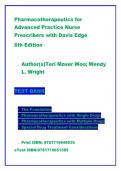
Pharmacotherapeutics for
Advanced Practice Nurse
Prescribers with Davis Edge
6th Edition
• Author(s)Teri Moser Woo; Wendy
L. Wright
TEST BANK
▪ The Foundation
▪ Pharmacotherapeutics with Single Drugs
▪ Pharmacotherapeutics with Multiple Drugs
▪ Special Drug Treatment Considerations
• Print ISBN: 9781719648035
eText ISBN:9781719651585
,Question 1
A newly certified Family Nurse Practitioner (FNP) begins
practicing in a primary care clinic. A 58-year-old patient with
newly diagnosed hypertension requests an antibiotic "just in
case" for a mild viral upper respiratory illness because they are
leaving for vacation. The patient has no fever, purulent
drainage, or signs of bacterial infection. What is the most
appropriate prescribing action by the APRN?
A. Prescribe amoxicillin because delayed treatment may
worsen symptoms.
B. Prescribe azithromycin because it has a broad spectrum and
convenient dosing.
C. Explain why an antibiotic is not indicated, recommend
symptomatic management, and provide follow-up instructions
if symptoms worsen.
D. Prescribe a 3-day course of ciprofloxacin to prevent
secondary bacterial infection.
Correct Answer: C
Rationale:
Evidence-based prescribing requires selecting medications only
when the anticipated benefits outweigh potential risks. Viral
upper respiratory infections do not benefit from antibiotic
,therapy. The APRN should educate the patient regarding the
expected illness course, recommend symptomatic treatment,
and establish clear return precautions. This approach promotes
antimicrobial stewardship, minimizes adverse drug reactions,
and reduces antimicrobial resistance.
• A: Inappropriate because no bacterial infection is present.
• B: Broad-spectrum antibiotics should not be prescribed
without an appropriate indication.
• D: Fluoroquinolones carry significant risks and should
never be used prophylactically for uncomplicated viral
illnesses.
Question 2
A 74-year-old woman with chronic kidney disease (estimated
GFR 32 mL/min/1.73 m²) is diagnosed with an uncomplicated
urinary tract infection. Before prescribing an antibiotic, which
action best reflects safe prescribing principles?
A. Prescribe the standard adult dose regardless of kidney
function.
B. Select a medication and dose after evaluating renal function
and potential drug accumulation.
C. Avoid all antibiotics because chronic kidney disease is a
contraindication.
, D. Double the loading dose to achieve therapeutic
concentrations more rapidly.
Correct Answer: B
Rationale:
Many medications undergo renal elimination. Reduced kidney
function may increase drug exposure, toxicity, and adverse
effects if doses are not adjusted appropriately. APRNs should
routinely assess renal function before prescribing medications
with significant renal clearance and individualize therapy
accordingly.
• A: May increase toxicity.
• C: Most antibiotics remain appropriate with proper
selection and dose adjustment.
• D: Higher loading doses are not routinely indicated and
may increase adverse effects.
Question 3
A 30-year-old woman who is 10 weeks pregnant presents with
newly diagnosed hypertension requiring pharmacologic
treatment. Before initiating therapy, which prescribing principle
is most appropriate?
A. Select the medication with the lowest acquisition cost.
B. Choose a medication based primarily on patient preference
regardless of fetal safety.
Advanced Practice Nurse
Prescribers with Davis Edge
6th Edition
• Author(s)Teri Moser Woo; Wendy
L. Wright
TEST BANK
▪ The Foundation
▪ Pharmacotherapeutics with Single Drugs
▪ Pharmacotherapeutics with Multiple Drugs
▪ Special Drug Treatment Considerations
• Print ISBN: 9781719648035
eText ISBN:9781719651585
,Question 1
A newly certified Family Nurse Practitioner (FNP) begins
practicing in a primary care clinic. A 58-year-old patient with
newly diagnosed hypertension requests an antibiotic "just in
case" for a mild viral upper respiratory illness because they are
leaving for vacation. The patient has no fever, purulent
drainage, or signs of bacterial infection. What is the most
appropriate prescribing action by the APRN?
A. Prescribe amoxicillin because delayed treatment may
worsen symptoms.
B. Prescribe azithromycin because it has a broad spectrum and
convenient dosing.
C. Explain why an antibiotic is not indicated, recommend
symptomatic management, and provide follow-up instructions
if symptoms worsen.
D. Prescribe a 3-day course of ciprofloxacin to prevent
secondary bacterial infection.
Correct Answer: C
Rationale:
Evidence-based prescribing requires selecting medications only
when the anticipated benefits outweigh potential risks. Viral
upper respiratory infections do not benefit from antibiotic
,therapy. The APRN should educate the patient regarding the
expected illness course, recommend symptomatic treatment,
and establish clear return precautions. This approach promotes
antimicrobial stewardship, minimizes adverse drug reactions,
and reduces antimicrobial resistance.
• A: Inappropriate because no bacterial infection is present.
• B: Broad-spectrum antibiotics should not be prescribed
without an appropriate indication.
• D: Fluoroquinolones carry significant risks and should
never be used prophylactically for uncomplicated viral
illnesses.
Question 2
A 74-year-old woman with chronic kidney disease (estimated
GFR 32 mL/min/1.73 m²) is diagnosed with an uncomplicated
urinary tract infection. Before prescribing an antibiotic, which
action best reflects safe prescribing principles?
A. Prescribe the standard adult dose regardless of kidney
function.
B. Select a medication and dose after evaluating renal function
and potential drug accumulation.
C. Avoid all antibiotics because chronic kidney disease is a
contraindication.
, D. Double the loading dose to achieve therapeutic
concentrations more rapidly.
Correct Answer: B
Rationale:
Many medications undergo renal elimination. Reduced kidney
function may increase drug exposure, toxicity, and adverse
effects if doses are not adjusted appropriately. APRNs should
routinely assess renal function before prescribing medications
with significant renal clearance and individualize therapy
accordingly.
• A: May increase toxicity.
• C: Most antibiotics remain appropriate with proper
selection and dose adjustment.
• D: Higher loading doses are not routinely indicated and
may increase adverse effects.
Question 3
A 30-year-old woman who is 10 weeks pregnant presents with
newly diagnosed hypertension requiring pharmacologic
treatment. Before initiating therapy, which prescribing principle
is most appropriate?
A. Select the medication with the lowest acquisition cost.
B. Choose a medication based primarily on patient preference
regardless of fetal safety.


