

APEA 3P Exam Evaluation - Pediatric Nurse Practitioner
Faculty - 2026/2027 Edition - 250 Verified Questions
APEA 3P Exam 2026-2027 QUESTIONS AND ANSWERS ALREADY GRADED A+. 100% Verified Solutions |
Updated Per Latest Guidelines | Graded A+
This comprehensive document contains 250 verified questions and answers designed to prepare
pediatric nurse practitioners for the APEA 3P Exam Evaluation. Covering essential topics in pediatric
primary care, the material reflects the latest clinical guidelines and exam blueprints for the 2026/2027
academic year. Each question is accompanied by detailed rationales to reinforce understanding and
critical thinking. Ideal for self-assessment and focused review, this resource ensures candidates are
thoroughly prepared for certification success.
Abstract:
The APEA 3P Exam Evaluation document for the 2026/2027 academic year provides a rigorous review of pediatric
primary care content essential for nurse practitioners. Comprising 250 verified questions, this resource
systematically addresses key domains including growth and development, common pediatric conditions,
pharmacotherapeutics, and preventive care. Each question is designed to test clinical reasoning and application of
evidence-based guidelines, with detailed rationales that explain correct and incorrect options. The material has
been meticulously updated to reflect the latest recommendations from the American Academy of Pediatrics and the
Centers for Disease Control and Prevention. This document serves as a definitive study tool for candidates seeking
to demonstrate competency in pediatric primary care and achieve certification. By covering high-yield topics and
emphasizing critical thinking, it prepares learners for the complexities of real-world pediatric practice. The
structured format facilitates efficient review and self-assessment, making it an indispensable resource for exam
success.
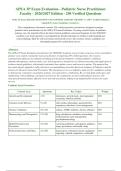
Content Area Overview:
Content Area Questions Key Topics Weight
Growth and Development 1-50 milestones, growth charts, developmental 20%
screening, nutrition, puberty
Common Acute Illnesses 51-100 otitis media, pharyngitis, gastroenteritis, 20%
respiratory infections, fever management
Chronic Conditions 101-150 asthma, ADHD, diabetes, obesity, allergies 20%
Pharmacology and Therapeutics 151-190 drug calculations, antibiotic stewardship, 16%
immunizations, pain management,
psychopharmacology
Health Promotion and 191-220 screening guidelines, anticipatory guidance, 12%
Prevention injury prevention, oral health, sleep
Professional Issues and Ethics 221-250 legal aspects, informed consent, mandatory 12%
reporting, cultural competence, telehealth
Page 1
,Q1. A school-age child presents with recurrent, episodic abdominal pain without organic cause. The
pain is periumbilical, occurs during school hours, and is associated with school refusal. Which
intervention is most evidence-based for first-line management?
A. Reassurance and trial of a low-FODMAP diet
B. Referral to pediatric gastroenterology for endoscopy
C. Cognitive-behavioral therapy and scheduled school attendance
D. Proton pump inhibitor therapy for 4 weeks
Correct Answer: C. Cognitive-behavioral therapy and scheduled school attendance
Rationale: This presentation is classic for functional abdominal pain (FAP) with school avoidance.
Cognitive-behavioral therapy (CBT) and behavioral strategies to maintain school attendance are
first-line; dietary changes lack strong evidence and endoscopy is not indicated without alarm symptoms.
Why Wrong:
A - Low-FODMAP diet has limited evidence in FAP and may not address the behavioral component.
B - Endoscopy is reserved for alarm symptoms (e.g., weight loss, hematochezia).
D - PPIs are indicated for GERD, not FAP without dyspepsia.
Reference: Kliegman, R. M., & St Geme, J. W. (2020). Nelson Textbook of Pediatrics, 21st Ed., Ch. 332.
Q2. Which of the following best describes the mechanism of action of atomoxetine in the treatment
of attention-deficit/hyperactivity disorder (ADHD)?
A. Selective inhibition of dopamine reuptake in the prefrontal cortex
B. Selective norepinephrine reuptake inhibition without significant dopamine effects
C. Agonism at alpha-2 adrenergic receptors
D. Irreversible inhibition of monoamine oxidase
Correct Answer: B. Selective norepinephrine reuptake inhibition without significant dopamine
effects
Rationale: Atomoxetine is a selective norepinephrine reuptake inhibitor (NRI) that increases
norepinephrine in the prefrontal cortex, improving attention and impulse control. It does not significantly
affect dopamine reuptake; that is the mechanism of stimulants like methylphenidate.
Why Wrong:
A - This describes stimulant medications (e.g., methylphenidate) that block dopamine reuptake.
C - Alpha-2 agonists (e.g., clonidine, guanfacine) work via this mechanism.
D - This describes MAOIs, which are rarely used in ADHD.
Reference: Stahl, S. M. (2021). Stahl's Essential Psychopharmacology, 5th Ed., Ch. 12.
Page 2
,Q3. A term neonate, delivered vaginally after an uncomplicated pregnancy, develops tachypnea and
grunting at 2 hours of life. Chest radiograph shows fluid in the interlobar fissures and prominent
perihilar streaking. What is the most likely diagnosis?
A. Transient tachypnea of the newborn (TTN)
B. Respiratory distress syndrome (RDS)
C. Meconium aspiration syndrome (MAS)
D. Congenital pneumonia
Correct Answer: A. Transient tachypnea of the newborn (TTN)
Rationale: TTN typically presents in term or late preterm infants after vaginal delivery, with tachypnea
and grunting. Radiographic findings include fluid in fissures and perihilar streaking due to delayed
clearance of fetal lung fluid. RDS is more common in preterm infants with surfactant deficiency.
Why Wrong:
B - RDS shows ground-glass opacities and air bronchograms, not fluid in fissures.
C - MAS presents with meconium-stained fluid and coarse, patchy infiltrates.
D - Congenital pneumonia would show focal or diffuse infiltrates and often has risk factors.
Reference: Gomella, T. L., & Cunningham, M. D. (2020). Neonatology: Management, Procedures,
On-Call Problems, 8th Ed., Ch. 45.
Q4. A 3-year-old child with a history of frequent otitis media has failed two courses of amoxicillin
for acute otitis media (AOM) in the past month. Tympanometry shows a flat curve. What is the next
best step in management?
A. Amoxicillin-clavulanate for 10 days
B. Referral for tympanostomy tube placement
C. Observation without antibiotics for 48 hours
D. Ceftriaxone intramuscular single dose
Correct Answer: A. Amoxicillin-clavulanate for 10 days
Rationale: This child has persistent AOM after two recent antibiotic courses, suggesting resistant
organisms. Amoxicillin-clavulanate is recommended for treatment failure. Tympanostomy tubes are
considered for recurrent AOM (3 episodes in 6 months or 4 in 12 months) or chronic OME with hearing
loss, not after only two failures.
Why Wrong:
B - Surgical referral is not first-line after two treatment failures without meeting criteria for recurrent
AOM.
C - Observation is not appropriate after treatment failure; antibiotics are indicated.
D - Ceftriaxone is an alternative if oral therapy cannot be used, but not first-line for treatment failure.
Reference: Lieberthal, A. S., et al. (2013). The diagnosis and management of acute otitis media.
Pediatrics, 131(3), e964-e999.
Page 3
, Q5. Which of the following immunizations is contraindicated in a child with a history of anaphylaxis
to baker's yeast (Saccharomyces cerevisiae)?
A. Measles, mumps, rubella (MMR) vaccine
B. Varicella vaccine
C. Hepatitis B vaccine
D. Inactivated polio vaccine (IPV)
Correct Answer: C. Hepatitis B vaccine
Rationale: Hepatitis B vaccine is produced using recombinant DNA technology in Saccharomyces
cerevisiae (baker's yeast) and may contain trace amounts of yeast protein. Anaphylaxis to baker's yeast is
a contraindication. MMR, varicella, and IPV are not produced in yeast systems.
Why Wrong:
A - MMR is grown in chick embryo fibroblast culture.
B - Varicella is grown in human diploid cell culture.
D - IPV is grown in Vero cells (monkey kidney cells).
Reference: Centers for Disease Control and Prevention. (2023). Epidemiology and Prevention of
Vaccine-Preventable Diseases, 14th Ed., Ch. 10.
Q6. A previously healthy adolescent presents with acute-onset severe headache, fever, and neck
stiffness. CSF analysis shows elevated opening pressure, WBC 1500/µL (90% neutrophils), low
glucose, and elevated protein. Gram stain shows gram-negative diplococci. Which empiric antibiotic
regimen is most appropriate before culture results?
A. Ceftriaxone plus vancomycin
B. Ampicillin plus gentamicin
C. Ceftriaxone alone
D. Acyclovir plus ceftriaxone
Correct Answer: A. Ceftriaxone plus vancomycin
Rationale: This presentation is classic for bacterial meningitis. Gram-negative diplococci suggest
Neisseria meningitidis, but empiric coverage must include ceftriaxone for meningococcus and vancomycin
for penicillin-resistant Streptococcus pneumoniae until sensitivities return. Ceftriaxone alone is
insufficient due to rising pneumococcal resistance.
Why Wrong:
B - Ampicillin/gentamicin is used for neonatal meningitis or Listeria, not this age group.
C - Ceftriaxone alone does not cover resistant pneumococcus.
D - Acyclovir is for herpes encephalitis, not bacterial meningitis.
Reference: Tunkel, A. R., et al. (2004). Practice guidelines for the management of bacterial meningitis.
Clinical Infectious Diseases, 39(9), 1267-1284.
Page 4
Faculty - 2026/2027 Edition - 250 Verified Questions
APEA 3P Exam 2026-2027 QUESTIONS AND ANSWERS ALREADY GRADED A+. 100% Verified Solutions |
Updated Per Latest Guidelines | Graded A+
This comprehensive document contains 250 verified questions and answers designed to prepare
pediatric nurse practitioners for the APEA 3P Exam Evaluation. Covering essential topics in pediatric
primary care, the material reflects the latest clinical guidelines and exam blueprints for the 2026/2027
academic year. Each question is accompanied by detailed rationales to reinforce understanding and
critical thinking. Ideal for self-assessment and focused review, this resource ensures candidates are
thoroughly prepared for certification success.
Abstract:
The APEA 3P Exam Evaluation document for the 2026/2027 academic year provides a rigorous review of pediatric
primary care content essential for nurse practitioners. Comprising 250 verified questions, this resource
systematically addresses key domains including growth and development, common pediatric conditions,
pharmacotherapeutics, and preventive care. Each question is designed to test clinical reasoning and application of
evidence-based guidelines, with detailed rationales that explain correct and incorrect options. The material has
been meticulously updated to reflect the latest recommendations from the American Academy of Pediatrics and the
Centers for Disease Control and Prevention. This document serves as a definitive study tool for candidates seeking
to demonstrate competency in pediatric primary care and achieve certification. By covering high-yield topics and
emphasizing critical thinking, it prepares learners for the complexities of real-world pediatric practice. The
structured format facilitates efficient review and self-assessment, making it an indispensable resource for exam
success.
Content Area Overview:
Content Area Questions Key Topics Weight
Growth and Development 1-50 milestones, growth charts, developmental 20%
screening, nutrition, puberty
Common Acute Illnesses 51-100 otitis media, pharyngitis, gastroenteritis, 20%
respiratory infections, fever management
Chronic Conditions 101-150 asthma, ADHD, diabetes, obesity, allergies 20%
Pharmacology and Therapeutics 151-190 drug calculations, antibiotic stewardship, 16%
immunizations, pain management,
psychopharmacology
Health Promotion and 191-220 screening guidelines, anticipatory guidance, 12%
Prevention injury prevention, oral health, sleep
Professional Issues and Ethics 221-250 legal aspects, informed consent, mandatory 12%
reporting, cultural competence, telehealth
Page 1
,Q1. A school-age child presents with recurrent, episodic abdominal pain without organic cause. The
pain is periumbilical, occurs during school hours, and is associated with school refusal. Which
intervention is most evidence-based for first-line management?
A. Reassurance and trial of a low-FODMAP diet
B. Referral to pediatric gastroenterology for endoscopy
C. Cognitive-behavioral therapy and scheduled school attendance
D. Proton pump inhibitor therapy for 4 weeks
Correct Answer: C. Cognitive-behavioral therapy and scheduled school attendance
Rationale: This presentation is classic for functional abdominal pain (FAP) with school avoidance.
Cognitive-behavioral therapy (CBT) and behavioral strategies to maintain school attendance are
first-line; dietary changes lack strong evidence and endoscopy is not indicated without alarm symptoms.
Why Wrong:
A - Low-FODMAP diet has limited evidence in FAP and may not address the behavioral component.
B - Endoscopy is reserved for alarm symptoms (e.g., weight loss, hematochezia).
D - PPIs are indicated for GERD, not FAP without dyspepsia.
Reference: Kliegman, R. M., & St Geme, J. W. (2020). Nelson Textbook of Pediatrics, 21st Ed., Ch. 332.
Q2. Which of the following best describes the mechanism of action of atomoxetine in the treatment
of attention-deficit/hyperactivity disorder (ADHD)?
A. Selective inhibition of dopamine reuptake in the prefrontal cortex
B. Selective norepinephrine reuptake inhibition without significant dopamine effects
C. Agonism at alpha-2 adrenergic receptors
D. Irreversible inhibition of monoamine oxidase
Correct Answer: B. Selective norepinephrine reuptake inhibition without significant dopamine
effects
Rationale: Atomoxetine is a selective norepinephrine reuptake inhibitor (NRI) that increases
norepinephrine in the prefrontal cortex, improving attention and impulse control. It does not significantly
affect dopamine reuptake; that is the mechanism of stimulants like methylphenidate.
Why Wrong:
A - This describes stimulant medications (e.g., methylphenidate) that block dopamine reuptake.
C - Alpha-2 agonists (e.g., clonidine, guanfacine) work via this mechanism.
D - This describes MAOIs, which are rarely used in ADHD.
Reference: Stahl, S. M. (2021). Stahl's Essential Psychopharmacology, 5th Ed., Ch. 12.
Page 2
,Q3. A term neonate, delivered vaginally after an uncomplicated pregnancy, develops tachypnea and
grunting at 2 hours of life. Chest radiograph shows fluid in the interlobar fissures and prominent
perihilar streaking. What is the most likely diagnosis?
A. Transient tachypnea of the newborn (TTN)
B. Respiratory distress syndrome (RDS)
C. Meconium aspiration syndrome (MAS)
D. Congenital pneumonia
Correct Answer: A. Transient tachypnea of the newborn (TTN)
Rationale: TTN typically presents in term or late preterm infants after vaginal delivery, with tachypnea
and grunting. Radiographic findings include fluid in fissures and perihilar streaking due to delayed
clearance of fetal lung fluid. RDS is more common in preterm infants with surfactant deficiency.
Why Wrong:
B - RDS shows ground-glass opacities and air bronchograms, not fluid in fissures.
C - MAS presents with meconium-stained fluid and coarse, patchy infiltrates.
D - Congenital pneumonia would show focal or diffuse infiltrates and often has risk factors.
Reference: Gomella, T. L., & Cunningham, M. D. (2020). Neonatology: Management, Procedures,
On-Call Problems, 8th Ed., Ch. 45.
Q4. A 3-year-old child with a history of frequent otitis media has failed two courses of amoxicillin
for acute otitis media (AOM) in the past month. Tympanometry shows a flat curve. What is the next
best step in management?
A. Amoxicillin-clavulanate for 10 days
B. Referral for tympanostomy tube placement
C. Observation without antibiotics for 48 hours
D. Ceftriaxone intramuscular single dose
Correct Answer: A. Amoxicillin-clavulanate for 10 days
Rationale: This child has persistent AOM after two recent antibiotic courses, suggesting resistant
organisms. Amoxicillin-clavulanate is recommended for treatment failure. Tympanostomy tubes are
considered for recurrent AOM (3 episodes in 6 months or 4 in 12 months) or chronic OME with hearing
loss, not after only two failures.
Why Wrong:
B - Surgical referral is not first-line after two treatment failures without meeting criteria for recurrent
AOM.
C - Observation is not appropriate after treatment failure; antibiotics are indicated.
D - Ceftriaxone is an alternative if oral therapy cannot be used, but not first-line for treatment failure.
Reference: Lieberthal, A. S., et al. (2013). The diagnosis and management of acute otitis media.
Pediatrics, 131(3), e964-e999.
Page 3
, Q5. Which of the following immunizations is contraindicated in a child with a history of anaphylaxis
to baker's yeast (Saccharomyces cerevisiae)?
A. Measles, mumps, rubella (MMR) vaccine
B. Varicella vaccine
C. Hepatitis B vaccine
D. Inactivated polio vaccine (IPV)
Correct Answer: C. Hepatitis B vaccine
Rationale: Hepatitis B vaccine is produced using recombinant DNA technology in Saccharomyces
cerevisiae (baker's yeast) and may contain trace amounts of yeast protein. Anaphylaxis to baker's yeast is
a contraindication. MMR, varicella, and IPV are not produced in yeast systems.
Why Wrong:
A - MMR is grown in chick embryo fibroblast culture.
B - Varicella is grown in human diploid cell culture.
D - IPV is grown in Vero cells (monkey kidney cells).
Reference: Centers for Disease Control and Prevention. (2023). Epidemiology and Prevention of
Vaccine-Preventable Diseases, 14th Ed., Ch. 10.
Q6. A previously healthy adolescent presents with acute-onset severe headache, fever, and neck
stiffness. CSF analysis shows elevated opening pressure, WBC 1500/µL (90% neutrophils), low
glucose, and elevated protein. Gram stain shows gram-negative diplococci. Which empiric antibiotic
regimen is most appropriate before culture results?
A. Ceftriaxone plus vancomycin
B. Ampicillin plus gentamicin
C. Ceftriaxone alone
D. Acyclovir plus ceftriaxone
Correct Answer: A. Ceftriaxone plus vancomycin
Rationale: This presentation is classic for bacterial meningitis. Gram-negative diplococci suggest
Neisseria meningitidis, but empiric coverage must include ceftriaxone for meningococcus and vancomycin
for penicillin-resistant Streptococcus pneumoniae until sensitivities return. Ceftriaxone alone is
insufficient due to rising pneumococcal resistance.
Why Wrong:
B - Ampicillin/gentamicin is used for neonatal meningitis or Listeria, not this age group.
C - Ceftriaxone alone does not cover resistant pneumococcus.
D - Acyclovir is for herpes encephalitis, not bacterial meningitis.
Reference: Tunkel, A. R., et al. (2004). Practice guidelines for the management of bacterial meningitis.
Clinical Infectious Diseases, 39(9), 1267-1284.
Page 4


