

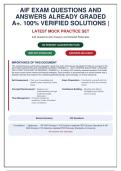
AIF EXAM QUESTIONS AND
ANSWERS ALREADY GRADED
A+. 100% VERIFIED SOLUTIONS |
LATEST MOCK PRACTICE SET
240 Questions with Answers and Detailed Rationales
100 PERCENT GUARANTEED PASS
INSTANT DOWNLOAD ANSWERS INCLUDED
IMPORTANCE OF THIS DOCUMENT
This comprehensive examination preparation guide has been meticulously developed to help you succeed in the
AIF EXAM QUESTIONS AND ANSWERS ALREADY GRADED A+. 100% VERIFIED SOLUTIONS | UPDATED
PER LATEST FIDUCIARY STANDARDS | GRADED A+. It contains 240 carefully selected questions that reflect
the most current exam content and testing strategies. Each question is accompanied by a correct answer and a
detailed rationale that explains the underlying pathophysiology, pharmacology, or clinical reasoning.
Self-Assessment – Test your knowledge and Exam Preparation – Familiarize yourself with the
identify areas requiring further question format and content
study areas
Concept Reinforcement – Deepen your Confidence Building – Develop test-taking
understanding through strategies and reduce
evidence-based exam anxiety
rationales
Time Management – Practice answering
questions under simulated
exam conditions
Review Summary 240 Questions
Foundations - Application - AIF AND Already A 100 Solutions Updated PER Fiduciary Standards A AIF
AND Already A 100 Solutions Updated PER Fiduciary Standards A University
All answers with rationales
,Table of Contents
Section A - Fiduciary Standards AND Section B - Investment Fiduciary
Duties Responsibilities
Questions 1 to 60 Questions 61 to 120
Section C - Prudent Investor RULE Section D - Portfolio Management
Questions 121 to 180 AND Asset Allocation
Questions 181 to 240
,Section A - Fiduciary Standards AND Duties
Q1.
Under the Prudent Investor Rule, a fiduciary must consider the role of each investment
within the total portfolio. Which of the following best describes the standard for evaluating
an individual investment's risk?
A. Each investment must be evaluated in B. An investment's risk is assessed based
isolation to ensure it meets a minimum on its contribution to the portfolio's overall
risk-return threshold. risk-return profile, not in isolation.
C. Only investments with a beta less than D. The fiduciary must avoid any investment
1.0 are permissible under the Prudent that has a probability of loss exceeding 10%
Investor Rule. in any given year.
Correct: B - An investment's risk is assessed based on its contribution to the portfolio's
overall risk-return profile, not in isolation.
Rationale:The Prudent Investor Rule (Restatement Third of Trusts) requires a
portfolio-focused approach, evaluating each investment in the context of the entire portfolio.
Option B correctly reflects this modern portfolio theory standard. Options A and C are
incorrect because the rule does not require isolation or a specific beta threshold. Option D is
incorrect because no fixed probability of loss is mandated.
Q2.
A fiduciary is considering a concentrated position in a single stock that has appreciated
significantly. Under the Uniform Prudent Investor Act (UPIA), which factor is most critical
when deciding whether to diversify?
A. The fiduciary's expectation that the stock B. The trust's investment objectives and the
will continue to outperform the market. role of the stock within the portfolio.
C. The tax consequences of selling the D. The beneficiary's emotional attachment
stock. to the stock.
Correct: B - The trust's investment objectives and the role of the stock within the portfolio.
Rationale:UPIA Section 3 mandates diversification unless the fiduciary reasonably
determines that it is in the interests of the beneficiaries not to diversify. The decision must be
based on the trust's investment objectives and the portfolio context (B). Tax consequences
(C) and beneficiary preferences (D) may be considered but are not the primary factor.
Expectations of future outperformance (A) alone do not justify concentration under the
prudent investor standard.
Page 3
, Section A - Fiduciary Standards AND Duties
Q3.
In applying the Restatement (Third) of Trusts: Prudent Investor Rule, which of the
following best describes the fiduciary's duty with respect to costs?
A. The fiduciary must minimize all B. The fiduciary must incur only costs that
transaction costs, regardless of other are reasonable and appropriate in relation to
considerations. the trust's objectives and the value of the
trust estate.
C. The fiduciary is required to use only D. The fiduciary must avoid any investment
no-load mutual funds to avoid sales with an expense ratio above 0.50%.
charges.
Correct: B - The fiduciary must incur only costs that are reasonable and appropriate in
relation to the trust's objectives and the value of the trust estate.
Rationale:The Restatement (Third) emphasizes that the fiduciary has a duty to minimize
costs, but only insofar as they are reasonable and appropriate given the trust's objectives and
the value of the trust estate (B). Option A is too absolute; cost minimization must be balanced
with other duties. Options C and D impose arbitrary thresholds not found in the Restatement.
Q4.
A trust instrument directs the trustee to 'invest in high-quality bonds only.' The trustee is
considering purchasing a bond rated BB by Standard & Poor's. Under the Uniform
Prudent Investor Act, what is the trustee's best course of action?
A. Purchase the bond because the trustee B. Seek court modification of the trust terms
has discretion to override the trust terms if it before purchasing the bond.
benefits the beneficiaries.
C. Do not purchase the bond, as the trust D. Purchase the bond and then notify the
terms are binding unless modified by court beneficiaries of the deviation.
order.
Correct: C - Do not purchase the bond, as the trust terms are binding unless modified by
court order.
Rationale:Under UPIA, the trustee must follow the terms of the trust unless they are contrary
to public policy or impossible to fulfill. A direction to invest only in high-quality bonds is
binding, and a BB-rated bond is below investment grade. The trustee must not purchase it
(C). Court modification (B) is possible but not the immediate course; the trustee cannot
unilaterally override (A) or deviate without permission (D).
Q5.
Which of the following statements about the delegation of investment functions under the
Uniform Prudent Investor Act is correct?
Page 4
ANSWERS ALREADY GRADED
A+. 100% VERIFIED SOLUTIONS |
LATEST MOCK PRACTICE SET
240 Questions with Answers and Detailed Rationales
100 PERCENT GUARANTEED PASS
INSTANT DOWNLOAD ANSWERS INCLUDED
IMPORTANCE OF THIS DOCUMENT
This comprehensive examination preparation guide has been meticulously developed to help you succeed in the
AIF EXAM QUESTIONS AND ANSWERS ALREADY GRADED A+. 100% VERIFIED SOLUTIONS | UPDATED
PER LATEST FIDUCIARY STANDARDS | GRADED A+. It contains 240 carefully selected questions that reflect
the most current exam content and testing strategies. Each question is accompanied by a correct answer and a
detailed rationale that explains the underlying pathophysiology, pharmacology, or clinical reasoning.
Self-Assessment – Test your knowledge and Exam Preparation – Familiarize yourself with the
identify areas requiring further question format and content
study areas
Concept Reinforcement – Deepen your Confidence Building – Develop test-taking
understanding through strategies and reduce
evidence-based exam anxiety
rationales
Time Management – Practice answering
questions under simulated
exam conditions
Review Summary 240 Questions
Foundations - Application - AIF AND Already A 100 Solutions Updated PER Fiduciary Standards A AIF
AND Already A 100 Solutions Updated PER Fiduciary Standards A University
All answers with rationales
,Table of Contents
Section A - Fiduciary Standards AND Section B - Investment Fiduciary
Duties Responsibilities
Questions 1 to 60 Questions 61 to 120
Section C - Prudent Investor RULE Section D - Portfolio Management
Questions 121 to 180 AND Asset Allocation
Questions 181 to 240
,Section A - Fiduciary Standards AND Duties
Q1.
Under the Prudent Investor Rule, a fiduciary must consider the role of each investment
within the total portfolio. Which of the following best describes the standard for evaluating
an individual investment's risk?
A. Each investment must be evaluated in B. An investment's risk is assessed based
isolation to ensure it meets a minimum on its contribution to the portfolio's overall
risk-return threshold. risk-return profile, not in isolation.
C. Only investments with a beta less than D. The fiduciary must avoid any investment
1.0 are permissible under the Prudent that has a probability of loss exceeding 10%
Investor Rule. in any given year.
Correct: B - An investment's risk is assessed based on its contribution to the portfolio's
overall risk-return profile, not in isolation.
Rationale:The Prudent Investor Rule (Restatement Third of Trusts) requires a
portfolio-focused approach, evaluating each investment in the context of the entire portfolio.
Option B correctly reflects this modern portfolio theory standard. Options A and C are
incorrect because the rule does not require isolation or a specific beta threshold. Option D is
incorrect because no fixed probability of loss is mandated.
Q2.
A fiduciary is considering a concentrated position in a single stock that has appreciated
significantly. Under the Uniform Prudent Investor Act (UPIA), which factor is most critical
when deciding whether to diversify?
A. The fiduciary's expectation that the stock B. The trust's investment objectives and the
will continue to outperform the market. role of the stock within the portfolio.
C. The tax consequences of selling the D. The beneficiary's emotional attachment
stock. to the stock.
Correct: B - The trust's investment objectives and the role of the stock within the portfolio.
Rationale:UPIA Section 3 mandates diversification unless the fiduciary reasonably
determines that it is in the interests of the beneficiaries not to diversify. The decision must be
based on the trust's investment objectives and the portfolio context (B). Tax consequences
(C) and beneficiary preferences (D) may be considered but are not the primary factor.
Expectations of future outperformance (A) alone do not justify concentration under the
prudent investor standard.
Page 3
, Section A - Fiduciary Standards AND Duties
Q3.
In applying the Restatement (Third) of Trusts: Prudent Investor Rule, which of the
following best describes the fiduciary's duty with respect to costs?
A. The fiduciary must minimize all B. The fiduciary must incur only costs that
transaction costs, regardless of other are reasonable and appropriate in relation to
considerations. the trust's objectives and the value of the
trust estate.
C. The fiduciary is required to use only D. The fiduciary must avoid any investment
no-load mutual funds to avoid sales with an expense ratio above 0.50%.
charges.
Correct: B - The fiduciary must incur only costs that are reasonable and appropriate in
relation to the trust's objectives and the value of the trust estate.
Rationale:The Restatement (Third) emphasizes that the fiduciary has a duty to minimize
costs, but only insofar as they are reasonable and appropriate given the trust's objectives and
the value of the trust estate (B). Option A is too absolute; cost minimization must be balanced
with other duties. Options C and D impose arbitrary thresholds not found in the Restatement.
Q4.
A trust instrument directs the trustee to 'invest in high-quality bonds only.' The trustee is
considering purchasing a bond rated BB by Standard & Poor's. Under the Uniform
Prudent Investor Act, what is the trustee's best course of action?
A. Purchase the bond because the trustee B. Seek court modification of the trust terms
has discretion to override the trust terms if it before purchasing the bond.
benefits the beneficiaries.
C. Do not purchase the bond, as the trust D. Purchase the bond and then notify the
terms are binding unless modified by court beneficiaries of the deviation.
order.
Correct: C - Do not purchase the bond, as the trust terms are binding unless modified by
court order.
Rationale:Under UPIA, the trustee must follow the terms of the trust unless they are contrary
to public policy or impossible to fulfill. A direction to invest only in high-quality bonds is
binding, and a BB-rated bond is below investment grade. The trustee must not purchase it
(C). Court modification (B) is possible but not the immediate course; the trustee cannot
unilaterally override (A) or deviate without permission (D).
Q5.
Which of the following statements about the delegation of investment functions under the
Uniform Prudent Investor Act is correct?
Page 4


