
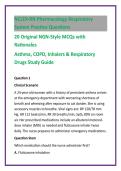
NCLEX-RN Pharmacology Respiratory
System Practice Questions
20 Original NGN-Style MCQs with
Rationales
Asthma, COPD, Inhalers & Respiratory
Drugs Study Guide
Question 1
Clinical Scenario
A 24-year-old woman with a history of persistent asthma arrives
at the emergency department with worsening shortness of
breath and wheezing after exposure to cat dander. She is using
accessory muscles to breathe. Vital signs are: BP 128/78 mm
Hg, HR 112 beats/min, RR 30 breaths/min, SpO₂ 89% on room
air. Her prescribed medications include an albuterol metered-
dose inhaler (MDI) as needed and fluticasone inhaler twice
daily. The nurse prepares to administer emergency medications.
Question Stem
Which medication should the nurse administer first?
A. Fluticasone inhalation
,B. Montelukast orally
C. Albuterol inhalation
D. Tiotropium inhalation
Correct Answer
Correct Answer: C. Albuterol inhalation
Detailed Rationale
Albuterol is a short-acting beta₂-adrenergic agonist (SABA) that
rapidly relaxes bronchial smooth muscle through stimulation of
beta₂ receptors, producing bronchodilation within minutes. This
patient demonstrates signs of an acute asthma exacerbation,
including hypoxemia, tachypnea, wheezing, and increased work
of breathing. Immediate bronchodilation is the priority to
restore airflow and improve oxygenation. Supplemental oxygen
and further assessment should accompany medication
administration.
Option A: Fluticasone is an inhaled corticosteroid used for long-
term control of airway inflammation. It does not provide
immediate bronchodilation and should never be relied upon
during an acute attack.
Option B: Montelukast is a leukotriene receptor antagonist
used for maintenance therapy and prevention of exercise-
induced bronchospasm. Its onset is too slow for emergency
symptom relief.
,Option D: Tiotropium is a long-acting muscarinic antagonist
(LAMA) used for maintenance treatment in asthma and COPD
but is not appropriate for rapid reversal of acute bronchospasm.
Following albuterol administration, reassess breath sounds,
respiratory effort, oxygen saturation, heart rate, and response
to therapy. Teach patients that rescue inhalers relieve acute
symptoms, whereas inhaled corticosteroids prevent future
exacerbations.
Learning Objectives
After completing this question, the learner should be able to:
• Differentiate rescue from maintenance asthma
medications.
• Prioritize treatment during acute bronchospasm.
• Recognize indications for short-acting beta₂ agonists.
Medication Safety Focus
Priority nursing action
Question 2
Clinical Scenario
A 67-year-old man with moderate chronic obstructive
pulmonary disease (COPD) has been prescribed tiotropium via a
, dry powder inhaler. During discharge teaching, the nurse
evaluates the client's understanding of proper medication use.
Question Stem
Which statement by the client indicates correct understanding
of the medication?
A. "I will use this inhaler whenever I suddenly become short of
breath."
B. "This medication helps prevent breathing problems, but I still
need my rescue inhaler."
C. "I should stop taking this medication once I feel better."
D. "I can swallow the inhalation capsule if I have trouble using
the device."
Correct Answer
Correct Answer: B. "This medication helps prevent breathing
problems, but I still need my rescue inhaler."
Detailed Rationale
Tiotropium is a long-acting muscarinic antagonist that produces
sustained bronchodilation by blocking acetylcholine-mediated
bronchoconstriction. It is prescribed for maintenance treatment
of COPD and selected patients with asthma but is not effective
for immediate symptom relief during acute respiratory distress.
System Practice Questions
20 Original NGN-Style MCQs with
Rationales
Asthma, COPD, Inhalers & Respiratory
Drugs Study Guide
Question 1
Clinical Scenario
A 24-year-old woman with a history of persistent asthma arrives
at the emergency department with worsening shortness of
breath and wheezing after exposure to cat dander. She is using
accessory muscles to breathe. Vital signs are: BP 128/78 mm
Hg, HR 112 beats/min, RR 30 breaths/min, SpO₂ 89% on room
air. Her prescribed medications include an albuterol metered-
dose inhaler (MDI) as needed and fluticasone inhaler twice
daily. The nurse prepares to administer emergency medications.
Question Stem
Which medication should the nurse administer first?
A. Fluticasone inhalation
,B. Montelukast orally
C. Albuterol inhalation
D. Tiotropium inhalation
Correct Answer
Correct Answer: C. Albuterol inhalation
Detailed Rationale
Albuterol is a short-acting beta₂-adrenergic agonist (SABA) that
rapidly relaxes bronchial smooth muscle through stimulation of
beta₂ receptors, producing bronchodilation within minutes. This
patient demonstrates signs of an acute asthma exacerbation,
including hypoxemia, tachypnea, wheezing, and increased work
of breathing. Immediate bronchodilation is the priority to
restore airflow and improve oxygenation. Supplemental oxygen
and further assessment should accompany medication
administration.
Option A: Fluticasone is an inhaled corticosteroid used for long-
term control of airway inflammation. It does not provide
immediate bronchodilation and should never be relied upon
during an acute attack.
Option B: Montelukast is a leukotriene receptor antagonist
used for maintenance therapy and prevention of exercise-
induced bronchospasm. Its onset is too slow for emergency
symptom relief.
,Option D: Tiotropium is a long-acting muscarinic antagonist
(LAMA) used for maintenance treatment in asthma and COPD
but is not appropriate for rapid reversal of acute bronchospasm.
Following albuterol administration, reassess breath sounds,
respiratory effort, oxygen saturation, heart rate, and response
to therapy. Teach patients that rescue inhalers relieve acute
symptoms, whereas inhaled corticosteroids prevent future
exacerbations.
Learning Objectives
After completing this question, the learner should be able to:
• Differentiate rescue from maintenance asthma
medications.
• Prioritize treatment during acute bronchospasm.
• Recognize indications for short-acting beta₂ agonists.
Medication Safety Focus
Priority nursing action
Question 2
Clinical Scenario
A 67-year-old man with moderate chronic obstructive
pulmonary disease (COPD) has been prescribed tiotropium via a
, dry powder inhaler. During discharge teaching, the nurse
evaluates the client's understanding of proper medication use.
Question Stem
Which statement by the client indicates correct understanding
of the medication?
A. "I will use this inhaler whenever I suddenly become short of
breath."
B. "This medication helps prevent breathing problems, but I still
need my rescue inhaler."
C. "I should stop taking this medication once I feel better."
D. "I can swallow the inhalation capsule if I have trouble using
the device."
Correct Answer
Correct Answer: B. "This medication helps prevent breathing
problems, but I still need my rescue inhaler."
Detailed Rationale
Tiotropium is a long-acting muscarinic antagonist that produces
sustained bronchodilation by blocking acetylcholine-mediated
bronchoconstriction. It is prescribed for maintenance treatment
of COPD and selected patients with asthma but is not effective
for immediate symptom relief during acute respiratory distress.


