
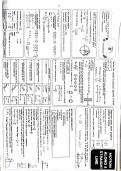
Motion with constant acceleration: Equations of motion
SISTANCEg (O v=uat Important points about graphical
MOTION
Distace = Length of actual poth (i)]S =ut* at analysis of motion
•Displacement Length of
shortest path B
•A Person travels from A to B covers unequal distances in equal
interval of timne with constant acceleration a then
• Instantaneous velocity is the siope of
position-time curve
ALONG A
[ox jodnl STRAIGHT
DISPLACEMENT Am
•Distance > jdisplacement
initial velocity y= 3S, -S, • Area of v-t curve gives displacement
2+ Slope. of velocity-time curve = instantaneous
A particie moves from A to B in a circular path of Acceleration a: S,-S, acceleration
LINE
radius R covering an angle 0 with uniform speed U
(H)|zu'2a.s
• Area of a-t curve gives change in velocity.
[av=fodr]
• Distance =18. Re • Displacement=AB= 2RSin • The number of planks required to stop the bullet u
• Ratio of Displacement to Distance = Sin ) A car accelerates from rest at a constant rate a for some time, after which it
N= decelerates a constant rate B, to come to rest. If the total time elapsed is t, then
Tine R u-y²
Average Velocity = 2Usn (9) The two ends of a train moving with constant acceleration pass a
certain point with velocitles u and v. The velocity with which the aß
Total Distance
middle point of the train passes the same point is
• Average Acceleration U'Sin
R
.
u
Calculation of stopping distance s: MOTION UNDER GRAVITY
Sign Cornvention
For uniform motion
(3, =u-(2n-1)| () initial velocity
Displacement = velocity x time +ve upward motion
• Ratio of distance travelled in equal interval of time in a uniformly
Average speed = laverage velocityl= (instantaneous velocityl accelerated motion from rest -ve downward motion
S,:S,:s, = 1:3:5 (it) Acceleration
Always -ve
Time average speed (ii) Displacement
Total dístanceecOVered t, v$, +vt.. • for uniform accelerated motion we = final position is above initial position
Totafttne elapsed t,+ +t+....+ T, t, •t+t, +. -ve = final position is below initial position
Zero = final position & initial position are at same level
If t, =, =t, =....zt,
then DIfferent Cases v-t graph s-t graph Object is dropped from top of a tower
(6) Ratio of displacement in equal interval of tie S,:5,:5,....:1:3:5.
1. Uniform motion yaconstat
for Vi z, () Ratio of time of covering equal distance
hmetic mean of speeds) t,:(t,-t,):(t,-t,);....:(t,-t,.,)= 1: (/2-Ī):(/3-V2):...«n-n-1
(ii) Ratio of total distance covered at the end of timet:2t:3t:. 1':2:3...
o Distance average speed
2. Uniformly accelerated motion If a body is thrown verticaly up with a velocity u in the uniform gravitational field (reglecting
Total distance covered *5*.:Sn 5 *3....*s, alr resistance) then
eTotaltime elapsed
V,
,4,S....
V, (0 Maximum helght attained Ha
then 3. Uniformly accelerated with szut+tat? (0 Thne of ascent time of descent
for v, & Yz 2v,,
u0 at t=0 & se0 at t=0
(iu) Total tine of flight =
V„v.V, speeds)
(Hormon ic mean of
(tv) Velocity of fall at the point of projection u (dowwards)
4. Uniformly accelerated motion /ss,uttat At point on its path the body will have same speed for upward journey and
with ub and ss, at t=0 downward journey. If a bodyy thrown upwards crosses a point in time t, & t,
Instantaneous Velocity v# respectively then
Instantaneous Acceleration AV=fadt
5. Uniformly retarded motion till
height of point h=t gt,t, Maximum height H t*t)°
Cas 2 velocity becomes zero Time of flight 1,+t,=
vaf(t) r x=f(t) Ve f(c) tef)
dv_d'x then A body is thrown upward,downward & horizontally with same speed
Gs-(double diff. of t w.r.t. x) y takes time t,. t, & t, respectively to reach the ground then
6. Uniformly retarded then 1S=ut-tat
Differnttetion. Differetietion, accelerated in opposite T3 *t,t, & height from where the particle was throw is hzt st2
1Displaoement 2 Velecity Acceleratlon direction
Itegetie
SISTANCEg (O v=uat Important points about graphical
MOTION
Distace = Length of actual poth (i)]S =ut* at analysis of motion
•Displacement Length of
shortest path B
•A Person travels from A to B covers unequal distances in equal
interval of timne with constant acceleration a then
• Instantaneous velocity is the siope of
position-time curve
ALONG A
[ox jodnl STRAIGHT
DISPLACEMENT Am
•Distance > jdisplacement
initial velocity y= 3S, -S, • Area of v-t curve gives displacement
2+ Slope. of velocity-time curve = instantaneous
A particie moves from A to B in a circular path of Acceleration a: S,-S, acceleration
LINE
radius R covering an angle 0 with uniform speed U
(H)|zu'2a.s
• Area of a-t curve gives change in velocity.
[av=fodr]
• Distance =18. Re • Displacement=AB= 2RSin • The number of planks required to stop the bullet u
• Ratio of Displacement to Distance = Sin ) A car accelerates from rest at a constant rate a for some time, after which it
N= decelerates a constant rate B, to come to rest. If the total time elapsed is t, then
Tine R u-y²
Average Velocity = 2Usn (9) The two ends of a train moving with constant acceleration pass a
certain point with velocitles u and v. The velocity with which the aß
Total Distance
middle point of the train passes the same point is
• Average Acceleration U'Sin
R
.
u
Calculation of stopping distance s: MOTION UNDER GRAVITY
Sign Cornvention
For uniform motion
(3, =u-(2n-1)| () initial velocity
Displacement = velocity x time +ve upward motion
• Ratio of distance travelled in equal interval of time in a uniformly
Average speed = laverage velocityl= (instantaneous velocityl accelerated motion from rest -ve downward motion
S,:S,:s, = 1:3:5 (it) Acceleration
Always -ve
Time average speed (ii) Displacement
Total dístanceecOVered t, v$, +vt.. • for uniform accelerated motion we = final position is above initial position
Totafttne elapsed t,+ +t+....+ T, t, •t+t, +. -ve = final position is below initial position
Zero = final position & initial position are at same level
If t, =, =t, =....zt,
then DIfferent Cases v-t graph s-t graph Object is dropped from top of a tower
(6) Ratio of displacement in equal interval of tie S,:5,:5,....:1:3:5.
1. Uniform motion yaconstat
for Vi z, () Ratio of time of covering equal distance
hmetic mean of speeds) t,:(t,-t,):(t,-t,);....:(t,-t,.,)= 1: (/2-Ī):(/3-V2):...«n-n-1
(ii) Ratio of total distance covered at the end of timet:2t:3t:. 1':2:3...
o Distance average speed
2. Uniformly accelerated motion If a body is thrown verticaly up with a velocity u in the uniform gravitational field (reglecting
Total distance covered *5*.:Sn 5 *3....*s, alr resistance) then
eTotaltime elapsed
V,
,4,S....
V, (0 Maximum helght attained Ha
then 3. Uniformly accelerated with szut+tat? (0 Thne of ascent time of descent
for v, & Yz 2v,,
u0 at t=0 & se0 at t=0
(iu) Total tine of flight =
V„v.V, speeds)
(Hormon ic mean of
(tv) Velocity of fall at the point of projection u (dowwards)
4. Uniformly accelerated motion /ss,uttat At point on its path the body will have same speed for upward journey and
with ub and ss, at t=0 downward journey. If a bodyy thrown upwards crosses a point in time t, & t,
Instantaneous Velocity v# respectively then
Instantaneous Acceleration AV=fadt
5. Uniformly retarded motion till
height of point h=t gt,t, Maximum height H t*t)°
Cas 2 velocity becomes zero Time of flight 1,+t,=
vaf(t) r x=f(t) Ve f(c) tef)
dv_d'x then A body is thrown upward,downward & horizontally with same speed
Gs-(double diff. of t w.r.t. x) y takes time t,. t, & t, respectively to reach the ground then
6. Uniformly retarded then 1S=ut-tat
Differnttetion. Differetietion, accelerated in opposite T3 *t,t, & height from where the particle was throw is hzt st2
1Displaoement 2 Velecity Acceleratlon direction
Itegetie


