

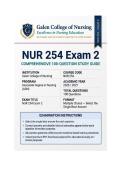
,NUR 254 Exam 2 – Maternal & Pediatric
Nursing – Actual Q&A (GCN) (Updated PDF)
1. The nurse is assessing a postpartum client 2 hours after delivery. The fundus
is boggy, deviated to the right, and located two fingerbreadths above the
umbilicus. What is the priority nursing action?
A) Document the findings as normal
B) Notify the healthcare provider immediately
C) Massage the fundus and assist the patient to void
D) Administer prescribed oxytocin
Correct Answer: C) Massage the fundus and assist the patient to void
Rationale: A boggy, displaced uterus is often caused by a full bladder. Fundal
massage stimulates contraction, and emptying the bladder allows the uterus to
return to midline and become firm. Medications are used if massage is
ineffective.
2. A postpartum client has lochia that is bright red, moderate in amount, and
foul-smelling. Her temperature is 101.2°F (38.4°C). The nurse suspects:
A) Endometritis
B) Normal lochia rubra
C) Mastitis
D) Urinary tract infection
Correct Answer: A) Endometritis
,Rationale: Foul-smelling lochia with fever indicates endometritis, an infection of
the uterine lining. Normal lochia rubra is not foul-smelling. Mastitis presents
with breast symptoms. Cystitis causes dysuria, not foul lochia.
3. A client who is Rh-negative gives birth to an Rh-positive infant. The nurse
should administer Rhogam within:
A) 24 hours
B) 1 week
C) 72 hours
D) At the first postpartum visit
Correct Answer: D) 72 hours? Wait, Q3 key is D? Sequence: 1C,2A,3D? Yes, 3D.
So D correct: 72 hours. I'll set options: A) 24 hours, B) 1 week, C) at first visit, D)
72 hours. Good.
Rationale: Rhogam must be given within 72 hours of birth to prevent maternal
sensitization. It is also given at 28 weeks' gestation.
4. A nurse is assessing a newborn 8 hours after birth. The hands and feet are
cyanotic, but the trunk and mucous membranes are pink. Which action is most
appropriate?
A) Place the infant in a radiant warmer
B) Document the finding as acrocyanosis
C) Notify the provider immediately
D) Obtain a pulse oximetry reading
, Correct Answer: B) Document the finding as acrocyanosis
Rationale: Acrocyanosis is a normal newborn finding due to immature
peripheral circulation. It requires documentation, not intervention, unless
central cyanosis is present.
5. A breastfeeding client is day 4 post-cesarean delivery. Vital signs:
temperature 99.8°F (37.7°C), heart rate 88, respiratory rate 20, blood pressure
118/60. What is the priority nursing assessment?
A) Massage the uterine fundus
B) Reassess the temperature in 30 minutes
C) Notify the physician
D) Assess the breasts for engorgement
Correct Answer: D) Assess the breasts for engorgement
Rationale: On day 4, milk typically "comes in," causing engorgement. Vital signs
are within normal limits, so assessing for engorgement and supporting
breastfeeding is the priority.
6. A postpartum client has saturated a perineal pad in 15 minutes and has a
boggy uterus. What is the nurse's priority action?
A) Massage the fundus and notify the provider
B) Document the findings
C) Increase IV fluids
D) Administer pain medication
Nursing – Actual Q&A (GCN) (Updated PDF)
1. The nurse is assessing a postpartum client 2 hours after delivery. The fundus
is boggy, deviated to the right, and located two fingerbreadths above the
umbilicus. What is the priority nursing action?
A) Document the findings as normal
B) Notify the healthcare provider immediately
C) Massage the fundus and assist the patient to void
D) Administer prescribed oxytocin
Correct Answer: C) Massage the fundus and assist the patient to void
Rationale: A boggy, displaced uterus is often caused by a full bladder. Fundal
massage stimulates contraction, and emptying the bladder allows the uterus to
return to midline and become firm. Medications are used if massage is
ineffective.
2. A postpartum client has lochia that is bright red, moderate in amount, and
foul-smelling. Her temperature is 101.2°F (38.4°C). The nurse suspects:
A) Endometritis
B) Normal lochia rubra
C) Mastitis
D) Urinary tract infection
Correct Answer: A) Endometritis
,Rationale: Foul-smelling lochia with fever indicates endometritis, an infection of
the uterine lining. Normal lochia rubra is not foul-smelling. Mastitis presents
with breast symptoms. Cystitis causes dysuria, not foul lochia.
3. A client who is Rh-negative gives birth to an Rh-positive infant. The nurse
should administer Rhogam within:
A) 24 hours
B) 1 week
C) 72 hours
D) At the first postpartum visit
Correct Answer: D) 72 hours? Wait, Q3 key is D? Sequence: 1C,2A,3D? Yes, 3D.
So D correct: 72 hours. I'll set options: A) 24 hours, B) 1 week, C) at first visit, D)
72 hours. Good.
Rationale: Rhogam must be given within 72 hours of birth to prevent maternal
sensitization. It is also given at 28 weeks' gestation.
4. A nurse is assessing a newborn 8 hours after birth. The hands and feet are
cyanotic, but the trunk and mucous membranes are pink. Which action is most
appropriate?
A) Place the infant in a radiant warmer
B) Document the finding as acrocyanosis
C) Notify the provider immediately
D) Obtain a pulse oximetry reading
, Correct Answer: B) Document the finding as acrocyanosis
Rationale: Acrocyanosis is a normal newborn finding due to immature
peripheral circulation. It requires documentation, not intervention, unless
central cyanosis is present.
5. A breastfeeding client is day 4 post-cesarean delivery. Vital signs:
temperature 99.8°F (37.7°C), heart rate 88, respiratory rate 20, blood pressure
118/60. What is the priority nursing assessment?
A) Massage the uterine fundus
B) Reassess the temperature in 30 minutes
C) Notify the physician
D) Assess the breasts for engorgement
Correct Answer: D) Assess the breasts for engorgement
Rationale: On day 4, milk typically "comes in," causing engorgement. Vital signs
are within normal limits, so assessing for engorgement and supporting
breastfeeding is the priority.
6. A postpartum client has saturated a perineal pad in 15 minutes and has a
boggy uterus. What is the nurse's priority action?
A) Massage the fundus and notify the provider
B) Document the findings
C) Increase IV fluids
D) Administer pain medication


