

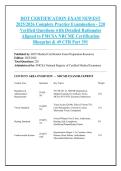
DOT CERTIFICATION EXAM NEWEST
2025/2026 Complete Practice Examination - 220
Verified Questions with Detailed Rationales
Aligned to FMCSA NRCME Certification
Blueprint & 49 CFR Part 391
Published by: DOT Medical Certification Exam Preparation Resources
Edition: 2025/2026
Total Questions: 220
Administered by: FMCSA National Registry of Certified Medical Examiners
CONTENT AREA OVERVIEW — NRCME EXAM BLUEPRINT
Content Area Questions Key Topics Weight
Regulatory & 49 CFR 391.41, NRCME Registration,
28 (Q1-
Administrative Medical Examiner's Certificate, Forms 13%
28)
Requirements MCSA-5875/5876, Electronic Submission
Visual Acuity (20/40), Field of Vision (70°),
24 (Q29-
Vision Standards Color Recognition, Corrective Lenses, 11%
52)
Monocular Vision, Exemptions
Forced Whisper Test (5 feet), Audiometry,
20 (Q53-
Hearing Standards Hearing Aids, Exemptions, 9%
72)
Qualifying/Disqualifying Criteria
Hypertension (Stages 1-3), Coronary Artery
28 (Q73-
Cardiovascular System Disease, Heart Failure, Arrhythmias, 13%
100)
Myocardial Infarction, Medications
,Content Area Questions Key Topics Weight
Diabetes Mellitus (Type 1/2), Insulin-
Endocrine & 22 (Q101-
Treated Diabetes, Hypoglycemia, Thyroid 10%
Metabolic Disorders 122)
Disorders, Obesity
Seizure Disorders, Epilepsy, Stroke, Head
Neurological & 24 (Q123-
Injury, Dementia, Depression, Anxiety, 11%
Psychiatric Disorders 146)
Substance Use
Sleep Apnea, COPD, Asthma, Pulmonary
Respiratory & Sleep 20 (Q147-
Hypertension, Oxygen Use, Respiratory 9%
Disorders 166)
Medications
Range of Motion, Amputations, Prosthetics,
Musculoskeletal & 18 (Q167-
Spinal Conditions, Physical Exam 8%
Physical Examination 184)
Techniques
Prescription Medications, Controlled
Medications & 18 (Q185-
Substances, Drug Testing, Alcohol Use, 8%
Substance Use 202)
Schedule I Substances
Clinical Decision-
18 (Q203- Certification Periods, Exemptions, Waivers,
Making & Special 8%
220) Complex Cases, Documentation, Ethics
Populations
SECTION 1: REGULATORY & ADMINISTRATIVE REQUIREMENTS
1. A driver presents for a physical examination. What is the minimum vision
requirement for a commercial driver's license (CDL) holder?
A) 20/40 in each eye without correction
B) 20/40 in each eye with or without correction
C) 20/50 in the better eye with correction
D) 20/70 in one eye with correction
Correct Answer: B
,Rationale: FMCSA regulations (49 CFR §391.41(b)(10)) require a driver to have
distant visual acuity of at least 20/40 (Snellen) in each eye with or without
corrective lenses. The standard is based on the ability to read a Snellen chart at 20
feet.
2. A driver has a diagnosis of unstable proliferative retinopathy. The Medical
Examiner should:
A) Issue a one-year certificate
B) Disqualify the driver
C) Issue a 3-month temporary certificate
D) Require a waiver from the state
Correct Answer: B
Rationale: Unstable proliferative retinopathy is a disqualifying eye condition due
to the high risk of vision loss and hemorrhage. It must be diagnosed by an
ophthalmologist. The driver may be qualified only after treatment and stabilization.
3. A driver has a hearing loss. According to FMCSA standards, the driver
must be able to:
A) Hear a normal conversation in the better ear at 10 feet
B) Hear a forced whisper in the better ear at 5 feet
C) Hear a forced whisper in the worse ear at 5 feet
D) Hear a forced whisper in both ears at 5 feet
Correct Answer: B
Rationale: FMCSA regulations (49 CFR §391.41(b)(11)) require that a driver first
perceives a forced whispered voice in the better ear at not less than 5 feet, with or
without the use of a hearing aid.
4. What is the maximum certification period a Medical Examiner can issue for
a driver who meets all physical qualification standards?
A) 6 months
B) 1 year
, C) 2 years
D) 3 years
Correct Answer: C
Rationale: The maximum time a medical examiner can certify a driver is 2 years.
The ME can certify for a period of time less than 2 years based on medical
conditions.
5. According to FMCSA regulations, a driver with blood pressure less than
140/90 may be certified for what period?
A) 6 months
B) 1 year
C) 2 years
D) 3 months
Correct Answer: C
Rationale: A driver with blood pressure <140/90 mmHg may be certified for the
maximum 2-year period (if no other disqualifying condition exists).
6. A driver presents with Stage 1 hypertension (blood pressure 140-159/90-99).
What is the appropriate certification period?
A) 2 years
B) 1 year
C) 6 months
D) Disqualify
Correct Answer: B
Rationale: Stage 1 hypertension (140-159/90-99) typically allows for a 1-year
certification period.
7. A driver with insulin-treated diabetes mellitus (ITDM) may be certified for
what maximum period?
2025/2026 Complete Practice Examination - 220
Verified Questions with Detailed Rationales
Aligned to FMCSA NRCME Certification
Blueprint & 49 CFR Part 391
Published by: DOT Medical Certification Exam Preparation Resources
Edition: 2025/2026
Total Questions: 220
Administered by: FMCSA National Registry of Certified Medical Examiners
CONTENT AREA OVERVIEW — NRCME EXAM BLUEPRINT
Content Area Questions Key Topics Weight
Regulatory & 49 CFR 391.41, NRCME Registration,
28 (Q1-
Administrative Medical Examiner's Certificate, Forms 13%
28)
Requirements MCSA-5875/5876, Electronic Submission
Visual Acuity (20/40), Field of Vision (70°),
24 (Q29-
Vision Standards Color Recognition, Corrective Lenses, 11%
52)
Monocular Vision, Exemptions
Forced Whisper Test (5 feet), Audiometry,
20 (Q53-
Hearing Standards Hearing Aids, Exemptions, 9%
72)
Qualifying/Disqualifying Criteria
Hypertension (Stages 1-3), Coronary Artery
28 (Q73-
Cardiovascular System Disease, Heart Failure, Arrhythmias, 13%
100)
Myocardial Infarction, Medications
,Content Area Questions Key Topics Weight
Diabetes Mellitus (Type 1/2), Insulin-
Endocrine & 22 (Q101-
Treated Diabetes, Hypoglycemia, Thyroid 10%
Metabolic Disorders 122)
Disorders, Obesity
Seizure Disorders, Epilepsy, Stroke, Head
Neurological & 24 (Q123-
Injury, Dementia, Depression, Anxiety, 11%
Psychiatric Disorders 146)
Substance Use
Sleep Apnea, COPD, Asthma, Pulmonary
Respiratory & Sleep 20 (Q147-
Hypertension, Oxygen Use, Respiratory 9%
Disorders 166)
Medications
Range of Motion, Amputations, Prosthetics,
Musculoskeletal & 18 (Q167-
Spinal Conditions, Physical Exam 8%
Physical Examination 184)
Techniques
Prescription Medications, Controlled
Medications & 18 (Q185-
Substances, Drug Testing, Alcohol Use, 8%
Substance Use 202)
Schedule I Substances
Clinical Decision-
18 (Q203- Certification Periods, Exemptions, Waivers,
Making & Special 8%
220) Complex Cases, Documentation, Ethics
Populations
SECTION 1: REGULATORY & ADMINISTRATIVE REQUIREMENTS
1. A driver presents for a physical examination. What is the minimum vision
requirement for a commercial driver's license (CDL) holder?
A) 20/40 in each eye without correction
B) 20/40 in each eye with or without correction
C) 20/50 in the better eye with correction
D) 20/70 in one eye with correction
Correct Answer: B
,Rationale: FMCSA regulations (49 CFR §391.41(b)(10)) require a driver to have
distant visual acuity of at least 20/40 (Snellen) in each eye with or without
corrective lenses. The standard is based on the ability to read a Snellen chart at 20
feet.
2. A driver has a diagnosis of unstable proliferative retinopathy. The Medical
Examiner should:
A) Issue a one-year certificate
B) Disqualify the driver
C) Issue a 3-month temporary certificate
D) Require a waiver from the state
Correct Answer: B
Rationale: Unstable proliferative retinopathy is a disqualifying eye condition due
to the high risk of vision loss and hemorrhage. It must be diagnosed by an
ophthalmologist. The driver may be qualified only after treatment and stabilization.
3. A driver has a hearing loss. According to FMCSA standards, the driver
must be able to:
A) Hear a normal conversation in the better ear at 10 feet
B) Hear a forced whisper in the better ear at 5 feet
C) Hear a forced whisper in the worse ear at 5 feet
D) Hear a forced whisper in both ears at 5 feet
Correct Answer: B
Rationale: FMCSA regulations (49 CFR §391.41(b)(11)) require that a driver first
perceives a forced whispered voice in the better ear at not less than 5 feet, with or
without the use of a hearing aid.
4. What is the maximum certification period a Medical Examiner can issue for
a driver who meets all physical qualification standards?
A) 6 months
B) 1 year
, C) 2 years
D) 3 years
Correct Answer: C
Rationale: The maximum time a medical examiner can certify a driver is 2 years.
The ME can certify for a period of time less than 2 years based on medical
conditions.
5. According to FMCSA regulations, a driver with blood pressure less than
140/90 may be certified for what period?
A) 6 months
B) 1 year
C) 2 years
D) 3 months
Correct Answer: C
Rationale: A driver with blood pressure <140/90 mmHg may be certified for the
maximum 2-year period (if no other disqualifying condition exists).
6. A driver presents with Stage 1 hypertension (blood pressure 140-159/90-99).
What is the appropriate certification period?
A) 2 years
B) 1 year
C) 6 months
D) Disqualify
Correct Answer: B
Rationale: Stage 1 hypertension (140-159/90-99) typically allows for a 1-year
certification period.
7. A driver with insulin-treated diabetes mellitus (ITDM) may be certified for
what maximum period?


