

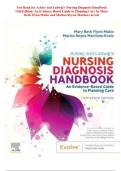
Test Bank for Nursing Diagnosis Handbook, 13th Edition by Ackley & Ladwig | Evidence-Based Nursing Care Study Resource
Prepare for your nursing coursework and strengthen your understanding of nursing diagnoses, clinical reasoning, and evidence-based patient care with this comprehensive study resource based on the Nursing Diagnosis Handbook, 13th Edition by Ackley and Ladwig. Designed for nursing students who want to reinforce their knowledge and prepare more effectively for coursework, assignments, quizzes, and examinations, this resource provides a convenient way to review important nursing concepts and apply them to clinical situations. The Nursing Diagnosis Handbook is widely used by nursing students and healthcare professionals as a resource for developing nursing diagnoses and planning individualized patient care. This study material is intended to complement your learning by helping you review key concepts related to nursing assessment, diagnosis, care planning, interventions, and evaluation. Whether you are studying for a nursing fundamentals course, medical-surgical nursing, clinical practice, or another nursing-related subject, this resource can support your revision by helping you connect theoretical knowledge with practical patient-care situations. One of the most important skills in nursing education is the ability to identify patient needs accurately and develop appropriate nursing diagnoses. Effective nursing care begins with a thorough assessment of the patient and the ability to recognize relevant signs, symptoms, risk factors, and contributing conditions. This resource can help students strengthen their understanding of the reasoning process involved in moving from patient assessment to nursing diagnosis and ultimately to an individualized plan of care. The material is particularly useful for students who want additional opportunities to review nursing diagnosis concepts and test their understanding. By working through practice material and reviewing explanations, learners can identify areas where they are confident and topics that may require additional study. A major focus of nursing education is the development of clinical judgment. Nurses must be able to collect relevant information, recognize important findings, prioritize patient needs, select appropriate interventions, and evaluate whether those interventions have achieved the desired outcomes. Reviewing nursing diagnosis and care-planning concepts can help students develop a structured approach to these important clinical responsibilities. This study resource may also help learners review the relationship between nursing diagnoses and evidence-based nursing care. Nursing interventions should be supported by appropriate clinical reasoning and evidence, while patient outcomes should be realistic, measurable, and relevant to the individual's condition and needs. Understanding this connection is essential for providing safe, effective, and patient-centered nursing care. Students can use this resource as part of a broader study plan. For example, you may begin by reviewing the relevant topic in your textbook or class notes, then use practice questions to evaluate your understanding. After completing a question, carefully review the rationale or explanation available in your study materials and identify why the selected answer is appropriate. This approach can help transform passive reading into active learning. The resource can be valuable when preparing for different types of academic assessments. Students may use it for regular revision throughout the semester, preparation before quizzes and examinations, clinical preparation, or review of challenging nursing concepts. It can also be used to identify areas that deserve additional attention before an important assessment. Key areas associated with nursing diagnosis and care planning include patient assessment, nursing diagnosis terminology, risk factors, related factors, defining characteristics, expected outcomes, nursing interventions, implementation, and evaluation. Reviewing these concepts can help nursing students better understand how each component contributes to the nursing process. The nursing process provides a structured framework for delivering patient care. Assessment involves collecting and analyzing information about the patient. Diagnosis involves identifying actual or potential patient problems that fall within the scope of nursing practice. Planning involves establishing appropriate outcomes and selecting interventions. Implementation involves carrying out the planned interventions, while evaluation determines whether the expected outcomes have been achieved or whether the care plan needs to be modified. Understanding each stage of the nursing process is essential for nursing students. This resource can be used to reinforce these concepts and encourage learners to think critically about how patient information influences nursing decisions. Another valuable aspect of studying nursing diagnoses is learning to distinguish between different types of patient problems. Students may need to recognize actual nursing diagnoses, risk diagnoses, and other relevant categories used in nursing practice. Developing this understanding can help learners approach clinical scenarios more systematically and select appropriate nursing priorities. The resource can also support preparation for questions that require application rather than simple memorization. Nursing assessments frequently present clinical situations in which students must determine the most appropriate nursing diagnosis, intervention, priority, or expected outcome. Practicing these types of scenarios can help learners develop stronger analytical and decision-making skills. For students who find care plans challenging, additional practice can be especially beneficial. Developing an effective nursing care plan requires the ability to connect assessment findings with an appropriate diagnosis, establish meaningful goals, select suitable interventions, and determine how patient progress will be evaluated. Reviewing these concepts repeatedly can help make the process more familiar and easier to apply. This study resource is also suitable for group study. Nursing students can work through practice questions together, discuss different answer choices, explain their reasoning, and identify areas where additional research or textbook review is needed. Group discussions can encourage deeper understanding and expose learners to different approaches to clinical reasoning. For individual study, students can use the material to create a structured revision routine. Consider dividing your study sessions into manageable topics, completing practice questions, reviewing explanations, and keeping track of concepts that require further review. Returning to difficult topics regularly can help reinforce learning over time. The resource is designed to be used alongside your primary course materials, including your textbook, lecture notes, instructor guidance, and other authorized educational resources. It should be viewed as a supplementary study aid rather than a replacement for formal instruction or the original textbook. If you are looking for an organized way to reinforce your understanding of nursing diagnoses and evidence-based patient care, this resource can be a useful addition to your nursing study collection. It can help you review important concepts, practice applying nursing knowledge, strengthen clinical reasoning, and prepare more confidently for academic assessments. Use this material to supplement your nursing education, focus on areas where you need additional practice, and develop a deeper understanding of the nursing process. Consistent review, active practice, and careful analysis of clinical scenarios can help you build the knowledge and reasoning skills needed for success in nursing school and future clinical practice. Important Note: This study resource is intended for educational and revision purposes. It is not affiliated with, sponsored by, or endorsed by Ackley, Ladwig, or the publisher of the Nursing Diagnosis Handbook. Students should use this resource together with the official textbook, course materials, and instructor-provided resources. No specific examination score or academic outcome is guaranteed.
Document information
- Uploaded on
- July 23, 2026
- Number of pages
- 100
- Written in
- 2025/2026
- Type
- Exam (elaborations)
- Contains
- Only questions


