
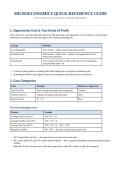
MICROECONOMICS QUICK-REFERENCE GUIDE
Core Concepts: Costs, Production, and Profit Maximization
1. Opportunity Cost & Two Kinds of Profit
Every choice has a next-best alternative given up. That giving-up is the opportunity cost of a decision, and it includes
both money you spend and value you forgo by not choosing something else.
Concept Definition
Accounting profit Total revenue − explicit costs (actual cash payments)
Economic profit Total revenue − explicit costs − implicit costs (opportunity costs of
owner's own resources)
Normal profit The economic profit level at which a firm just covers its opportunity
costs (economic profit = 0)
• A firm can show positive accounting profit while earning zero (or negative) economic profit.
• Economic profit above zero signals resources are earning more here than in their next-best use.
2. Cost Categories
Term Meaning Behavior as output rises
Fixed Cost (FC) Doesn't change with output (rent, equipment) Constant
Variable Cost (VC) Changes with output (materials, labor) Rises
Total Cost (TC) FC + VC Rises
Per-unit (average) costs
Measure Formula
Average Fixed Cost (AFC) AFC = FC ÷ Q
Average Variable Cost (AVC) AVC = VC ÷ Q
Average Total Cost (ATC) ATC = TC ÷ Q = AFC + AVC
Marginal Cost (MC) MC = ΔTC ÷ ΔQ (cost of producing one more unit)
• AFC always falls as Q rises — the same fixed cost is spread over more units.
• MC crosses both AVC and ATC at their minimum points — this is a graph relationship worth memorizing, not just a
formula.
• When MC is below average cost, it pulls the average down; when MC is above, it pulls the average up.
Core Concepts: Costs, Production, and Profit Maximization
1. Opportunity Cost & Two Kinds of Profit
Every choice has a next-best alternative given up. That giving-up is the opportunity cost of a decision, and it includes
both money you spend and value you forgo by not choosing something else.
Concept Definition
Accounting profit Total revenue − explicit costs (actual cash payments)
Economic profit Total revenue − explicit costs − implicit costs (opportunity costs of
owner's own resources)
Normal profit The economic profit level at which a firm just covers its opportunity
costs (economic profit = 0)
• A firm can show positive accounting profit while earning zero (or negative) economic profit.
• Economic profit above zero signals resources are earning more here than in their next-best use.
2. Cost Categories
Term Meaning Behavior as output rises
Fixed Cost (FC) Doesn't change with output (rent, equipment) Constant
Variable Cost (VC) Changes with output (materials, labor) Rises
Total Cost (TC) FC + VC Rises
Per-unit (average) costs
Measure Formula
Average Fixed Cost (AFC) AFC = FC ÷ Q
Average Variable Cost (AVC) AVC = VC ÷ Q
Average Total Cost (ATC) ATC = TC ÷ Q = AFC + AVC
Marginal Cost (MC) MC = ΔTC ÷ ΔQ (cost of producing one more unit)
• AFC always falls as Q rises — the same fixed cost is spread over more units.
• MC crosses both AVC and ATC at their minimum points — this is a graph relationship worth memorizing, not just a
formula.
• When MC is below average cost, it pulls the average down; when MC is above, it pulls the average up.


