

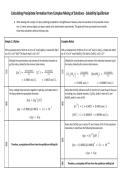
Calculating Precipitate Formation from Complex Mixing of Solutions - Solubility Equilibrium
● When dealing with a simple 1:1 ratio, predicting precipitation is straightforward. However, when the reactants or the precipitate involve
non-1:1 ratios, we must adjust our steps to satisfy strict stoichiometric requirements. This guide will show you exactly how to handle
those extra calculations without missing a step.
Simple 1:1 Ratios Complex Ratios
Will a precipitate form if 50.0 mL of 4.0 x 10⁻⁴ mol/L AgNO3 is mixed with 150.0 Will a precipitate form if 100 mL of 2.0 x 10⁻⁴ mol/L Cr2(SO4)3 is mixed with 100.0
mL of 2.0 x 10⁻³ NaCl? The Ksp for AgCl is 1.8 x 10⁻¹⁰. mL of 3.0 x 10⁻⁵ mol/L Ba(OH)2? The Ksp for Cr(OH)3 is 6.3 x 10⁻³¹
Multiply the concentrations and volumes of the individual reactants to Multiply the concentrations and volumes of the individual reactants to get
get the moles, divided by the common total volume. the moles, divided by the common total volume.
① +
[𝐴𝑔 ] =
(0.05)(0.0004)
0.2
−
[𝐶𝑙 ] =
(0.15)(0.002)
0.2
① [𝐶𝑟2 (𝑆𝑂4 ) ] =
(0.1)(0.0002)
[𝐵𝑎(𝑂𝐻)2 ] =
(0.1)(0.00003)
0.2 0.2
3
= 0. 0001 𝑚𝑜𝑙 / 𝐿 = 0. 0015 𝑚𝑜𝑙 / 𝐿
= 0. 0001 𝑚𝑜𝑙 / 𝐿 = 0. 000015 𝑚𝑜𝑙 / 𝐿
Then, multiply these two terms together to get Qsp, and relate them to Notice that Cr(OH)3 references both Cr and OH, let's scale those for Qsp use
the Ksp to determine precipitate formation. by looking at our original reactants. Cr2(SO4)3 yields 2 moles of Cr, and
+ − Ba(OH)2 yields 2 moles of OH.
𝑄𝑠𝑝 = [𝐴𝑔 ][𝐶𝑙 ]
② ② 3+
[𝐶𝑟 ] = 2 × 0. 0001 = 0. 0002 𝑚𝑜𝑙 / 𝐿
−7
𝑄𝑠𝑝 = (0. 0001)(0. 0015) = 1. 5 × 10
−
[𝑂𝐻 ] = 2 × 0. 000015 = 0. 00003 𝑚𝑜𝑙 / 𝐿
∴ 𝑄𝑠𝑝 > 𝐾𝑠𝑝
Notice that Cr(OH)3 uses 1 mole of Cr and 3 moles of OH. If this precipitate
dissociates, it would have the following Qsp expression:
3+ − 3
𝑄𝑠𝑝 = [𝐶𝑟 ][𝑂𝐻 ]
③
③ Therefore, a precipitate will form from the equilibrium shifting left 𝑄𝑠𝑝 = (0. 0002)(0. 00003)
3
= 5. 4 × 10
−18
∴ 𝑄𝑠𝑝 > 𝐾𝑠𝑝
④ Therefore, a precipitate will form from the equilibrium shifting left
● When dealing with a simple 1:1 ratio, predicting precipitation is straightforward. However, when the reactants or the precipitate involve
non-1:1 ratios, we must adjust our steps to satisfy strict stoichiometric requirements. This guide will show you exactly how to handle
those extra calculations without missing a step.
Simple 1:1 Ratios Complex Ratios
Will a precipitate form if 50.0 mL of 4.0 x 10⁻⁴ mol/L AgNO3 is mixed with 150.0 Will a precipitate form if 100 mL of 2.0 x 10⁻⁴ mol/L Cr2(SO4)3 is mixed with 100.0
mL of 2.0 x 10⁻³ NaCl? The Ksp for AgCl is 1.8 x 10⁻¹⁰. mL of 3.0 x 10⁻⁵ mol/L Ba(OH)2? The Ksp for Cr(OH)3 is 6.3 x 10⁻³¹
Multiply the concentrations and volumes of the individual reactants to Multiply the concentrations and volumes of the individual reactants to get
get the moles, divided by the common total volume. the moles, divided by the common total volume.
① +
[𝐴𝑔 ] =
(0.05)(0.0004)
0.2
−
[𝐶𝑙 ] =
(0.15)(0.002)
0.2
① [𝐶𝑟2 (𝑆𝑂4 ) ] =
(0.1)(0.0002)
[𝐵𝑎(𝑂𝐻)2 ] =
(0.1)(0.00003)
0.2 0.2
3
= 0. 0001 𝑚𝑜𝑙 / 𝐿 = 0. 0015 𝑚𝑜𝑙 / 𝐿
= 0. 0001 𝑚𝑜𝑙 / 𝐿 = 0. 000015 𝑚𝑜𝑙 / 𝐿
Then, multiply these two terms together to get Qsp, and relate them to Notice that Cr(OH)3 references both Cr and OH, let's scale those for Qsp use
the Ksp to determine precipitate formation. by looking at our original reactants. Cr2(SO4)3 yields 2 moles of Cr, and
+ − Ba(OH)2 yields 2 moles of OH.
𝑄𝑠𝑝 = [𝐴𝑔 ][𝐶𝑙 ]
② ② 3+
[𝐶𝑟 ] = 2 × 0. 0001 = 0. 0002 𝑚𝑜𝑙 / 𝐿
−7
𝑄𝑠𝑝 = (0. 0001)(0. 0015) = 1. 5 × 10
−
[𝑂𝐻 ] = 2 × 0. 000015 = 0. 00003 𝑚𝑜𝑙 / 𝐿
∴ 𝑄𝑠𝑝 > 𝐾𝑠𝑝
Notice that Cr(OH)3 uses 1 mole of Cr and 3 moles of OH. If this precipitate
dissociates, it would have the following Qsp expression:
3+ − 3
𝑄𝑠𝑝 = [𝐶𝑟 ][𝑂𝐻 ]
③
③ Therefore, a precipitate will form from the equilibrium shifting left 𝑄𝑠𝑝 = (0. 0002)(0. 00003)
3
= 5. 4 × 10
−18
∴ 𝑄𝑠𝑝 > 𝐾𝑠𝑝
④ Therefore, a precipitate will form from the equilibrium shifting left


