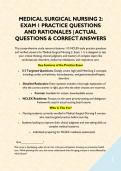
MEDICAL SURGICAL NURSING 2:
EXAM 1 PRACTICE QUESTIONS
AND RATIONALES | ACTUAL
QUESTIONS & CORRECT ANSWERS
This comprehensive study resource features 115 NCLEX-style practice questions
and verified answers for Medical-Surgical Nursing 2, Exam 1. It is designed to test
your critical thinking, clinical judgment, and mastery of complex topics like
cardiovascular disorders, endocrine imbalances, and respiratory care.
Key Features of the Practice Exam
• 115 Targeted Questions: Deeply covers high-yield Med-Surg 2 concepts,
including cardiac arrhythmias, hemodynamics, and gastrointestinal/hepatic
disorders.
• Detailed Rationales: Every question includes a thorough explanation of
why the correct answer is right, plus why the other choices are incorrect.
• Format: Available for instant, downloadable access.
• NCLEX Readiness: Focuses on the same priority-setting and delegation
frameworks used in actual nursing board exams.
Who Is This For?
• Nursing students currently enrolled in Medical-Surgical Nursing II courses
who need targeted practice before test day.
• Students looking to improve their clinical judgment and test-taking skills on
complex medical scenarios.
• Individuals preparing for NCLEX readiness assessments
Quiz_________________?
The nurse is developing a plan of care for a 65-year-old patient, focusing on preventive health
care. While planning this care, the nurse understands that the aging process is most affected by
which factor?
1
,A. Hobbies and interests
B. Financial issues
C. Age at retirement
D. Immobility -
.
ANSWER: D
Rationale: Immobility drives muscle and bone loss, cardiac and respiratory decline, and skin
breakdown, making it the biggest physiologic driver of aging decline. Hobbies and interests
affect psychosocial wellbeing, not the physical aging process. Financial issues affect access to
resources and care, not physiology. Age at retirement is just a life-stage marker with no direct
physiologic effect.
Quiz_________________?
What disorder may cause immobility in the older adult?
A. Stroke
B. Carpel tunnel
C. Minor burns
D. Multiple personalities -
.
ANSWER: A
Rationale: Stroke can cause hemiparesis, hemiplegia, or significant motor and balance deficits,
directly leading to prolonged immobility in older adults. Carpal tunnel syndrome affects wrist
and hand function but does not typically cause overall immobility. Minor burns are localized and
generally do not impair mobility significantly. Multiple personalities is a psychiatric condition
with no direct physical mobility impact.
2
, Quiz_________________?
A female patient with systemic lupus erythematosus (SLE) complains of photosensitivity. The
LPN/LVN should instruct the patient on which self-care measure?
A. Include foods high in betacarotene in her diet.
B. Use a tanning bed once per week to help with rashes.
C. Wear sunblock whenever she is outdoors.
D. Manage joint pain with prescribed medications. -
.
ANSWER: C
Rationale: Photosensitivity in SLE means UV exposure can trigger or worsen skin rashes and
disease flares, so sunblock and sun protective measures are the key self-care instruction.
Betacarotene has no established role in managing photosensitivity. Tanning beds directly
worsen photosensitivity and can trigger flares. Managing joint pain with medication is important
general SLE care but does not address the photosensitivity complaint specifically.
Quiz_________________?
The patient presents to the clinic after falling from her bike and is diagnosed with a Grade II
ankle sprain. The nurse should make which statements to the patient regarding the treatment
of her sprained ankle? (Select all that apply.)
A. Rest your ankle as much as possible.
B. Place an ice pack on your ankle for 30 minutes every 4 hours.
C. Begin walking on your injured ankle after 24 hours, and increase your ambulation as
tolerated.
D. You should wrap your ankle with an elastic bandage.
E. Prop your ankle on pillows while resting.
F. Take stimulant laxatives with your narcotic pain medication. -
3
, .
ANSWER: A, B, D, E, F
Rationale: RICE therapy is the standard for ankle sprains, rest, ice for swelling control,
compression with an elastic bandage, and elevation to reduce edema all apply. Stimulant
laxatives are appropriate teaching since narcotic pain medications commonly cause
constipation. Option C is incorrect because a Grade II sprain involves partial ligament tearing
with instability, so early full ambulation within 24 hours risks re-injury.
Quiz_________________?
The patient presents to the clinic with a compound fracture of the right leg. The nurse
anticipates the administration of which classes of medications? (Select all that apply.)
A. Hepatitis B vaccine
B. Aspirin
C. Corticosteroids
D. Tetanus booster
E. IV antibiotics -
.
ANSWER: D, E
Rationale: A compound fracture breaks the skin, creating a direct portal for bacterial
contamination, so tetanus prophylaxis and IV antibiotics are standard anticipated treatment to
prevent tetanus and wound infection or osteomyelitis. Hepatitis B vaccine is not indicated for
fracture management. Aspirin is not the anticipated medication class here and can increase
bleeding risk in trauma. Corticosteroids are not part of standard open fracture management
and can impair wound and bone healing.
Quiz_________________?
4
EXAM 1 PRACTICE QUESTIONS
AND RATIONALES | ACTUAL
QUESTIONS & CORRECT ANSWERS
This comprehensive study resource features 115 NCLEX-style practice questions
and verified answers for Medical-Surgical Nursing 2, Exam 1. It is designed to test
your critical thinking, clinical judgment, and mastery of complex topics like
cardiovascular disorders, endocrine imbalances, and respiratory care.
Key Features of the Practice Exam
• 115 Targeted Questions: Deeply covers high-yield Med-Surg 2 concepts,
including cardiac arrhythmias, hemodynamics, and gastrointestinal/hepatic
disorders.
• Detailed Rationales: Every question includes a thorough explanation of
why the correct answer is right, plus why the other choices are incorrect.
• Format: Available for instant, downloadable access.
• NCLEX Readiness: Focuses on the same priority-setting and delegation
frameworks used in actual nursing board exams.
Who Is This For?
• Nursing students currently enrolled in Medical-Surgical Nursing II courses
who need targeted practice before test day.
• Students looking to improve their clinical judgment and test-taking skills on
complex medical scenarios.
• Individuals preparing for NCLEX readiness assessments
Quiz_________________?
The nurse is developing a plan of care for a 65-year-old patient, focusing on preventive health
care. While planning this care, the nurse understands that the aging process is most affected by
which factor?
1
,A. Hobbies and interests
B. Financial issues
C. Age at retirement
D. Immobility -
.
ANSWER: D
Rationale: Immobility drives muscle and bone loss, cardiac and respiratory decline, and skin
breakdown, making it the biggest physiologic driver of aging decline. Hobbies and interests
affect psychosocial wellbeing, not the physical aging process. Financial issues affect access to
resources and care, not physiology. Age at retirement is just a life-stage marker with no direct
physiologic effect.
Quiz_________________?
What disorder may cause immobility in the older adult?
A. Stroke
B. Carpel tunnel
C. Minor burns
D. Multiple personalities -
.
ANSWER: A
Rationale: Stroke can cause hemiparesis, hemiplegia, or significant motor and balance deficits,
directly leading to prolonged immobility in older adults. Carpal tunnel syndrome affects wrist
and hand function but does not typically cause overall immobility. Minor burns are localized and
generally do not impair mobility significantly. Multiple personalities is a psychiatric condition
with no direct physical mobility impact.
2
, Quiz_________________?
A female patient with systemic lupus erythematosus (SLE) complains of photosensitivity. The
LPN/LVN should instruct the patient on which self-care measure?
A. Include foods high in betacarotene in her diet.
B. Use a tanning bed once per week to help with rashes.
C. Wear sunblock whenever she is outdoors.
D. Manage joint pain with prescribed medications. -
.
ANSWER: C
Rationale: Photosensitivity in SLE means UV exposure can trigger or worsen skin rashes and
disease flares, so sunblock and sun protective measures are the key self-care instruction.
Betacarotene has no established role in managing photosensitivity. Tanning beds directly
worsen photosensitivity and can trigger flares. Managing joint pain with medication is important
general SLE care but does not address the photosensitivity complaint specifically.
Quiz_________________?
The patient presents to the clinic after falling from her bike and is diagnosed with a Grade II
ankle sprain. The nurse should make which statements to the patient regarding the treatment
of her sprained ankle? (Select all that apply.)
A. Rest your ankle as much as possible.
B. Place an ice pack on your ankle for 30 minutes every 4 hours.
C. Begin walking on your injured ankle after 24 hours, and increase your ambulation as
tolerated.
D. You should wrap your ankle with an elastic bandage.
E. Prop your ankle on pillows while resting.
F. Take stimulant laxatives with your narcotic pain medication. -
3
, .
ANSWER: A, B, D, E, F
Rationale: RICE therapy is the standard for ankle sprains, rest, ice for swelling control,
compression with an elastic bandage, and elevation to reduce edema all apply. Stimulant
laxatives are appropriate teaching since narcotic pain medications commonly cause
constipation. Option C is incorrect because a Grade II sprain involves partial ligament tearing
with instability, so early full ambulation within 24 hours risks re-injury.
Quiz_________________?
The patient presents to the clinic with a compound fracture of the right leg. The nurse
anticipates the administration of which classes of medications? (Select all that apply.)
A. Hepatitis B vaccine
B. Aspirin
C. Corticosteroids
D. Tetanus booster
E. IV antibiotics -
.
ANSWER: D, E
Rationale: A compound fracture breaks the skin, creating a direct portal for bacterial
contamination, so tetanus prophylaxis and IV antibiotics are standard anticipated treatment to
prevent tetanus and wound infection or osteomyelitis. Hepatitis B vaccine is not indicated for
fracture management. Aspirin is not the anticipated medication class here and can increase
bleeding risk in trauma. Corticosteroids are not part of standard open fracture management
and can impair wound and bone healing.
Quiz_________________?
4