
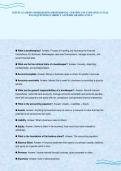
INTUIT ACADEMY BOOKKEEPING PROFESSIONAL CERTIFICATE 5 UPDATED ACTUAL
EXAM QUESTIONS CORRECT ANSWERS GRADED A PLUS
● What is bookkeeping?. Answer: Process of tracking and recording the financial
transactions of a business. Bookkeepers document transactions, manage accounts, and
record financial data.
● What are the four ethical traits of a bookkeeper?. Answer: Honesty, objectivity,
confidentiality, and professionalism.
● Accounts payable. Answer: Money a business owes to others for goods or services.
● Accounts receivable. Answer: Money that is owed to a business for providing a good or
service.
● What are the general responsibilities of a bookkeeper?. Answer: Record financial
transactions, reconcile bank accounts, manage accounts receivable and accounts payable,
work with tax preparers and assist with tax compliance, and generate financial statements.
● What is the accounting equation?. Answer: Assets = Liabilities + Equity
● Assets. Answer: Anything the business owns of value or a resource of value that has the
potential to be transformed into cash.
● Liability. Answer: What a business owes to others.
● Equity. Answer: Owner's stake in the business, how much they have invested or
withdrawn.
● What is the foundation of the balance sheet?. Answer: The accounting equation.
● Balance Sheet. Answer: A financial statement that reports a business's assets, liabilities,
and equity at a specific point in time.
● Revenue. Answer: Income earned through business, gross proceeds or sales.
● Expenses. Answer: Cost of doing business
, ● Debits. Answer: An increase in assets or expenses, or a decrease in liabilities, owner's
equity, or revenue.
● Credits. Answer: A decrease in assets or expenses, or an increase in liabilities, owner's
equity, or revenue.
● What is the cardinal rule of bookkeeping?. Answer: Debits and credits need to be equal.
● What are the eight accounting principles?. Answer: Economic entity assumption,
reliability assumption, full disclosure principle, conservatism assumption, materiality principle,
consistency principle, monetary unit assumption, and going concern assumption.
● Economic Entity Assumption. Answer: The business is it's own separate entity, distinct
from it's owners.
● Reliability Assumption. Answer: Information recorded in your client's financial documents
is verifiable and backed by proper documentation.
● Full Disclosure Principle. Answer: This principle states that any information lenders or
investors might need to make informed decisions should be disclosed in the financial
statements or accompanying notes.
● Conservatism Assumption. Answer: When you are not sure if or how to record an item,
this principle guides us to err on the side of caution. It means we choose options that show
less income or asset benefit. Potential losses can be recorded, while potential gains cannot.
● Materiality Principle. Answer: This principle allows you to focus on what really matters. It
states that if an accounting standard has such a small impact on the financial statements that
it wouldn't mislead anyone, you can ignore it.
● Consistency Principle. Answer: Once a business adopts a specific accounting method for
recording certain items, it commits to entering all similar items in the same way in the future.
This principle applies to line items on all financial statements and reports.
● Monetary Unit Assumption. Answer: This assumption brings simplicity and uniformity to
your accounting practices. It states that you use one currency throughout all of your
accounting activities. In the United States, that currency is the US dollar.
● Going Concern Assumption. Answer: This principle assures us that the business is stable
enough to operate and meet its obligations for the foreseeable future. The business acts and
makes decisions with the intention of continuing to run the business rather than liquidating it.
EXAM QUESTIONS CORRECT ANSWERS GRADED A PLUS
● What is bookkeeping?. Answer: Process of tracking and recording the financial
transactions of a business. Bookkeepers document transactions, manage accounts, and
record financial data.
● What are the four ethical traits of a bookkeeper?. Answer: Honesty, objectivity,
confidentiality, and professionalism.
● Accounts payable. Answer: Money a business owes to others for goods or services.
● Accounts receivable. Answer: Money that is owed to a business for providing a good or
service.
● What are the general responsibilities of a bookkeeper?. Answer: Record financial
transactions, reconcile bank accounts, manage accounts receivable and accounts payable,
work with tax preparers and assist with tax compliance, and generate financial statements.
● What is the accounting equation?. Answer: Assets = Liabilities + Equity
● Assets. Answer: Anything the business owns of value or a resource of value that has the
potential to be transformed into cash.
● Liability. Answer: What a business owes to others.
● Equity. Answer: Owner's stake in the business, how much they have invested or
withdrawn.
● What is the foundation of the balance sheet?. Answer: The accounting equation.
● Balance Sheet. Answer: A financial statement that reports a business's assets, liabilities,
and equity at a specific point in time.
● Revenue. Answer: Income earned through business, gross proceeds or sales.
● Expenses. Answer: Cost of doing business
, ● Debits. Answer: An increase in assets or expenses, or a decrease in liabilities, owner's
equity, or revenue.
● Credits. Answer: A decrease in assets or expenses, or an increase in liabilities, owner's
equity, or revenue.
● What is the cardinal rule of bookkeeping?. Answer: Debits and credits need to be equal.
● What are the eight accounting principles?. Answer: Economic entity assumption,
reliability assumption, full disclosure principle, conservatism assumption, materiality principle,
consistency principle, monetary unit assumption, and going concern assumption.
● Economic Entity Assumption. Answer: The business is it's own separate entity, distinct
from it's owners.
● Reliability Assumption. Answer: Information recorded in your client's financial documents
is verifiable and backed by proper documentation.
● Full Disclosure Principle. Answer: This principle states that any information lenders or
investors might need to make informed decisions should be disclosed in the financial
statements or accompanying notes.
● Conservatism Assumption. Answer: When you are not sure if or how to record an item,
this principle guides us to err on the side of caution. It means we choose options that show
less income or asset benefit. Potential losses can be recorded, while potential gains cannot.
● Materiality Principle. Answer: This principle allows you to focus on what really matters. It
states that if an accounting standard has such a small impact on the financial statements that
it wouldn't mislead anyone, you can ignore it.
● Consistency Principle. Answer: Once a business adopts a specific accounting method for
recording certain items, it commits to entering all similar items in the same way in the future.
This principle applies to line items on all financial statements and reports.
● Monetary Unit Assumption. Answer: This assumption brings simplicity and uniformity to
your accounting practices. It states that you use one currency throughout all of your
accounting activities. In the United States, that currency is the US dollar.
● Going Concern Assumption. Answer: This principle assures us that the business is stable
enough to operate and meet its obligations for the foreseeable future. The business acts and
makes decisions with the intention of continuing to run the business rather than liquidating it.


