Chapter 1
Core features of emotions:
1. Emotions arise when an individual evaluates a situation that they consider relevant to a currently active
goal
2. Multifaceted
- Emotions make us feel
- Incline us to act à the resulting actions cause changes in experiences and behavior
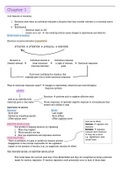
Modal model of emotion:
Emotions as person-situation transactions
SITUATION à ATTENTION à APPRAISAL à RESPONSE
Situation is Individual attends to Individual evaluates
Deemed relevant à these situations à in light of relevant à Emotional responses
(internal/external) goals
Circle back modifying the situation that
originally gave rise to these emotional responses
What do emotional responses cause? à changes in experiential, behavioral and neurobiological
Response systems
AFFECT
Emotions à positives and/or negative affective state
used as an umbrella term
relatively good or bad states Stress responses à typically negative response to circumstances that
exceed one’s ability to cope
EMOTIONS VS MOODS
Emotions Moods
- More brief - Last longer
- Elicited by something specific - More diffuse
- Affect actions more - Affect cognition more
Goal can be either:
EMOTION REGULATION Intrinsic à regulates own
The process of shaping emotions by regulating: emotions
1. When they happen Extrinsic à regulates
2. Which emotion one has someone else’s emotions
3. How one experiences and expresses emotions Or they can co-occur
CORE FEATURES e.g., regulating to calm
oneself down
- There is activation of a goal to modify the emotion process
- Engagement in the process responsible for the regulation
- Impact on the dynamic of emotion (e.g., its magnitude, duration & offset)
THE PROCESS MODEL OF EMOTION REGULATION
This model takes into account each step of the Modal Model and they are recognized as being a potential
target for emotion regulation à emotion regulation could potentially occur in each of these steps
,SITUATION SELECTION à SITUATION MODIFICATION àATTENTIONAL DEPLOYMENT à COGNITIVE
APPRAISAL à RESPONSE MODULATION
SITUATION SELECTION:
This occurs during the first step and comprises of taking action that make it more or less likely to end up
in a situation that elicits a desirable/undesirable response.
SITUATION MODIFICATION:
This occurs when the situation is already in motion and entails
ATTENTIONAL DEPLOYMENT:
Involves shifting attention to experience/ avoid certain emotions that would be elicited by the situation
one is in. E.g., looking away when watching a horror movie
COGNITIVE APPRAISAL:
Involves modifying how one appraises (evaluates) a situation
RESPONE MODULATION:
Occurs when the emotional response is already happening and refers to directly influencing experiential,
behavioral and/or physiological components of the emotional response. E.g., taking deep breaths
People usually aim at down-regulating negative emotions and up-regulating positive emotions.
This is what is known as “hedonic considerations” à relating to pleasure
However, that is not always the case. People may also seek to down-regulate positive emotions and up-regulate
negative ones depending on context, situation and one’s goals.
Known as “instrumental considerations! à one could down-regulate positive emotions and up-regulate negative
if this is instrumental for achieving non-emotional goals.
APPRAISAL VS SUPPRESSION
Studies have focused on investigating and understanding the effects on different outcomes of certain
common emotion-regulation strategies.
APPRAISAL SUPPRESSION
What does it entail? à thinking about a certain What does it entail? à decreasing of emotion-
Situation in a way that alters expressive behavior while
The emotional response being emotionally aroused
Affective outcomes: Affective outcomes:
- Decreases levels of negative emotions & increases - Decreases positive but NOT negative emotion
levels of positive emotions experiences
- No impact/decrease of sympathetic nervous system - Increases sympathetic nervous system responses
- Less activation of amygdala and similar regions - Greater activation of emotion-generative regions
- Experiences & expressions of more positive emotions. e.g., amygdala
& less negative emotions + fewer depressive symptoms - Experience of more negative and less positive
emotion experiences
Cognitive outcomes: Cognitive outcomes:
- No impact/improvement of memories - worse memory
- Enhanced performance on standardized tests
Social outcomes: Social outcomes:
- No consequences for social affiliation - Less liking from social interaction partners
- More likely to share emotions - Increase I partner’s blood pressure levels
- Closer relationships with friends - Avoiding of close relationships
, - Less positive relations with others
NOTE: Reappraisal does not have same experiential and cognitive benefits when engaged during an on-going
highly intense emotional response + effect of this strategy varies and depends on context (even cultural context).
Keil. The origin of Emotion, Temperament and Personality
Emotions à transient states corresponding to physiological and cognitive processes associated with distinct
internal sensations and feelings
BODILY AROUSAL COGNITIVE APPRAISAL
PATTERNS OF DIFFERENTIATION OF EMOTIONS
Infants à no differentiation into more complex emotions
positive
Emotions
negative
still need to learn how to channel their emotions into more nuanced expressions
Some studies suggest that infants start differentiating emotions as their needs and expressive skills become
more refined. However, other researchers believe that differentiation occurs due to physiological maturation
rather than through learning.
FUNCTIONALIST APPROACH TO EMOTIONS:
Emotional responses as a function à they mobilize us into actions towards a goal
HOW? à by signaling information i.e., communicating to others
This is especially useful in infants as their capacity to communicate is still limited
DISGUST à avoid contamination
FEAR à maintain integrity of the self (mainly physically but also conceptually)
SADNESS à any end state that the child wants
ANGER à any end state that the child wants
DIFFERENTIATION OF EMOTIONS
Infants à undifferentiated emotions à at first only categorized into positive and negative emotions
As infant matures, emotions start gradually differentiating
+/- 6 m/o
Contentment à joy
BIRTH: Primary emotions Interest à surprise
Distress. Sadness anger
Disgust fear
1 ½ YEARS: Complex emotions à eg., simple embarrassment, envy, empathy self-conscious thoughts
2 ½ YEARS: More complex emotions à e.g., complex embarrassment, pride, shame, guilt incorporation of
rules & norms
, BASIC EMOTIONS:
6 m/o à six basic emotions (also known as primary emotions)
JOY, SADNESS, DISGUST, SURPRISE, FEAR, ANGER
BASIC = they appear early on in development and they are human universals
Infants’ emotions can vary in intensity, especially positive ones e.g., from gentle contemptment to exuberant joy
They can be expressed with many nuances in between
(from a close-mouthed smile to a full open-mouthed smile)
Negative emotions à are less continuum and distinct in adults
but less differentiated in infants à they experience more “general” emotions
2 m/o à negative emotions à start differentiating at least into sadness and anger
6 m/o à fear starts becoming more evident
Why later? à possibly because evaluating something as potentially threatening requires
more complex mental representations
> 6 m/o à differentiation into narrower categories of emotions
POSITIVE NEGATIVE
Physical Acquisitive pain sadness grief anger shame
pleasure pleasure
pleasure from material gains
+ love, friendships & pride
COMPLEX EMOTIONS:
- Emotions that build on and occur developmentally later
- Emerge from combinations of basic emotions with more complex cognition regarding situations
- They involve more complex goals
Vary across cultures and are partly socialized
- Many complex emotions are also self-conscious emotions à the emotional experience itself requires some
degree of self-awareness
- 1 ½ - 2 y/o à first display of self-conscious emotions à this age period coincides with the period in which
social standards and awareness of others start
developing
BASIC EMOTIONS COMPLEX EMOTIONS
Closely linked to Other regions as well
the amygdala interact with the
amygdala
RECOGNIZING EMOTIONS IN OTHERS
Infants start understanding the emotions in other people’s voice tone before they even understand language
and what is being said to them
+/- 7 m/o à brain starts responding more strongly in the right inferior frontal cortex when they hear a happy
intonation vs. a neutral tone
à already able to distinguish different basic expressions of emotions
Infants à use visual and auditory cues of others’ emotions to guide their own behavior
e.g., the visual cliff experiment (around 1 y/o)
or the avoidance of a toy when the object is associated with
someone’s negative reaction to it e.g., anger, even if it is a
stranger (around 10 m/o)
Core features of emotions:
1. Emotions arise when an individual evaluates a situation that they consider relevant to a currently active
goal
2. Multifaceted
- Emotions make us feel
- Incline us to act à the resulting actions cause changes in experiences and behavior
Modal model of emotion:
Emotions as person-situation transactions
SITUATION à ATTENTION à APPRAISAL à RESPONSE
Situation is Individual attends to Individual evaluates
Deemed relevant à these situations à in light of relevant à Emotional responses
(internal/external) goals
Circle back modifying the situation that
originally gave rise to these emotional responses
What do emotional responses cause? à changes in experiential, behavioral and neurobiological
Response systems
AFFECT
Emotions à positives and/or negative affective state
used as an umbrella term
relatively good or bad states Stress responses à typically negative response to circumstances that
exceed one’s ability to cope
EMOTIONS VS MOODS
Emotions Moods
- More brief - Last longer
- Elicited by something specific - More diffuse
- Affect actions more - Affect cognition more
Goal can be either:
EMOTION REGULATION Intrinsic à regulates own
The process of shaping emotions by regulating: emotions
1. When they happen Extrinsic à regulates
2. Which emotion one has someone else’s emotions
3. How one experiences and expresses emotions Or they can co-occur
CORE FEATURES e.g., regulating to calm
oneself down
- There is activation of a goal to modify the emotion process
- Engagement in the process responsible for the regulation
- Impact on the dynamic of emotion (e.g., its magnitude, duration & offset)
THE PROCESS MODEL OF EMOTION REGULATION
This model takes into account each step of the Modal Model and they are recognized as being a potential
target for emotion regulation à emotion regulation could potentially occur in each of these steps
,SITUATION SELECTION à SITUATION MODIFICATION àATTENTIONAL DEPLOYMENT à COGNITIVE
APPRAISAL à RESPONSE MODULATION
SITUATION SELECTION:
This occurs during the first step and comprises of taking action that make it more or less likely to end up
in a situation that elicits a desirable/undesirable response.
SITUATION MODIFICATION:
This occurs when the situation is already in motion and entails
ATTENTIONAL DEPLOYMENT:
Involves shifting attention to experience/ avoid certain emotions that would be elicited by the situation
one is in. E.g., looking away when watching a horror movie
COGNITIVE APPRAISAL:
Involves modifying how one appraises (evaluates) a situation
RESPONE MODULATION:
Occurs when the emotional response is already happening and refers to directly influencing experiential,
behavioral and/or physiological components of the emotional response. E.g., taking deep breaths
People usually aim at down-regulating negative emotions and up-regulating positive emotions.
This is what is known as “hedonic considerations” à relating to pleasure
However, that is not always the case. People may also seek to down-regulate positive emotions and up-regulate
negative ones depending on context, situation and one’s goals.
Known as “instrumental considerations! à one could down-regulate positive emotions and up-regulate negative
if this is instrumental for achieving non-emotional goals.
APPRAISAL VS SUPPRESSION
Studies have focused on investigating and understanding the effects on different outcomes of certain
common emotion-regulation strategies.
APPRAISAL SUPPRESSION
What does it entail? à thinking about a certain What does it entail? à decreasing of emotion-
Situation in a way that alters expressive behavior while
The emotional response being emotionally aroused
Affective outcomes: Affective outcomes:
- Decreases levels of negative emotions & increases - Decreases positive but NOT negative emotion
levels of positive emotions experiences
- No impact/decrease of sympathetic nervous system - Increases sympathetic nervous system responses
- Less activation of amygdala and similar regions - Greater activation of emotion-generative regions
- Experiences & expressions of more positive emotions. e.g., amygdala
& less negative emotions + fewer depressive symptoms - Experience of more negative and less positive
emotion experiences
Cognitive outcomes: Cognitive outcomes:
- No impact/improvement of memories - worse memory
- Enhanced performance on standardized tests
Social outcomes: Social outcomes:
- No consequences for social affiliation - Less liking from social interaction partners
- More likely to share emotions - Increase I partner’s blood pressure levels
- Closer relationships with friends - Avoiding of close relationships
, - Less positive relations with others
NOTE: Reappraisal does not have same experiential and cognitive benefits when engaged during an on-going
highly intense emotional response + effect of this strategy varies and depends on context (even cultural context).
Keil. The origin of Emotion, Temperament and Personality
Emotions à transient states corresponding to physiological and cognitive processes associated with distinct
internal sensations and feelings
BODILY AROUSAL COGNITIVE APPRAISAL
PATTERNS OF DIFFERENTIATION OF EMOTIONS
Infants à no differentiation into more complex emotions
positive
Emotions
negative
still need to learn how to channel their emotions into more nuanced expressions
Some studies suggest that infants start differentiating emotions as their needs and expressive skills become
more refined. However, other researchers believe that differentiation occurs due to physiological maturation
rather than through learning.
FUNCTIONALIST APPROACH TO EMOTIONS:
Emotional responses as a function à they mobilize us into actions towards a goal
HOW? à by signaling information i.e., communicating to others
This is especially useful in infants as their capacity to communicate is still limited
DISGUST à avoid contamination
FEAR à maintain integrity of the self (mainly physically but also conceptually)
SADNESS à any end state that the child wants
ANGER à any end state that the child wants
DIFFERENTIATION OF EMOTIONS
Infants à undifferentiated emotions à at first only categorized into positive and negative emotions
As infant matures, emotions start gradually differentiating
+/- 6 m/o
Contentment à joy
BIRTH: Primary emotions Interest à surprise
Distress. Sadness anger
Disgust fear
1 ½ YEARS: Complex emotions à eg., simple embarrassment, envy, empathy self-conscious thoughts
2 ½ YEARS: More complex emotions à e.g., complex embarrassment, pride, shame, guilt incorporation of
rules & norms
, BASIC EMOTIONS:
6 m/o à six basic emotions (also known as primary emotions)
JOY, SADNESS, DISGUST, SURPRISE, FEAR, ANGER
BASIC = they appear early on in development and they are human universals
Infants’ emotions can vary in intensity, especially positive ones e.g., from gentle contemptment to exuberant joy
They can be expressed with many nuances in between
(from a close-mouthed smile to a full open-mouthed smile)
Negative emotions à are less continuum and distinct in adults
but less differentiated in infants à they experience more “general” emotions
2 m/o à negative emotions à start differentiating at least into sadness and anger
6 m/o à fear starts becoming more evident
Why later? à possibly because evaluating something as potentially threatening requires
more complex mental representations
> 6 m/o à differentiation into narrower categories of emotions
POSITIVE NEGATIVE
Physical Acquisitive pain sadness grief anger shame
pleasure pleasure
pleasure from material gains
+ love, friendships & pride
COMPLEX EMOTIONS:
- Emotions that build on and occur developmentally later
- Emerge from combinations of basic emotions with more complex cognition regarding situations
- They involve more complex goals
Vary across cultures and are partly socialized
- Many complex emotions are also self-conscious emotions à the emotional experience itself requires some
degree of self-awareness
- 1 ½ - 2 y/o à first display of self-conscious emotions à this age period coincides with the period in which
social standards and awareness of others start
developing
BASIC EMOTIONS COMPLEX EMOTIONS
Closely linked to Other regions as well
the amygdala interact with the
amygdala
RECOGNIZING EMOTIONS IN OTHERS
Infants start understanding the emotions in other people’s voice tone before they even understand language
and what is being said to them
+/- 7 m/o à brain starts responding more strongly in the right inferior frontal cortex when they hear a happy
intonation vs. a neutral tone
à already able to distinguish different basic expressions of emotions
Infants à use visual and auditory cues of others’ emotions to guide their own behavior
e.g., the visual cliff experiment (around 1 y/o)
or the avoidance of a toy when the object is associated with
someone’s negative reaction to it e.g., anger, even if it is a
stranger (around 10 m/o)