

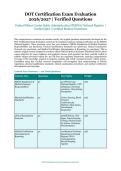
DOT Certification Exam Evaluation
2026/2027 | Verified Questions
Federal Motor Carrier Safety Administration (FMCSA) National Registry |
Verified Q&A | Certified Medical Examiners
This comprehensive evaluation set contains exactly 120 original questions meticulously developed for the
DOT Certification Exam Evaluation 2026/2027 for medical examiners seeking certification on the FMCSA
National Registry. These questions cover four core domains: FMCSA Regulations & Medical Examiner
Responsibilities (30 questions), Physical Qualification Standards (30 questions), Clinical Examination
Protocols (30 questions), and Medical Certification Determination & Reporting (30 questions). This is
entirely original content designed to reinforce official FMCSA Medical Examiner Handbook (MCSA-5870)
course objectives for exam readiness and academic success. Each question has been carefully crafted to
address unique sub-topics within the 49 CFR Part 391 regulatory framework, ensuring comprehensive
coverage of the knowledge required to properly examine and certify commercial motor vehicle drivers.
Candidates using this Verified Answers compilation will strengthen their understanding of FMCSA
regulations, physical qualification standards, clinical examination procedures, and medical certification
determination and reporting.
Content Area Overview — 120 Total Questions
Content Area Questions Key Topics Weight
FMCSA Regulations & 30 49 CFR Part 391, 25%
Medical Examiner National Registry, CMV
Responsibilities definitions, Interstate
commerce, Drug testing,
Exemptions
Physical Qualification 30 Vision, Hearing, Blood 25%
Standards Pressure,
Cardiovascular,
Diabetes, Sleep Apnea,
Neurological,
Respiratory
Clinical Examination 30 Health History, Vital 25%
Protocols Signs, Vision/Hearing
Testing, Physical Exam
by System, Urinalysis,
Documentation
Medical Certification 30 Certification Decisions, 25%
Determination & Reporting to National
Reporting Registry, SDLA
Communication,
Record-Keeping,
Appeals
DOT Certification Exam Evaluation 2026/2027
,Domain: FMCSA Regulations & Medical Examiner Responsibilities (Questions 1–30)
1. According to FMCSA regulations, which drivers are required to obtain a DOT medical
certification?
A. All licensed drivers regardless of vehicle type
B. Drivers operating commercial motor vehicles (CMVs) in interstate commerce that meet or exceed
specified thresholds
C. Only drivers of passenger vehicles carrying more than 8 passengers
D. Only drivers transporting hazardous materials within their home state
Correct Answer: B
FMCSA regulations (49 CFR 391.41-391.45) require medical certification for drivers operating CMVs in
interstate commerce when the vehicle: has a GVWR/GCWR of 10,001 lbs or more, transports 16+
passengers (including driver), transports hazardous materials requiring placarding, or transports 9-15
passengers for hire in interstate commerce. Intrastate-only drivers may be subject to state
requirements.
2. What is the minimum gross vehicle weight rating (GVWR) that triggers the requirement
for a DOT physical examination?
A. 4,500 pounds
B. 8,001 pounds
C. 10,001 pounds
D. 26,001 pounds
Correct Answer: C
A DOT physical examination is required when the CMV has a GVWR or gross combination weight
rating (GCWR) of 10,001 pounds or more. This includes single vehicles and combination vehicles (truck
and trailer). Vehicles below this threshold in interstate commerce (that don't meet other criteria) do not
require federal medical certification.
3. To perform DOT physical examinations, a medical examiner must be listed on which
federal registry?
A. The State Medical Board registry
B. The FMCSA National Registry of Certified Medical Examiners
C. The American Medical Association directory
D. The Department of Labor health provider list
Correct Answer: B
Since May 21, 2014, all medical examiners performing DOT physical examinations must be certified and
listed on the FMCSA National Registry of Certified Medical Examiners. To become listed, the examiner
must complete the FMCSA training course, pass the certification test, and maintain certification through
continuing education and periodic re-testing every 5 years.
4. How often must a certified medical examiner renew their FMCSA National Registry
certification?
A. Every 2 years
B. Every 3 years
C. Every 5 years
D. Every 10 years
Correct Answer: C
Medical examiner certification on the National Registry is valid for 5 years. To renew, the examiner
must: complete at least 5 hours of continuing education related to the medical standards for CMV
drivers, and pass the renewal test. Failure to maintain certification results in removal from the National
Registry and inability to perform DOT examinations.
5. What is the primary purpose of 49 CFR Part 391?
A. To regulate vehicle maintenance standards
DOT Certification Exam Evaluation 2026/2027
, B. To establish qualifications, training requirements, and medical standards for commercial motor
vehicle drivers
C. To set speed limits for commercial vehicles
D. To determine fuel tax requirements for carriers
Correct Answer: B
49 CFR Part 391 (Qualifications of Drivers) establishes the minimum qualifications for persons who
operate CMVs in interstate commerce. Subpart E (§391.41-391.49) specifically addresses physical
qualification standards, examination requirements, and medical certification. These regulations exist to
ensure CMV drivers are physically and mentally capable of safely operating large vehicles.
6. Which of the following is considered 'interstate commerce' for DOT medical certification
purposes?
A. Driving exclusively within one state with no goods crossing state lines
B. Trade, traffic, or transportation that crosses state lines or affects interstate commerce, even if the
driving occurs within a single state
C. Only driving between two major metropolitan areas
D. Commuting to work in a personal vehicle
Correct Answer: B
Interstate commerce includes: (1) transportation between places in different states, (2) transportation
between places within one state as part of trade/traffic that crosses state lines, or (3) transportation
that affects interstate commerce. A driver may be considered 'interstate' even if they never physically
cross state lines, if the cargo they transport is part of an interstate journey.
7. A driver with a history of insulin-treated diabetes mellitus (ITDM) wishes to operate a
CMV in interstate commerce. What is required?
A. Automatic disqualification with no possibility of certification
B. The driver may be certified if they meet specific FMCSA criteria, including stable insulin regimen
for at least 3 months, no severe hypoglycemic episodes, and evaluation by an endocrinologist using
the ITDM assessment form
C. A waiver from the state governor only
D. Only a special FMCSA exemption granted by Congress
Correct Answer: B
Since November 19, 2018, drivers with insulin-treated diabetes mellitus may be certified for interstate
CMV operation if they meet specific criteria: stable insulin regimen for ≥3 months, A1c ≤10%, no severe
hypoglycemic episodes (requiring assistance) in the past 12 months, no diabetic complications that
impair driving, and completion of the ITDM Assessment Form (MCSA-5870) by the treating
endocrinologist or primary care provider.
8. What is the maximum certification period for a driver who meets all physical
qualification standards with no conditions requiring monitoring?
A. 1 year
B. 2 years
C. 3 years
D. 5 years
Correct Answer: B
The maximum certification period is 2 years from the date of examination, provided the driver meets all
physical qualification standards and has no conditions that warrant more frequent monitoring. The
medical examiner has discretion to certify for a shorter period if a condition requires monitoring (e.g.,
hypertension requiring medication adjustment, recent cardiac event).
9. Which type of commercial vehicle operation requires the driver to transport hazardous
materials in quantities requiring placarding?
A. Only if transporting explosives
B. Any material designated as hazardous by the DOT that requires placarding under 49 CFR 172,
regardless of the quantity being transported
DOT Certification Exam Evaluation 2026/2027
, C. Only bulk fuel transport
D. Only chemical transport in tankers
Correct Answer: B
Any driver transporting hazardous materials in quantities requiring placarding (per 49 CFR 172) must
hold a valid DOT medical certificate. This includes all DOT-designated hazardous materials classes
when transported in quantities meeting placarding thresholds. The medical certification requirement
applies regardless of the GVWR of the vehicle.
10. What document must the medical examiner complete and provide to the driver
following a DOT physical examination?
A. A prescription for any needed medications
B. The Medical Examiner's Certificate (MCSA-5876) if the driver is qualified, or a written explanation
if not qualified
C. Only the long examination form
D. A referral to the driver's primary care physician
Correct Answer: B
After completing the DOT physical, the medical examiner must provide the driver with a copy of the
Medical Examiner's Certificate (MCSA-5876, also called the 'wallet card') if the driver is determined
qualified. If the driver is not qualified, the examiner provides written documentation of the
determination. The examiner also retains the completed Long Form (MCSA-5875) in their records.
11. What information must the medical examiner transmit electronically to the FMCSA
National Registry after completing a DOT examination?
A. Only the driver's name and certification date
B. The driver's unique identifier from the Long Form, examination results, certification decision, and
certificate details within one business day of the examination
C. Only whether the driver passed or failed
D. Complete medical records including all test results
Correct Answer: B
Within one business day of completing the DOT physical examination, the medical examiner must
electronically transmit the examination results to the FMCSA National Registry. This includes the
driver's unique case record number, examination findings, certification decision, certificate number,
and expiration date. This ensures the State Driver Licensing Agency (SDLA) has current medical
certification information.
12. Under FMCSA regulations, who is responsible for maintaining a current medical
examiner's certificate on file with their State Driver Licensing Agency (SDLA)?
A. The motor carrier only
B. The medical examiner who performed the examination
C. The driver (commercial motor vehicle operator)
D. The FMCSA regional office
Correct Answer: C
The driver (CMV operator) is responsible for providing a copy of their current medical examiner's
certificate to their SDLA and maintaining it while operating a CMV. The SDLA posts the medical
certification status to the driver's commercial driving record (CDLIS). Drivers must also carry their
original or copy of the medical certificate when operating a CMV.
13. Which of the following medications would MOST likely disqualify a CMV driver from
certification?
A. Metformin for Type 2 diabetes
B. Schedule I controlled substances (such as methadone used for addiction treatment, unless part of
a documented maintenance program with specific restrictions)
C. Lisinopril for hypertension
D. Levothyroxine for hypothyroidism
Correct Answer: B
DOT Certification Exam Evaluation 2026/2027
2026/2027 | Verified Questions
Federal Motor Carrier Safety Administration (FMCSA) National Registry |
Verified Q&A | Certified Medical Examiners
This comprehensive evaluation set contains exactly 120 original questions meticulously developed for the
DOT Certification Exam Evaluation 2026/2027 for medical examiners seeking certification on the FMCSA
National Registry. These questions cover four core domains: FMCSA Regulations & Medical Examiner
Responsibilities (30 questions), Physical Qualification Standards (30 questions), Clinical Examination
Protocols (30 questions), and Medical Certification Determination & Reporting (30 questions). This is
entirely original content designed to reinforce official FMCSA Medical Examiner Handbook (MCSA-5870)
course objectives for exam readiness and academic success. Each question has been carefully crafted to
address unique sub-topics within the 49 CFR Part 391 regulatory framework, ensuring comprehensive
coverage of the knowledge required to properly examine and certify commercial motor vehicle drivers.
Candidates using this Verified Answers compilation will strengthen their understanding of FMCSA
regulations, physical qualification standards, clinical examination procedures, and medical certification
determination and reporting.
Content Area Overview — 120 Total Questions
Content Area Questions Key Topics Weight
FMCSA Regulations & 30 49 CFR Part 391, 25%
Medical Examiner National Registry, CMV
Responsibilities definitions, Interstate
commerce, Drug testing,
Exemptions
Physical Qualification 30 Vision, Hearing, Blood 25%
Standards Pressure,
Cardiovascular,
Diabetes, Sleep Apnea,
Neurological,
Respiratory
Clinical Examination 30 Health History, Vital 25%
Protocols Signs, Vision/Hearing
Testing, Physical Exam
by System, Urinalysis,
Documentation
Medical Certification 30 Certification Decisions, 25%
Determination & Reporting to National
Reporting Registry, SDLA
Communication,
Record-Keeping,
Appeals
DOT Certification Exam Evaluation 2026/2027
,Domain: FMCSA Regulations & Medical Examiner Responsibilities (Questions 1–30)
1. According to FMCSA regulations, which drivers are required to obtain a DOT medical
certification?
A. All licensed drivers regardless of vehicle type
B. Drivers operating commercial motor vehicles (CMVs) in interstate commerce that meet or exceed
specified thresholds
C. Only drivers of passenger vehicles carrying more than 8 passengers
D. Only drivers transporting hazardous materials within their home state
Correct Answer: B
FMCSA regulations (49 CFR 391.41-391.45) require medical certification for drivers operating CMVs in
interstate commerce when the vehicle: has a GVWR/GCWR of 10,001 lbs or more, transports 16+
passengers (including driver), transports hazardous materials requiring placarding, or transports 9-15
passengers for hire in interstate commerce. Intrastate-only drivers may be subject to state
requirements.
2. What is the minimum gross vehicle weight rating (GVWR) that triggers the requirement
for a DOT physical examination?
A. 4,500 pounds
B. 8,001 pounds
C. 10,001 pounds
D. 26,001 pounds
Correct Answer: C
A DOT physical examination is required when the CMV has a GVWR or gross combination weight
rating (GCWR) of 10,001 pounds or more. This includes single vehicles and combination vehicles (truck
and trailer). Vehicles below this threshold in interstate commerce (that don't meet other criteria) do not
require federal medical certification.
3. To perform DOT physical examinations, a medical examiner must be listed on which
federal registry?
A. The State Medical Board registry
B. The FMCSA National Registry of Certified Medical Examiners
C. The American Medical Association directory
D. The Department of Labor health provider list
Correct Answer: B
Since May 21, 2014, all medical examiners performing DOT physical examinations must be certified and
listed on the FMCSA National Registry of Certified Medical Examiners. To become listed, the examiner
must complete the FMCSA training course, pass the certification test, and maintain certification through
continuing education and periodic re-testing every 5 years.
4. How often must a certified medical examiner renew their FMCSA National Registry
certification?
A. Every 2 years
B. Every 3 years
C. Every 5 years
D. Every 10 years
Correct Answer: C
Medical examiner certification on the National Registry is valid for 5 years. To renew, the examiner
must: complete at least 5 hours of continuing education related to the medical standards for CMV
drivers, and pass the renewal test. Failure to maintain certification results in removal from the National
Registry and inability to perform DOT examinations.
5. What is the primary purpose of 49 CFR Part 391?
A. To regulate vehicle maintenance standards
DOT Certification Exam Evaluation 2026/2027
, B. To establish qualifications, training requirements, and medical standards for commercial motor
vehicle drivers
C. To set speed limits for commercial vehicles
D. To determine fuel tax requirements for carriers
Correct Answer: B
49 CFR Part 391 (Qualifications of Drivers) establishes the minimum qualifications for persons who
operate CMVs in interstate commerce. Subpart E (§391.41-391.49) specifically addresses physical
qualification standards, examination requirements, and medical certification. These regulations exist to
ensure CMV drivers are physically and mentally capable of safely operating large vehicles.
6. Which of the following is considered 'interstate commerce' for DOT medical certification
purposes?
A. Driving exclusively within one state with no goods crossing state lines
B. Trade, traffic, or transportation that crosses state lines or affects interstate commerce, even if the
driving occurs within a single state
C. Only driving between two major metropolitan areas
D. Commuting to work in a personal vehicle
Correct Answer: B
Interstate commerce includes: (1) transportation between places in different states, (2) transportation
between places within one state as part of trade/traffic that crosses state lines, or (3) transportation
that affects interstate commerce. A driver may be considered 'interstate' even if they never physically
cross state lines, if the cargo they transport is part of an interstate journey.
7. A driver with a history of insulin-treated diabetes mellitus (ITDM) wishes to operate a
CMV in interstate commerce. What is required?
A. Automatic disqualification with no possibility of certification
B. The driver may be certified if they meet specific FMCSA criteria, including stable insulin regimen
for at least 3 months, no severe hypoglycemic episodes, and evaluation by an endocrinologist using
the ITDM assessment form
C. A waiver from the state governor only
D. Only a special FMCSA exemption granted by Congress
Correct Answer: B
Since November 19, 2018, drivers with insulin-treated diabetes mellitus may be certified for interstate
CMV operation if they meet specific criteria: stable insulin regimen for ≥3 months, A1c ≤10%, no severe
hypoglycemic episodes (requiring assistance) in the past 12 months, no diabetic complications that
impair driving, and completion of the ITDM Assessment Form (MCSA-5870) by the treating
endocrinologist or primary care provider.
8. What is the maximum certification period for a driver who meets all physical
qualification standards with no conditions requiring monitoring?
A. 1 year
B. 2 years
C. 3 years
D. 5 years
Correct Answer: B
The maximum certification period is 2 years from the date of examination, provided the driver meets all
physical qualification standards and has no conditions that warrant more frequent monitoring. The
medical examiner has discretion to certify for a shorter period if a condition requires monitoring (e.g.,
hypertension requiring medication adjustment, recent cardiac event).
9. Which type of commercial vehicle operation requires the driver to transport hazardous
materials in quantities requiring placarding?
A. Only if transporting explosives
B. Any material designated as hazardous by the DOT that requires placarding under 49 CFR 172,
regardless of the quantity being transported
DOT Certification Exam Evaluation 2026/2027
, C. Only bulk fuel transport
D. Only chemical transport in tankers
Correct Answer: B
Any driver transporting hazardous materials in quantities requiring placarding (per 49 CFR 172) must
hold a valid DOT medical certificate. This includes all DOT-designated hazardous materials classes
when transported in quantities meeting placarding thresholds. The medical certification requirement
applies regardless of the GVWR of the vehicle.
10. What document must the medical examiner complete and provide to the driver
following a DOT physical examination?
A. A prescription for any needed medications
B. The Medical Examiner's Certificate (MCSA-5876) if the driver is qualified, or a written explanation
if not qualified
C. Only the long examination form
D. A referral to the driver's primary care physician
Correct Answer: B
After completing the DOT physical, the medical examiner must provide the driver with a copy of the
Medical Examiner's Certificate (MCSA-5876, also called the 'wallet card') if the driver is determined
qualified. If the driver is not qualified, the examiner provides written documentation of the
determination. The examiner also retains the completed Long Form (MCSA-5875) in their records.
11. What information must the medical examiner transmit electronically to the FMCSA
National Registry after completing a DOT examination?
A. Only the driver's name and certification date
B. The driver's unique identifier from the Long Form, examination results, certification decision, and
certificate details within one business day of the examination
C. Only whether the driver passed or failed
D. Complete medical records including all test results
Correct Answer: B
Within one business day of completing the DOT physical examination, the medical examiner must
electronically transmit the examination results to the FMCSA National Registry. This includes the
driver's unique case record number, examination findings, certification decision, certificate number,
and expiration date. This ensures the State Driver Licensing Agency (SDLA) has current medical
certification information.
12. Under FMCSA regulations, who is responsible for maintaining a current medical
examiner's certificate on file with their State Driver Licensing Agency (SDLA)?
A. The motor carrier only
B. The medical examiner who performed the examination
C. The driver (commercial motor vehicle operator)
D. The FMCSA regional office
Correct Answer: C
The driver (CMV operator) is responsible for providing a copy of their current medical examiner's
certificate to their SDLA and maintaining it while operating a CMV. The SDLA posts the medical
certification status to the driver's commercial driving record (CDLIS). Drivers must also carry their
original or copy of the medical certificate when operating a CMV.
13. Which of the following medications would MOST likely disqualify a CMV driver from
certification?
A. Metformin for Type 2 diabetes
B. Schedule I controlled substances (such as methadone used for addiction treatment, unless part of
a documented maintenance program with specific restrictions)
C. Lisinopril for hypertension
D. Levothyroxine for hypothyroidism
Correct Answer: B
DOT Certification Exam Evaluation 2026/2027


