

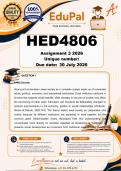
HED4806 Assignment 3 (COMPLETE ANSWERS) 2026 - DUE 30 July 2026
HED4806 Assignment 3 (COMPLETE ANSWERS) 2026 - DUE 30 July 2026; 100% TRUSTED Complete, trusted solutions and explanations. For assistance, Whats-App 0.8.1..2.7.8..3.3.7.2... Ensure your success with us. Question 1 [30] Read the excerpt below and answer the questions that follow: “The decades after the Second World War saw the rapid economic recovery of Europe, the decolonisation of large parts of the Third World and finally the worldwide economic boom of the 1960s. The post-Second World War recovery of Europe was widely attributed to education, with an increase in the level of education and training of the European workforce. In these times, a ceilingless belief in the power of education to bring about any kind of desired change, took hold. For example, someone who wishes to reduce the incidence of aggression in society advocates ‘anti-aggression education’, or the person who is concerned about pollution pleads for environmental education. This belief in the societal elevating power of education spilled over to the field of comparative education too. The dominant paradigm in this field shifted from the factors and forces framework to structural-functionalism and its derivate modernisation.” 1.1 Compare the central tenets of structural functionalism and modernisation theories in relation to: a) Society (5) b) Education and development (5) 1.2 Briefly discuss the idea of education as a “panacea for all social ills”, and frame it in the context of the excerpt, as well as your understanding of the role of education in economic development. (10) 1.3 The field of Comparative and International Education plays a crucial role in the evaluation of global systems of education. a) Explain the mechanisms used to evaluate global education systems, with specific reference to the institutions involved in such practices, and their role in shaping international education. (4) b) Name three (3) educational aspects to which Comparative and International Education can be applied. (6) HED4806/101/0/2026 21 Question 2 [20] 2.1 Curriculum development in most countries in the Global South (including South Africa) often takes the Objectives Model route. a) Briefly explain the pitfalls of the Objectives Model in curriculum development, using a country in the Global South as an example. (5) b) What model(s) of curriculum development would you recommend to a system of education or country seeking to formulate an alternative curriculum policy that is not anchored in the Objectives Model? (2) c) Explain three (3) basic assumptions underpinning the curriculum model discussed in question b. (3) 2.2 “Our view is that a transformed curriculum should reflect the ethos of the people that it is meant to serve rather than the interests of people elsewhere. We subscribe to this view because we believe that South Africa, like any other country, has its own ways of knowledge creation and its own way of knowing that have been discarded in the interests of promoting Western ways of knowing. For example, the idea of group learning is common among South Africans because they promote communal living rather than individualism. In a transformed curriculum, we propose that the social capital of teachers and learners can be leveraged to make schools inclusive. The use of local languages for teaching and learning is one example of how indigenous knowledge systems can play a vital role in the transformation of curriculum.” a) Discuss your views on what should constitute a ‘decolonised curriculum’ in postcolonial African schooling contexts. In your discussion, state the basic principles as well as the values that will undergird a “decolonised curriculum”. Justify your response by citing a case(s) from the Global South. (10) Question 3 [30] 3.1 Read the following excerpt on Tanzanian and Turkish educational reforms and answer the questions which follow: Excerpt 1: Education Objectives in Tanzania “Education is designed to achieve several different general objectives, which guide education policymakers, planners, curriculum developers and designers, teachers, quality assurers and 22 other stakeholders. As such, education in Tanzania is expected to achieve set objectives consistent with the Tanzania Development Vision 2025 conceived to transform Tanzania into a well-educated and learned society. These objectives include, but are not limited to, the following: the development and improvement of human resources; promotion of and use of ‘literacy, social, scientific, vocational, technological, professional and other forms of knowledge’ to improve the conditions for all of society; improve the ability of every citizen to acquire and improve their mental, practical and other skills to ‘meet the changing needs of the industry and economy’; instill values of national ethnic and integrity, peace and justice and use, manage and conserve the environment.” Excerpt 2: Education Objectives in Turkey “In addition to the objectives of good citizenship, the education law also emphasises the importance of independent and scientific thinking, respecting human rights and appreciating individuality, among others. One of the objectives of the education system is ensuring that individuals have professions that make them happy and allow them to contribute to the welfare of the society. In the law, 14 basic principles of [the] Turkish education system are also stated: generality and equality, meeting the needs of the individual and society, guidance, the right to basic education, equal chance and opportunity, continuity, Atatürk’s reforms, principles and Atatürk’s nationalism, democracy education, secularism, the scientific approach, planning, co-education, school–family co-operation, education everywhere.” a) Compare, contrast and critically evaluate the efficacy of the educational objectives of the Tanzanian and Turkish education systems. (15) b) Identify and briefly analyse selected educational objectives that are imprecisely formulated in both national contexts. In what specific respects is their formulation ambiguous or indeterminate? How would you reformulate these objectives to enhance their clarity, specificity, and operationalizability? (15) Question 4 [20] 4.1 “… if education in Tanzania and, indeed, in other parts of Africa is to mean anything, it must aim at equipping children with the knowledge, skills and attitudes for tackling … societal problems.” a) In a few sentences, explain the aims of education for self-reliance (ESR). (5) b) Briefly explain the challenges the Tanzanian government experienced in relation to the implementation of ESR. (5) HED4806/101/0/2026 23 4.2 Discuss five (5) reasons for the restructuring of higher education institutions in South Africa, as outlined in the National Plan for Higher Education. (10)
Documentinformatie
- Geüpload op
- 21 juli 2026
- Aantal pagina's
- 13
- Geschreven in
- 2025/2026
- Type
- Tentamen (uitwerkingen)
- Bevat
- Vragen en antwoorden


