

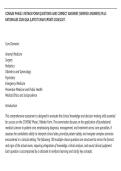
COMSAE PHASE 3 RETAKE FORM QUESTIONS AND CORRECT ANSWERS (VERIFIED ANSWERS) PLUS
RATIONALES 2026 Q&A |LATEST EXAM UPDATE 2026/2027.
Core Domains:
Internal Medicine
Surgery
Pediatrics
Obstetrics and Gynecology
Psychiatry
Emergency Medicine
Preventive Medicine and Public Health
Medical Ethics and Jurisprudence
Introduction
This comprehensive assessment is designed to evaluate the clinical knowledge and decision-making skills essential
for success on the COMSAE Phase 3 Retake Form. The examination focuses on the application of foundational
medical sciences to patient care, emphasizing diagnosis, management, and treatment across core specialties. It
assesses the candidate's ability to interpret clinical data, prioritize patient safety, and navigate complex scenarios
encountered in a clinical setting. The following 100 multiple-choice questions are structured to mirror the format
and rigor of the actual exam, requiring integration of knowledge, critical analysis, and sound clinical judgment.
Each question is accompanied by a rationale to reinforce learning and clarify key concepts.
,Section One: Questions 1–100
1. A 55-year-old male with a 30-pack-year history presents with a new-onset cough and hoarseness. A chest
X-ray reveals a right hilar mass. Which of the following findings on physical examination would most
strongly suggest superior vena cava (SVC) syndrome?
A. Pericardial friction rub
B. Distended neck veins and facial edema
C. Unilateral upper extremity cyanosis
D. Tracheal deviation to the left
🟢 B. Distended neck veins and facial edema
🔴 RATIONALE: SVC syndrome results from compression or obstruction of the superior vena cava, leading to
venous congestion in the head, neck, and upper extremities. Distended neck veins and facial edema are
hallmark signs. Pericardial friction rub (A) suggests pericarditis, unilateral upper extremity cyanosis (C) is more
consistent with deep vein thrombosis or arterial insufficiency, and tracheal deviation (D) is associated with a
tension pneumothorax or large mediastinal shift.
2. A 28-year-old woman presents with acute onset of right lower quadrant pain, nausea, and vomiting. Her
temperature is 38.5°C (101.3°F). On examination, she has rebound tenderness over McBurney's point. Which
of the following is the most appropriate next step in management?
A. Computed tomography (CT) scan of the abdomen and pelvis
B. Urgent appendectomy
C. Abdominal ultrasound
D. Broad-spectrum antibiotics and observation
,🟢 B. Urgent appendectomy
🔴 RATIONALE: This patient's presentation is classic for acute appendicitis. In the setting of a clear clinical
diagnosis, surgical consultation and urgent appendectomy are the standard of care and are the most
appropriate next step. While imaging like a CT scan (A) or ultrasound (C) can be useful in equivocal cases, they
would delay definitive treatment here. Antibiotics alone (D) without surgical intervention is not the standard of
care for a non-perforated appendicitis.
3. A 72-year-old male with a history of hypertension and type 2 diabetes presents to the clinic with a chief
complaint of progressive bilateral lower extremity edema, orthopnea, and paroxysmal nocturnal dyspnea
over the past two weeks. His blood pressure is 155/90 mmHg, and heart rate is 95 bpm. An S3 gallop is
auscultated at the apex. Which of the following findings on a chest X-ray would be most consistent with his
presentation?
A. Kerley B lines and cardiomegaly
B. Pleural effusion with a water-bottle shaped heart
C. Widened mediastinum with a leftward tracheal shift
D. Hyperlucent lungs with decreased vascular markings
🟢 A. Kerley B lines and cardiomegaly
🔴 RATIONALE: The patient’s symptoms of orthopnea, PND, edema, and an S3 gallop are classic signs of acute
decompensated heart failure (ADHF). Kerley B lines are thin horizontal lines in the lung periphery, indicating
interlobular septal edema, and are a classic radiographic sign of pulmonary edema. Cardiomegaly is often
present in chronic heart failure. Pleural effusion with a water-bottle shaped heart (B) is characteristic of
pericardial effusion. A widened mediastinum with a leftward tracheal shift (C) suggests a mediastinal mass or
, aortic dissection. Hyperlucent lungs with decreased vascular markings (D) is consistent with chronic obstructive
pulmonary disease or a large pulmonary embolism.
4. A 65-year-old woman is brought to the emergency department after a ground-level fall. She reports
severe pain in her right hip and is unable to bear weight. Her right leg is shortened and externally rotated.
Which of the following is the most appropriate initial imaging study?
A. Magnetic resonance imaging (MRI) of the right hip
B. Computed tomography (CT) scan of the right hip
C. Anteroposterior (AP) and lateral radiographs of the right hip
D. Bone scan of the right hip
🟢 C. Anteroposterior (AP) and lateral radiographs of the right hip
🔴 RATIONALE: In a patient with a suspected hip fracture, plain radiographs (AP and lateral views) are the initial
imaging modality of choice due to their accessibility, speed, and cost-effectiveness. They are sufficient to
diagnose most hip fractures. While an MRI (A) or CT scan (B) may be used if radiographs are equivocal, they are
not the first-line investigation. A bone scan (D) is typically used to detect occult fractures, stress fractures, or
metastases and is not the initial study for acute trauma.
5. A 45-year-old male presents with severe, tearing chest pain radiating to his back. His blood pressure is
100/60 mmHg, and his heart rate is 110 bpm. He has a history of hypertension and Marfan syndrome. Which
of the following is the most likely diagnosis?
A. Acute myocardial infarction
B. Pulmonary embolism
RATIONALES 2026 Q&A |LATEST EXAM UPDATE 2026/2027.
Core Domains:
Internal Medicine
Surgery
Pediatrics
Obstetrics and Gynecology
Psychiatry
Emergency Medicine
Preventive Medicine and Public Health
Medical Ethics and Jurisprudence
Introduction
This comprehensive assessment is designed to evaluate the clinical knowledge and decision-making skills essential
for success on the COMSAE Phase 3 Retake Form. The examination focuses on the application of foundational
medical sciences to patient care, emphasizing diagnosis, management, and treatment across core specialties. It
assesses the candidate's ability to interpret clinical data, prioritize patient safety, and navigate complex scenarios
encountered in a clinical setting. The following 100 multiple-choice questions are structured to mirror the format
and rigor of the actual exam, requiring integration of knowledge, critical analysis, and sound clinical judgment.
Each question is accompanied by a rationale to reinforce learning and clarify key concepts.
,Section One: Questions 1–100
1. A 55-year-old male with a 30-pack-year history presents with a new-onset cough and hoarseness. A chest
X-ray reveals a right hilar mass. Which of the following findings on physical examination would most
strongly suggest superior vena cava (SVC) syndrome?
A. Pericardial friction rub
B. Distended neck veins and facial edema
C. Unilateral upper extremity cyanosis
D. Tracheal deviation to the left
🟢 B. Distended neck veins and facial edema
🔴 RATIONALE: SVC syndrome results from compression or obstruction of the superior vena cava, leading to
venous congestion in the head, neck, and upper extremities. Distended neck veins and facial edema are
hallmark signs. Pericardial friction rub (A) suggests pericarditis, unilateral upper extremity cyanosis (C) is more
consistent with deep vein thrombosis or arterial insufficiency, and tracheal deviation (D) is associated with a
tension pneumothorax or large mediastinal shift.
2. A 28-year-old woman presents with acute onset of right lower quadrant pain, nausea, and vomiting. Her
temperature is 38.5°C (101.3°F). On examination, she has rebound tenderness over McBurney's point. Which
of the following is the most appropriate next step in management?
A. Computed tomography (CT) scan of the abdomen and pelvis
B. Urgent appendectomy
C. Abdominal ultrasound
D. Broad-spectrum antibiotics and observation
,🟢 B. Urgent appendectomy
🔴 RATIONALE: This patient's presentation is classic for acute appendicitis. In the setting of a clear clinical
diagnosis, surgical consultation and urgent appendectomy are the standard of care and are the most
appropriate next step. While imaging like a CT scan (A) or ultrasound (C) can be useful in equivocal cases, they
would delay definitive treatment here. Antibiotics alone (D) without surgical intervention is not the standard of
care for a non-perforated appendicitis.
3. A 72-year-old male with a history of hypertension and type 2 diabetes presents to the clinic with a chief
complaint of progressive bilateral lower extremity edema, orthopnea, and paroxysmal nocturnal dyspnea
over the past two weeks. His blood pressure is 155/90 mmHg, and heart rate is 95 bpm. An S3 gallop is
auscultated at the apex. Which of the following findings on a chest X-ray would be most consistent with his
presentation?
A. Kerley B lines and cardiomegaly
B. Pleural effusion with a water-bottle shaped heart
C. Widened mediastinum with a leftward tracheal shift
D. Hyperlucent lungs with decreased vascular markings
🟢 A. Kerley B lines and cardiomegaly
🔴 RATIONALE: The patient’s symptoms of orthopnea, PND, edema, and an S3 gallop are classic signs of acute
decompensated heart failure (ADHF). Kerley B lines are thin horizontal lines in the lung periphery, indicating
interlobular septal edema, and are a classic radiographic sign of pulmonary edema. Cardiomegaly is often
present in chronic heart failure. Pleural effusion with a water-bottle shaped heart (B) is characteristic of
pericardial effusion. A widened mediastinum with a leftward tracheal shift (C) suggests a mediastinal mass or
, aortic dissection. Hyperlucent lungs with decreased vascular markings (D) is consistent with chronic obstructive
pulmonary disease or a large pulmonary embolism.
4. A 65-year-old woman is brought to the emergency department after a ground-level fall. She reports
severe pain in her right hip and is unable to bear weight. Her right leg is shortened and externally rotated.
Which of the following is the most appropriate initial imaging study?
A. Magnetic resonance imaging (MRI) of the right hip
B. Computed tomography (CT) scan of the right hip
C. Anteroposterior (AP) and lateral radiographs of the right hip
D. Bone scan of the right hip
🟢 C. Anteroposterior (AP) and lateral radiographs of the right hip
🔴 RATIONALE: In a patient with a suspected hip fracture, plain radiographs (AP and lateral views) are the initial
imaging modality of choice due to their accessibility, speed, and cost-effectiveness. They are sufficient to
diagnose most hip fractures. While an MRI (A) or CT scan (B) may be used if radiographs are equivocal, they are
not the first-line investigation. A bone scan (D) is typically used to detect occult fractures, stress fractures, or
metastases and is not the initial study for acute trauma.
5. A 45-year-old male presents with severe, tearing chest pain radiating to his back. His blood pressure is
100/60 mmHg, and his heart rate is 110 bpm. He has a history of hypertension and Marfan syndrome. Which
of the following is the most likely diagnosis?
A. Acute myocardial infarction
B. Pulmonary embolism


