

Written by students who passed Immediately available after payment Read online or as PDF Wrong document? Swap it for free 4.6 TrustPilot
logo-home
Document preview thumbnail
Preview 3 out of 30 pages
Exam (elaborations)

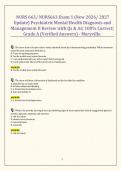
NURS 663/ NURS663 Exam 1 (New 2026/ 2027 Update) Psychiatric Mental Health Diagnosis and Management II Review with Qs & As| 100% Correct| Grade A (Verified Answers) - Maryville

Document preview thumbnail
Preview 3 out of 30 pages

NURS 663/ NURS663 Exam 1 (New 2026/ 2027 Update) Psychiatric Mental Health Diagnosis and Management II Review with Qs & As| 100% Correct| Grade A (Verified Answers) - Maryville. Q. The nurse learns at report that a newly admitted manic pt is demonstrating grandiosity. Which statement would be most consistent with this sx A. I cant do anything anymore B. I'm the worlds most astute financier C. I can understand why my wife is upset that I overspend D. I cant understand where all the money in our family goes ANSWER B. I'm the worlds most astute financier Q. The nurse will base a discussion of dysthymia on the fact that the condition A. typically has an acute onset B. involves delusional thinking C. is chronic low level depression D. does not include SI ANSWER C. is chronic low level depression Q. What is the priority nursing dx for a pt exhibiting signs of acute mania that include exaggerated physical activity, agitation, insomnia and anorexia A. risk for injury B. chronic low self esteem C. noncompliance D. insomnia ANSWER A. risk for injury Q. A pt has been admitted with a dx of atypical depression. In planning interventions, the nurse would expect to consider the characteristic sx of A. seasonal episodes B. leaden paralysis C. psychomotor agitation D. increased depression in the morning ANSWER B. leaden paralysis Q. An inappropriately dressed pt has not slept for 3 days while making excessive, expensive long distance phone calls. When the pt can be heard singing loudly in the examining room, the nurse makes initial plans to focus on A. assessing needs for food, liquids and rest B. setting strict limits on dress and behavior C. conducting an in-depth suicide assessment D. obtaining a complete psychosocial assessment ANSWER A. assessing needs for food, liquids and rest Q. Which statement by the pt would indicate the need for additional education regarding the prescribed lithium tx regimen A. i will restrict my daily salt intake B. i will take my meds with food C. i will have my blood drawn on schedule D. i will drink 8 to 12 glasses of liquids daily ANSWER A. i will restrict my daily salt intake Q. The nurse would evaluate that pt ed regarding lithium therapy for an individual with bipolar disorder as effective if the pt states A. I can stop my lithium when I feel better B. I can continue with my diuretic and cardiac meds C. I will probably need to take the lithium for the rest of my life D. I will taper my lithium when a therapeutic serum level is achieved ANSWER C. I will probably need to take the lithium for the rest of my life Q. A pt who has been taking lithium 300mg TID comes to the outpt department with a list of meds he is taking. Which of the meds on the list would require re-evaluation of lithium dosage A. hydrodiuril daily B. navane BID C. ativan at HS D. cefobid daily ANSWER A. hydrodiuril daily Q. Which outcomes would be appropriate to determine early favorable response to antidepressant med A. the pt will complete own self care activities B. the pt will demonstrate assertive communication skills C. the pt will describe signs and sx of MDD D. the pt will make plans to attend one community social activity a week ANSWER A. the pt will complete own self care activities Q. Prior to initiating med therapy with phenelzine, the nurse should plan to determine the pt's A. mood and affect B. activity level C. cognitive ability to understand information about the med D. support network and its members willingness to participate in tx ANSWER C. cognitive ability to understand information about the med Q. A pt who has a hx of bipolar disorder recently underwent orthopedic surgery and was discharged to return home. When visited by the home care nurse, the nurse documented the following: slow and soft speech; sad facial expression; and pt crying when describing extreme fatigue, low mood, and the feeling that he will never get well. He has refused to bathe and perform ADLs for several days. Which nursing dx would be appropriate A. self care deficit secondary to possible depression B. situational low self esteem r/t immobility C. deficient knowledge r/t depression and surgery D. disturbed thought processes r/t bipolar disorder ANSWER A. self care deficit secondary to possible depression Q. The nurse caring for an extremely withdrawn pt with depression wants to assist her to become more interactive. The best approach would be to say A. I know youll feel better if you leave your room B. You look so gloomy sitting here all by yourself C. lets explore how it feels to sit alone here all day and feel sad D. i need another person for a card game and id like you to be my partner ANSWER D. i need another person for a card game and id like you to be my partner Q. Which nursing dx would relate to the primary nursing concern r/t a recently written prescription for amitriptyline 50mg TID A. anxiety B. ineffective coping C. risk for self injury D. chronic low self esteem ANSWER C. risk for self injury Q. What information concerning amitriptyline 50mg TID would the nurse give the pt regarding the expected outcome of this med therapy A. complying with this therapy will cure your depression B. this med is expected to improve brain chemical imbalance C. amitriptyline will help re-establish you ability to think clearly again D. amitriptyline will be particular effective at assisting you in regaining your independence ANSWER B. this med is expected to improve brain chemical imbalance Q. Which princple should the nurse apply when planning nursing care for a pt who was vol admitted after a suicide attempt A. pts who attempt suicide and fail will not try again B. the more specific the plan, the greater the risk for suicide C. pts who talk about suicide are less likely to attempt it D. pts who attempt suicide and fail do not really want to die ANSWER B. the more specific the plan, the greater the risk for suicide Q. An appropriate nursing strategy to assist a pt who was invol admitted after a suicide attempt is A. avoiding any focus on the topic of suicide B. encouraging pt to verbalize personal feelings C. supporting pt focus on others rather than self D. discussing the impact of suicidal thoughts on the family ANSWER B. encouraging pt to verbalize personal feelings Q. Which principle should the nurse apply when planning care for a pt who is dx with bipolar disorder and currently in the manic phase A. manic pts respond well to peer pressure B. decreasing stimulation tends to diminish sx C. increasing stimulation tends to encourage the pt to focus D. detailed activities will facilitate the pts ability to self control behavior ANSWER D. detailed activities will facilitate the pts ability to self control behavior Q. Which nursing intervention is most therapeutic when the nurse is managing the aggressive, disruptive behaviors of a manic pt whose attempts to control the milieu has been rejected by other pts A. advising that the pt to accept the wishes of the group B. suggesting that the pt either quiet down or leave the room C. accompanying the pt to a quieter part of the unit D. ignoring the pts outbursts because they are surly r/t the mania ANSWER C. accompanying the pt to a quieter part of the unit Q. What information would serve as the basis for the nurses reply when asked whether the cycling of moods from depressed to manic is a constant pattern seen in bipolar disorders A. clinical observation tells us that mood disorders tend to remit and recur B. most cyclic behavior can be managed with the appropriate forms of therapy C. mood disorders generally see a decrease in cyclic affecting within 5 years of onset D. persons with higher cognitive abilities will generally exhibit fewer cyclic episodes ANSWER A. clinical observation tells us that mood disorders tend to remit and recur The individual who displays the hx and sx most consistent with a medical dx of seasonal affective disorder is A. 26 yrs of age and complains of 3 consecutive years of depressed mood beginning in November and remitting in April B. 64 yrs of age and complains of anhedonia, early morning awakening, psychomotor retardation, weight loss, and excessive feelings of guilt C. 46 yrs of age and complains of dysphoric mood for 3 yrs, poor concentration, loss of interest in social activities, indecision, low energy and low self esteem D. 38 yrs of age and complains of sadness, loss of ability to react to positive stimuli, weight gain, hypersomnia, leaden paralysis of limbs, and sensitivity to interpersonal rejection A. 26 yrs of age and complains of 3 consecutive years of depressed mood beginning in November and remitting in April A pt with suspected seasonal affectie disorder asks the nurse, Ive been feeling down for 3 months. Will I ever feel like myself again? The response that builds on an understanding of this disorder is A. spontaneous improvement usually comes in 6 months to a year B. can you tell me what you mean when you say feel like myself C. people who have seasonal mood changes often feel better when spring comes D. usually pts with this disorder see improvement during the fall and winter C. people who have seasonal mood changes often feel better when spring comes A chinese-american pt comes to the mental health clinic after referral by her PCP. She complains of nervousness, headaches, fatigue, and vague GI sx for which no organic basis has been established. The sx began about 9 months ago when her favorite aunt died. The most appropriate independent nursing action would be to A. prescribe a trial course of antianxiety med B. plan strategies for CBT C. arrange admission to the inpt unit for a complete work up and psychological testing D. confer with the psychiatrist about the cultural association between depression and somatic sx D. confer with the psychiatrist about the cultural association between depression and somatic sx A pt with melancholic depression paces and wringer her hands for hours at a time while repeating, Im a bad person. Staff members have been unsuccessful in their attempts to promote rest. Which intervention is most appropriate in promoting rest? A. instructing the pt to lie down for 15 min every hour B. asking the pt to fold and stack bath towels and washclothes C. making the pt aware of the negative effects of fatigue on mood D. reassuring the pt that she is accepted and not considered a bad person B. asking the pt to fold and stack bath towels and washclothes What measure will facilitate communication with a pt who is depressed and evidencing psychomotor retardation and withdrawal A. ask the pt to indicate yes or no with finger signals B. arrange to spend time with the pt at prearranged intervals C. give concrete and concise directions rather than asking questions D. speak loudly and rapidly to the pt to focus his or her attention B. arrange to spend time with the pt at prearranged intervals Which measure consistent with the use of cognitive therapy could the nurse incorporate into the treatment plan of a chronically depressed pt A. approach the pt with cheerful affect and optimistic remarks B. ignore the pts pessimistic statements; give attention for positive thinking C. identify negative evaluations and challenge pessimistic beliefs D. seek to uncover unconscious conflicts about significant relationships C. identify negative evaluations and challenge pessimistic beliefs Which sx r/t thought flow disturbance is the nurse most likely to assess in a newly admitted pt who is dx with bipolar disorder, manic episode A. slow, halting speech B. flight of ideas C. schemata D. anhedonia D. anhedonia Therapeutic interactions between the nurse and a manic pt will be facilitated when the nurse A. uses a calm, matter of fact approach to structuring B. focuses primarily on enforcing rigid limits on behaviors C. implements a laissez-faire approach to the pt sx D. encourages the pt to use humor and wit to redirect energy A. uses a calm, matter of fact approach to structuring A pt who is experiencing a manic episode approaches the nurse and with pressured speech states, I hate oatmeal. Lets get everybody together to do exercises. Im thirsty and Im burning up. Get out of my way; I have to see that guy. The priority nursing action is to A. measure the pts temp and pulse B. offer to have the dietitian visit to discuss his diet C. tell the pt he can lead exercises at the community meeting D. show relief when the pts ends the interaction and walks away A. measure the pts temp and pulse A pt with bipolar disorder reveals to the clinic nurse that she may be 4 weeks pregnant. Which action will the nurse take A. confer with the provider about ordering a pregnancy test and discontinuing lithium B. educate the pt to the risk to the fetus as a result of exposure to the lithium in her blood C. suggest to the provider that the lithium dose should be increased for better sx control D. remind the pt that barrier birth control methods should be used to prevent pregnancy during lithium therapy A. confer with the provider about ordering a pregnancy test and discontinuing lithium Which nursing measure would be relevant to protecting the physiologic integrity of a pt during a manic episode when marked hyperactivity is present A. provide appropriate attire for pt to wear B. set firm limits on behavior injurious to others C. monitor the pts weight at the same time daily D. use genuineness to develop a therapeutic alliance with the pt C. monitor the pts weight at the same time daily When assessing a pt dx with a mood disorder, which abnormal dx test would be considered a possible factor in the manifestation of the disorder (SATA) A. RBC B. ECG C. BUN D. TSH E. blood glucose A. RBC D. TSH E. blood glucose Which statements regarding a hypomanic episode are true (SATA) A. behavior has been observed in the pt for at least 4 days B. pt appears unaware of potentially dangerous situations C. hospitalization is generally required to stabilize the behavior D. pt is engaging in behaviors that are normally uncharacteristic of them E. primary difference between mania and hypomania is the nature of the acitivity A. behavior has been observed in the pt for at least 4 days B. pt appears unaware of potentially dangerous situations D. pt is engaging in behaviors that are normally uncharacteristic of them Sensory-Motor Period Piaget: 0-2yrs object permanence by 2y/o; requires the ability to form a mental representation (i.e., a schema) of the object. Respond to stimuli; new people; Response patterns: hand to mouth Searches for hidden objects understands causes not visible Pre-operational Stage Piaget: 2 to 7 years punishment for bad deeds is unavoidable (immanent justice) think about things symbolically: a word or an object - stand for something other than itself. Egocentric: you do it too; difficulty taking another view point. Animistic: I'm afraid of the moon Lack of hierarchy: where do the blocks go Centration: I want it now! Irreversibility: I don't know how to go back there Tranducive reasoning: go the way Daddy goes 5-6 get humor; do chores 6-7 good memory, solve problems Concrete Operations Period Piaget: 7 to 11 years can think logically but still learn best from direct experience. thought is logical and reversible; the child understands classes, relationships, and part-whole relationships dealing with concrete things. understanding of conservation and reversibility: conserve number (age 6), mass (age 7), and weight (age 9). Understand hierarchies Formal (abstract) Operational stage Piaget: 11 years to adulthood—development of logic and reasoning and second-order thoughts: thinking about thoughts. the ability to think about abstract concepts, and logically test hypotheses. Problem-solving is systematized and organized manner, rather than through trial-and-error Avoid things based on supposition of neg consequences Trust vs. Mistrust Erickson: Infancy to 18 mo If needs are dependably met, infants develop a sense of basic trust; dependent on primary caregiver attachment Hope temporal perspective vs time confusion mutual recognition vs autistic isolation psychopathology: psychosis, addiction, depression Autonomy vs. Shame and Doubt Erikson: 18 mo-3 yrs learns to exercise will and to do things independently. Holding on and letting go: speech, sphincter and muscle control Will Will to be oneself vs doubt Self-certainty vs self-consciousness psychopath: paranoia, obsessions, compulsions, impulsivity Initiative vs. Guilt Erikson: 3-5 yrs independence in planning, playing and other activities. beginnings of super-ego, conscience in failure of the oedipal quest Purpose Anticipation of roles vs role inhibition Role experimentation vs role fixation psychopath: conversion disorder, inhibition Industry vs. Inferiority Erikson: 5 and 13 yrs learns to be productive, work with others, division of labor, acquisition of tools, identification with teachers and occupations. Competence Task ID vs sense of futility Apprenticeship vs work paralysis If earlier stages fail or interruption of this stage: inadequacy and inferiority psychopath: creative inhibition, inertia identity vs. role confusion Erikson: 13-21 yrs teenagers and young adults search for and become their true selves. Comparison of self as viewed by others vs as viewed by self. Social roles important Fidelity psychopath: delinquent behavior; gender-related identity; borderline psychotic episodes Intimacy vs. Isolation Erikson: 21-40 yrs stage in which individuals form deeply personal relationships, marry, begin families. Make and honor commitments To love and to work Love Sexual polarization vs bisexual confusion Psychopath: schizoid personality; distantiation (repudiate, isolate and destroy what is dangerous to one's own) Generativity vs. Stagnation Erikson 40-65 y/o middle-aged people begin to devote themselves more to fulfilling one's potential and doing public service. Guiding the next generation Care leadership and followership vs abdication of responsibility psychopath: midlife crisis, escapism in alcohol, drugs, sex, other infidelities premature invalidism Ego Integrity vs. Despair Erikson: 65+ achieve a sense of integrity of the self by accepting the lives they have lived or yield to despair that their lives cannot be relived. Love in a meaningful way; stop wishing for different Wisdom ideological commitment vs confusion of values psychopath: extreme alienation and despair. Early Adolescence (12-14) striking initial changes: physical, attitude, behavior. Focus shifts away from family and toward peer group; begin to challenge authority; begin experiment with drugs/alcohol/cigs Middle Adolescence (14-16) lifestyle may reflect efforts to pursue independence; abstract reasoning, realistic decision-making and application of social judgment put to the test. Sexual behavior intensifies. Self-esteem pivotal for risk-taking. Omnipotence and underestimation of risk taking; drive for autonomy Late Adolescence (17-19) Exploration of personal tastes, academic activities, athletics and social bonds lead toward greater self-definition developmental milestones: 2mo: Soc: begins to smile; can calm self, tries to look at parent Lang: Coos, Turns head toward sounds; raising head and chest when lying on stomach Cognitive: Attends to faces; follow things with eyes, recognize people at a distance; act bored (cries, fussy) if activity doesn't change Movement/Physical Development: hold head up and begins to push up when lying on tummy; smoother movements with arms and legs developmental milestones: 4mo: Social and Emotional: Smiles spontaneously, cry when playing stops; Copies some: smiling or frowning, movement Language/Communication: babble with expression; copies sounds he hears Cries different: hunger, pain, or being tired Cognitive: shows happy or sad; Responds to affection Reaches for toy one hand; eye/hand coord; watches/follows with eyes; Recognizes at a distance Movement/Physical Development: Holds head unsupported; Pushes down on legs when feet are on a hard surface; roll over; hold or swing at toys; Brings hands to mouth; pushes up to elbows developmental milestones: 6mo: Social and Emotional: familiar and stranger distinction; responds to other's emotions; look at self in a mirror Language/Communication Responds to sounds by making sounds, pleasure/displeasure; vowels/consonants together; responds to name. Cognitive: Looks around, things to mouth; curiosity to get things that are out of reach; pass things from one hand to the other Movement/Physical Development Rolls over in both directions; sit without support; supports weight on legs and might bounce; Rocks back and forth developmental milestones: 9mo: Social and Emotional: afraid of strangers; clingy; favorite toys Language/Communication Understands "no"; many sounds; Copies others verb/action; fingers to point at things Cognitive: Watches the path of something as it falls; Looks for things she sees you hide; peek-a-boo; Puts things in his mouth Moves things smoothly from one hand to the other; Picks up things like cereal o's between thumb and index finger Movement/Physical Development: Stands, holding on; get into sitting position ; Sits without support; Pulls to stand; Crawls developmental milestones: 12mo: Social and Emotional: shy or nervous with stranger; favorite things and people; situational fear; communicate with gestures and sounds; Language/Communication: Responds to simple spoken requests; copies and uses simple gestures, "no"; "bye-bye"; sounds more like speech; "mama" and "dada";"uh-oh!"; repeats heard speech Cognitive; Explores like shaking, banging, throwing; Finds hidden things easily; Looks at named thing; use things correctly: drinks from a cup, brushes hair; Lets things go without help Follows simple directions; lets go w/o help Movement/Physical Development: sitting position without help; Pulls up to stand, walks holding on to furniture ("cruising"); few steps without holding on; stand alone developmental milestones: 18mo: Social and Emotional: hand things to others as play; temper tantrums; afraid of strangers; affection to familiar people; simple pretend, such as feeding a doll; Points to show something interesting; Explores alone with parent close by Language/Communication: several single words; Says and shakes head "no"; points for wants Cognitive: knows ordinary object use: telephone, brush, spoon; gestures for communicat/attn; Points to one body part; Scribbles; follow one step verbal commands w/o gestures Movement/Physical Development: Walks alone May walk up steps and run; Pulls toys while walking; help undress herself; use of tools developmental milestones: 2 yrs Social and Emotional: Copies others, especially older; excited with other children; inc independence; defiant behavior; side by side play but beginning to include like chase games Language/Communication: can ID named pics; Knows names of familiar people and body parts; sentences with 2 to 4 word; simple instructions Repeats overheard words; Points to things in a book Cognitive: Finds well-hidden things; Begins to sort shapes and colors; Completes sentences and rhymes in familiar books; simple make-believe games; towers of 4 or more blocks; use one hand more than the other; follow two-step instructions; Names items in a picture book such as a cat, bird, or dog Movement/Physical Development: Stands on tiptoe, Kicks a ball, Begins to run developmental milestones: 3 yrs Social and Emotional: Copies adults and friends; affection for friends w/o prompt; turn taking; concern for crying friend' Understands "mine" and "his" or "hers"; wide range of emotions; Separates easily from mom and dad; major changes in routine upsetting; Dresses and undresses self Language/Communication: Follows i 2 or 3 steps; name most familiar things; Understands spacial prep: "in," "on," and "under"; first name, age, and sex; Names friend; knows pronouns ans some plurals; conversation of 2 to 3 sentences Cognitive: work toys with buttons, levers, and moving parts; make-believe with dolls, animals, and people; puzzles with 3 or 4 pieces; Understands what "two" means; Copies a circle with pencil or crayon; Turns pages one at a time Builds towers of more than 6 blocks; Movement/Physical Development: Climbs well Runs easily; Pedals a tricycle; Walks up and down stairs, one foot on each step Phenylketonuria (PKU) an inherited disorder of protein metabolism in which the absence of an enzyme leads to a toxic buildup of certain compounds, causing irreversible brain damage and intellectual disability if not caught early; late: behavioral probs and sz Phenylketonuria (PKU) symptoms seizures, tremors, trembling and shaking, stunted growth, hyperactivity, skin conditions such as eczema, musty odor of their breath, skin or urine. Phenylketonuria (PKU) TX dietary therapy involving restriction of dietary protein and phenylalanine (phe) intake, and supplementation of all other amino acids in the form of specialized formulas (Lofenalac) or other dietary products. Avoid high protien: eggs, cheese, nuts, milk, beans, chicken, beef, pork and fish. Phenylketonuria (PKU) RX (FDA) recently approved sapropterin (Kuvan) for the treatment of PKU. Sapropterin helps lower phenylalanine levels. This medication must be used in combination with a special meal plan. it doesn't work for everyone. It's most effective in children with mild cases. Prader-Willi syndrome Most common genetic cause of life-threatening childhood obesity. affects males and females with equal frequency and affects all races and ethnicities. genetic disorder that occurs in approximately one out of every 15,000 births. Prader-Willi syndrome cause dysfunction of the hypothalamus; unclear genetic abnormality causing dysfunction Hypothalamus small endocrine organ at the base of the brain that plays a crucial role in many bodily functions, including regulating hunger and satiety, body temperature, pain, sleep-wake balance, fluid balance, emotions, and fertility. Prader-Willi syndrome s/sx -low normal to moderate intellectual disability -normal IQ= learning disability -Other: deficiency/short stature, small hands and feet, scoliosis, sleep disturbances with excessive daytime sleepiness, high pain threshold, speech apraxia/dyspraxia, and infertility/under-developed sex organs. -Behavioral difficulties may include obsessive-compulsive symptoms, skin picking, and difficulty controlling emotions; incr risk for MI -Spectrum disorder Prader-Willi syndrome DX methylation test will identify all types and is the preferred test for diagnosis; looks for genetic abnormalities additional testing may be needed to determine whether caused by a paternal deletion, UPD, or an imprinting mutation. In cases where an imprinting mutation is suspected, blood may also be drawn from the parent Prader-Willi syndrome TX Currently no cure; tx symptoms endocrinologist, behavior specialists, a dietitian, physical and occupational therapist, a mental health professional, a geneticist good nutrition for infants, human growth hormone (HGH) treatment, sex hormone treatment, weight management, treatment of sleep disturbances, physical, speech, occupational, and development therapy, behavior management, mental health care; testing diabetes, hypothyroid, scoliosis Rett Syndrome cause progressive neurodevelopmental disorder that almost exclusively affects females; part of a spectrum of disease relating to mutations of the MECP2 gene. DX in infancy Rett Syndrome S/sx Infants very placid and having a poor sucking ability and a weak cry. May not demand attn Low muscle tone (hypotonia) is also common before 6 months of age. Head growth slow as early as 3 months of age 6 and 18 months of age: developmental stagnation. Loss of eye contact; lack of interest in play Irritability, crying and restlessness may be seen. Development may continue but at a delayed rate. autistic-like features (avoid mis-dx), panic attacks, teeth grinding (bruxism), tremors and apraxia apraxia the inability to perform learned (familiar) movements on command, even though the command is understood and there is a willingness to perform the movement microcephaly a condition characterized by head circumference that is smaller than would normally be expected for age and gender Rett Syndrome Tx Symptom specific by team of specialists Pediatricians, pediatric neurologists, gastroenterologists, speech therapists, psychiatrists, nutritionists, and other healthcare professionals may need to systematically and comprehensively plan an affect child's treatment. Genetic counseling beneficial Conduct disorder severe condition characterized by hostile and physically violent behavior,disregard for others cruelty, from early pushing, hitting and biting to, later, more than normal teasing and bullying, hurting animals, picking fights, theft, vandalism, Forced sexual behavior, fire setting, persistent lying, truancy, run away b4 13y/o, SI/SA. Child: onset before 10y/o Adolescent: no behaviors before 10y/o ID limited prosocial: requires collateral ID lack of remorse, callous/lack of empathy, doesn't care about performance, shallow/deficient affect Risk of untreated conduct disorder adult antisocial personality disorder tx as early as possible Conduct disorder risk factors Children with a parent (biological or adoptive) or a sibling with conduct disorder biological parents have (ADHD, alcohol use disorder most supported by the research), depression, bipolar disorder, or schizophrenia Experience abuse, parental rejection or neglect, and harsh or inconsistent parenting are more at risk, as are those exposed to neighborhood violence, peer rejection, and peer delinquency Conduct Disorder Treatment complicated by the negative attitudes the disorder instills. psychotherapy and behavioral therapy are often undertaken for long periods of time, the entire family and support network of the child is brought into the loop. The earlier the condition is diagnosed, the more successful the therapy will be. child learns a better way to interact with the world at large, the family learns the best ways to communicate with him. bipolar I disorder: manic episode a period of abnormally and persistently elevated, expansive, or irritable mood and increased goal-directed activity or energy, lasting AT LEAST 1 WEEK, and present most of the day, every day. bipolar I disorder: manic episode sx Three or more (4 if mood is only irritable) inflated self-esteem decreased need for sleep more talkative or pressured speech flights of ideas or racing thoughts (subjective) distractibility Increase goal-directed activity Excessive involvement in activities that are likely to have painful consequences: sex, money psychosis or hosp because of these sx = auto dx ADHD basics Inattention, hyperactivity, impulsivity ADHD inattention criteria 6 or more sx for at least 6 mo fails close attention or careless mistakes difficulty sustaining attention doesn't seem to listen not follow instructions, fails to finish work diff organizing tasks/activities avoids, dislikes sustained attn activities loses necessary things: materials, keys, pencils easily distracted by external stim forgetful of daily activities ADHD Hyperactivity and Impulsivity 6 or more sx for at least 6 mo Fidgets with or taps hands or feet, or squirms in seat, Leaves seat that otherwise require stay Feels restless, Unable to play or take part in leisure activities quietly, Unable to be or comfortable being still for extended time, Talks excessively, Blurts out an answer before a question has been completed, Has trouble waiting his or her turn, Interrupts or intrudes on others. ADHD additional criteria present prior age 12 can't be dx under 4 y/o and diff to confirm 4-6 y/o; monitor developmental milestones sx present in 2 or more settings Indicate: inattentive or hyperactive/impulsive Indicate severity and remission status Adderall, Adderall XR amphetamine and dextroamphetamine salts Focalin, Focalin XR dexmethylphenidate Dexedrine, Dexedrine Spansules dextroamphetamine preparation Ritalin, Ritalin SR, Ritalin LA, Methylin, Methylin ER, Metadate ER, Metadate CD, Concerta, Daytrana patch methylphenidate preps Dopamine agonists stimulate dopamine receptors Stimulants First line of tx for ADHD Once a day sustained release stimulants preferred for convenience and diminished rebound side effects All stimulant major SE Adrenergic effects (increased BP & HR). Dose-related SEs: insomnia (late admin), decreased appetite, irritability or nervousness, weight loss (50-60%); give with meals, max other meals Stomach pain (30-40%), anxiety, HTN, tachycardia, cardiac arrhythmias, dysphoria. headache: (20-40%) Less common: possible induction of movements disorders, such as tics, Tourette's d/o-like symptoms, & dyskinesias (all often self-limited over 7-10 days). schedule 2 drug, can suppress child growth (use "holidays" for children to allow growth); All stimulant major contraindications May exacerbate glaucoma, HTN, cardiovascular disorders, hyperthyroidism; anxiety, psychotic, & seizure disorders. All stimulant major SE high doses High doses may cause dry mouth, pupillary dilation, bruxism, formication, excessive ebullience, restlessness, emotional liability, & occasionally seizures.Long-term use of high doses associated with delusional disorder that resembles paranoid schizophrenia. All stimulant Overdose Overdosages result in HTN, tachycardia, hyperthermia, toxic psychosis, delirium, hyperpyrexia, convulsions, coma, CP, arrhythmia, heart block, HTN or hypotension, shock, & nausea. Amoxetine (Strattera)-mech of action Norepinephrine reuptake inhibitor (NRI). Non-stimulant, believed to produce a therapeutic effect through selective inhibition of the presynaptic norepinephrine transporter Used in UK as anti-depressant Amoxetine (Strattera) SE Abdominal discomfort (including nausea, vomiting, dyspepsia or indigestion), decreased appetite with resulting weight loss (less than stimulants), sexual dysfunction, dizziness, vertigo, irritability, & mood swings, fatigue Minor increases in BP & HR. Severe liver injury (rare). Black box for suicide Vyvanse (lisdexamfetamine) requires intestinal activation; FDA approved for 6 y/o and up; similar stimulation S/E profile; prodrug Rebound effect brain's reaction when _____________ medication is wearing off. When the medication leaves the system too quickly, it causes symptoms to return, sometimes with a vengeance Stimulant Age of FDA approval 6 and older except for 3 and older: Destroamphetamine (dexedrine) and amphetamine salts (Adderall/XR) Prodrug Therapeutically inactive until metabolized in the body alpha agonists clonidine, guanfacine approved for 6 y/o and up adjunct to stimulants or when stim not well tolerated Amoxetine metabolism CYP2D6: can increase plasma concentration 5 times if inhibited Dose adjustment for poor metabolizers CYP2D6 inihibitors include: fluoxetine, paroxetine, quinidine Clonidine (Kapvay) Alpha 2 agonist - extended release clonidine Pediatric ADHD Dose: Initiate at 0.1 mg once daily at bedtime Adjust by 0.1 mg/day weekly; Dosed twice a day with equal or higher split dose being given at bedtime Max dose: 0.4mg/d (0.2 mg BID) Taper off: No more than 0.1 mg every 3 to 7 days Do not substitute other clonidine products on a mg-per-mg basis Stop previous product and initiate ER as above Guanfacine (Tenex, Intuniv) once a day med Swallow whole with water or milk; not high fat meal Start at 1mg and titrate by 1mg/week; max 4mg/day Clonidine (Kapvay) side effects low BP and HR somnolence, headache, upper adominal pain, fatigue. Taper slowly to avoid rebound HTN Guanfacine (Tenex, Intuniv) low BP and HR somnolence, sedation, fatigue, nausea, insomnia, dizziness. Taper slowly to avoid rebound HTN longer half-life and fewer sedative, hypotensive effects Autism's core symptoms social communication challenges and restricted, repetitive behaviors, interests and activities Also sensory issues: over or under sensitive to sound, light, touch, taste, smell and pain Associated with higher rates of other phys and mental disorder ASD diagnosis Specialized healthcare providers diagnose using a checklist of criteria in communication and restrictive/repetitive behaviors. Assess symptom severity. Autism's severity scale reflects how much support a person needs for daily function ASD DSM-V severity Deficits in socio-emotional reciprocity Deficits in non-verbal communication Deficits in developing and maintaining relationships symptoms present in the early developmental period ASD DSM-V criteria 2 or more current or by history stereotyped, repetitive movement, speech, use of objects insistence on sameness, inflexible routine, ritualized patterns of verbal and non-verbal Highly restricted, fixated interests of abnormal intensity Hyper or hypo-reactivity to sensory experiences or unusual interest in sensory aspects of the environment. ASD includes autistic disorder, Asperger's disorder and pervasive developmental disorder (PDD-NOS) (combo'd from DSM-IV) Associated behavioral symptoms of ASD Language disturbances Intellectual disability Irritability/instability of mood and affect Sensory responses Hyperactivity and inattention Precocious skills Insomnia (melatonin useful) Minor infections and GI problems ASD incidence 1%; currently 1:59 births sex ratio is 4:1 male to female Pre and perinatal complications are increased 30% may be intellectually disabled. ASD sx Stiles review Not respond to their name by 12 months of age Not point at objects to show interest by 14 months Not play "pretend" games by 18 months Avoid eye contact and want to be alone Have trouble understanding other people's feelings or talking about their own feelings Have delayed speech and language skills Repeat words or phrases over and over(echolalia) Give unrelated answers to questions Get upset by minor changes Have obsessive interests Flap their hands, rock their body, or spin in circles Have unusual reactions to the way things sound, smell, taste, look, or feel Applied Behavioral Analysis (ABA) an intensive treatment for autism, based on operant conditioning works to systematically change behavior based on principles of learning derived from behavioral psychology. encourages positive behaviors and discourages negative behaviors. teaches new skills and applies those skills to new situations Early Intensive Behavioral Intervention (EIBI) Behavioral treatment in which children are taught skills on a one-on-one basis, using principles of operant conditioning and observational learning Pivotal Response Training a variation of ABA that works to increase a child's motivation to learn, monitor his own behavior, and initiate communication with others by focusing on behaviors that are seen as key to learning other skills, such as language, play, and social skills. This training works to generalize skills across many settings with different people. Discrete trial teaching common form of ABA, what is taught is broken down into smaller steps, and taught using prompts and rewards for each step. Prompts and rewards are phased out over time. Vanderbilt Assessment scale help diagnose ADHD in children between the ages of 6 and 12. a 55-question assessment tool that reviews symptoms of __________. It also looks for other conditions such as conduct disorder, oppositional-defiant disorder, anxiety, and depression. Looks at med side effects; parent/teacher sections. should not be used alone to make a diagnosis of ADHD without confirming and elaborating the information with interviews with at least the primary caregivers (usually parents) and patients Free Conners Comprehensive Behavior Rating Scales (CBRS) and CI (shorter 25 item scale) suitable in assessing children ages 6 to 18. There are 3 forms: parents, teachers, self-report screen for emotional, behavioral, and academic disorders 1. measure hyperactivity 2. provide a perspective from people who 3. interact closely with the child on a regular basis 4. help your healthcare team develop an intervention and treatment plan for your child 5. establish an emotional, behavioral, and academic baseline before beginning therapy and medication 6. offer standardized clinical information to support any decisions made by your doctor 7. classify and qualify for inclusion or exclusion in special education programs or research studies Not free; copyright cost Neurofeedback monitor, quantify, and train brain waves in real time in order to help individuals increase their ability to regulate brain function. (EEG)—to measure and record the brain's electrical activity. Experts then work with this information to promote positive brain activity and/or or identify and address any brain areas that may be experiencing dysregulation. CBT A short-term, goal-oriented psychotherapy treatment that takes a hands-on, practical approach to problem-solving. Its goal is to change patterns of thinking or behavior that are behind people's difficulties, and so change the way they feel behavioral therapy --theory of classical conditioning. -- all behavior is learned; faulty learning (i.e. conditioning) is the cause of abnormal behavior. --individual has to learn the correct or acceptable behavior. -- focus on current problems and behavior, and on attempts to remove behavior the patient finds troublesome Dialectical behavioral therapy A cognitive behavioral treatment that emphasizes individual psychotherapy and group skills training classes to help people learn and use new skills and strategies to develop a life that they experience as worth living. Skills include mindfulness, emotion regulation, distress tolerance, and interpersonal effectiveness mild intellectual disability IQ 50 to 70 Slower than typical in all developmental areas No unusual physical characteristics Able to learn practical life skills Attains reading and math skills up to grade levels 3 to 6 Able to blend in socially Functions in daily life About 85 percent of people fall into the mild category and many even achieve academic success. Can read but diff understanding what is read moderate intellectual disability IQ 35 to 49 Noticeable developmental delays (i.e. speech, motor skills) May have physical signs of impairment (i.e. thick tongue) Can communicate in basic, simple ways Able to learn basic health and safety skills Can complete self-care activities Can travel alone to nearby, familiar places Fair communication skills, but cannot typically communicate on complex levels. Difficulty in social situations and problems with social cues and judgment. Can care for themselves, but might need more instruction and support than the typical person. Many can live in independent situations, but some still need the support of a group home. About 10 percent fall into this category severe intellectual disability IQ 20 to 34 Considerable delays in development Understands speech, but little ability to communicate Able to learn daily routines May learn very simple self-care Needs direct supervision in social situations Only about 3 or 4 percent fall this category. Can only communicate on the most basic levels. Cannot perform all self-care activities independently; need daily supervision and support. Most people in this category cannot successfully live an independent life and will need to live in a group home setting. profound intellectual disability IQ less than 20 Significant developmental delays in all areas Obvious physical and congenital abnormalities Requires close supervision Requires attendant to help in self-care activities May respond to physical and social activities Not capable of independent living Require round-the-clock support and care. Depend on others for all aspects of day-to-day life and have extremely limited communication ability. Frequently have other physical limitations as well. About 1 to 2 percent fall into this category. Separation Anxiety Disorder (SAD) Unusual distress at the discussion or experience of being parted from their attachment figure (AF). Excessive fears that harm will befall their AF Persistent worry of an unexpected event lead to separation AF Refusal to leave AF Excessive fear of being alone. Nightmares about separation. Anxiety about sleeping being separated from AF Physical complaints when separation is immanent. Lasting more than 4 weeks in child/adolescent SAD treatment Treatment for typically involves CBT helps children learn to understand and manage their fears. Exposure therapy, a specialized form of CBT, might also be used. Exposure therapy works by carefully exposing children to separation in small, controlled doses, helping to reduce their anxiety over time. SAD meds A variety of medications have been shown to be effective: the first-line medication is one of the SSRIs: Prozac Typical anxiolytics—or anti-anxiety medications—like the benzodiazepines are also effective, but not recommended habit forming. primitive defense mechanisms child/adolescent Denial: "So what? Grades don't mean anything to me. I didn't even study for that test anyway." Rationalization: "I didn't tell the teacher because I knew she wouldn't have done anything about it." Conversion: "I have a headache. I need to lie down." Altruism: "Hello, I was recently diagnosed with terminal melanoma and I want to give back by volunteering on the cancer unit." Displacement: "I'm sorry. I took my anger out on you, but it was my friend that I was really angry at Major depressive disorder At least 5 of the following must be present for at least 2 weeks: Sleep - increased or decreased (if decreased, often early morning awakening) Interest - decreased Guilt/worthlessness Energy - decreased or fatigued Concentration/difficulty making decisions Appetite and/or weight increase or decrease Psychomotor activity - increased or decreased Suicidal ideation MDD tx Children already taking an SSRI medication should remain on the medication if it has been helpful, but should be carefully monitored by a doctor for side effects. Parents should promptly seek medical advice and evaluation if their child or adolescent experiences suicidal thinking or behavior, nervousness, agitation, irritability, mood instability, or sleeplessness that either emerges or worsens during treatment with SSRI medications. MDD SSRI AE Parents should promptly seek medical advice and evaluation if their child or adolescent experiences suicidal thinking or behavior, nervousness, agitation, irritability, mood instability, or sleeplessness that either emerges or worsens during treatment with SSRI medications. Cycle of sleep Stage 1 (light sleep) - Stage 2 (light sleep) - Stage 3 (deep sleep) - Stage 2 (light sleep) - Stage 1 (light sleep) - REM Sleep 90 min after sleep onset, NREM yields to first REM episode. Every 90-100min REM period occurs. First REM shortest (10min); later REMs 15-40min; most REM in the last 3rd of the night. Stage 1 light sleep where you drift in and out of sleep and can be awakened easily. In this stage, the eyes move slowly and muscle activity slows. During this stage, many people experience sudden muscle contractions preceded by a sensation of falling. low voltage mixed frequency activity; slow eye movement, slightly decreased tone Stage 2 eye movement stops and brain waves become slower with only an occasional burst of rapid brain waves. The body begins to prepare for deep sleep, as the body temperature begins to drop and the heart rates slows. low voltage, mixed frequency; no eye movements; low tone Stage 3 extremely slow brain waves called delta waves are interspersed with smaller, faster waves. This is deep sleep. It is during this stage that a person may experience sleepwalking, night terrors, talking during one's sleep, and bedwetting. These behaviors are known as parasomnias, and tend to occur during the transitions between non-REM and REM sleep. High amplitude waves; no eye movement and low tone Stage 4 deep sleep continues as the brain produces delta waves almost exclusively. People roused from this state feel disoriented for a few minutes. high amplitude waves; no eye movement low tone Stages 3 and 4 referred to as deep sleep, slow wave sleep, or delta sleep. It is very difficult to wake someone from them. Children are nearly impossible to wake up from this stage, and may be prone to bedwetting, sleepwalking or night terrors. In deep sleep, there is no eye movement or muscle activity. Night terrors can be a normal part of development enuresis repeated, spontaneous voiding of urine during sleep in a child five years or older. affects 5 to 7 million children in the United States R/O physical before moving to psychological Primary nocturnal enuresis caused by disparity between bladder capacity and nocturnal urine production and failure of the child to awaken in response to a full bladder. Nocturnal enuresis Less commonly, is secondary to a medical, psychological, or behavioral problem. A diagnosis with a history and a physical examination followed by urinalysis Desmopressin (DDAVP) rapidly reduces bedwetting, good choice for situational use such as sleepovers, camping, and holidays Desmopressin adverse reactions minimal such as nasal irritation, nausea, and headaches, but parents should minimize evening water intake to prevent rare water intoxication side effects. Piaget's theory intelligence not a fixed trait cognitive development as a process which occurs due to biological maturation and interaction with the environment. FISH (fluorescence in-situ hybridization) test test identifies by deletion, but it does not diagnose other forms ADHD types inattentive, hyperactive-impulsive, combined ASD medications Risperdal (dopamine-D2; serotonin 5-HT2 receptor antagonist properties) is first line tx; also aripiprazole; FDA approved for Irritability Subdue aggressive or self-injurious behaviors Some decrease in repetitive behaviors Risperdal SE weight gain, increased appetite; metabolic SE: hyperglycemia, prolactin elevation and dyslipidemia fatigue, drowsiness, dizziness, drooling orthostatic hypotension Aripiprozole SE sedation, dizziness, insomnia, akathisia, nausea and vomiting. weight gain not as pronounced as risperdal, but moderat AE Olanzapine good effect for irritability but significant wt gain and sedation ASD CAM interventions music therapy: communication and expresion Yoga: attention and decrease activity Melatonin: for sleep onset latency Projection perceiving and reacting to unacceptable inner impulses and their derivatives as though they were outside the self Denial avoid becoming aware of some painful aspect of reality; refusing to acknowledge what one sees, hears, experiences Distortion Reshaping experiences of external reality to suit inner needs Acting out direct expression of an unconscious wish or impulse in action to avoid being conscious of the accompanying affect Blocking temporary inhibition of affects and possibly thinking and impulses Hypochondriasis transformation of reproach toward others arising from bereavement, loneliness, or unacceptable aggressive impulses, into self-reproach in the form of somatic complaints of pain, illness, etc Introjection internalization of characteristics of the object with the goal of ensuring closeness to and constant presence of the object. Passive-Aggressive behavior aggression toward an object expressed indirectly and ineffectively through passivity, masochism and turning against the self Projection attributing one's own unacknowledged feelings on another Regression return to previous stage of development or functioning to avoid anxieties or hostilities involved in later stages Schizoid fantasy use of fantasy and to indulge in autistic retreat for the purpose of conflict resolution and gratification Somatization defensive conversion of psychic derivatives into bodily symptoms. React with somatic rather than psychic manifestations. REM very similar to awake: characterized by high level of brain activity and physiological activities similar to those in wakefulness. VS are all high Thermoregulation is altered; poikilothermia Men includes erection and can help identify psych vs phys impotence. Significant feature: dreaming is abstract surreal. poikilothermia failure to respond to changes in ambient temperature with shivering or sweating to maintain body temp. NREM stages 1-4; pulse rate is 5-10 beats slower per minutes; respiration is slower and BP low with less variation. Episodic involuntary movements. Seldom erections in men. Dreaming: lucid and purposeful. Most stage 4 in the first third of the night. Bowlby stages of behavior Attachment is ongoing beginning b/w 6 and 12 months in which infant develops an emotional secure, consistent bond and base with parents/caregivers from which to explore and learn about their world Separation, fear, insecurity: activate attachement Maternal deprivation hypothesis If away from carer in critical period it could cause long lasting mental and intellectual problems and make children act younger than what they are. instinctive behaviors not rigidly predetermined but organized into flexible, goal-oriented systems through learning and corrected feedback caring not food preadapted" (biologically pre-programmed) to form attachments because this will help them survive via relationship-enhancing behaviors; smiling, crying, clinging, that stimulate caregiving from adults Continual disruption of the attachment between infant and primary caregiver causes long term cognitive, social, and emotional difficulties for that infant critical two year period continues to age of 5 y/o child will suffer irreversible long-term consequences of this maternal deprivation Attachment is ongoing beginning b/w 6 and 12 months develops an emotional secure, consistent bond and base with parents/caregivers from which to explore and learn about their world. obstinate attachment paradoxical attachment to an abusive or neglectful caregiver Attachment theory considered the most comprehensive integrative model of psychological development limbic system develops between 1--4yrs Is critical to regulate emotions, interpret non-verbal info, experience empathy for others, feel social connectedness, tolerate distress and differences cortical function most complex brain region develops most actively between 3-6yrs abstract cognitive processing and integration of social-emotional information Early experience, relational inadequate sensory input, or pandemonium=neural organization in disarray compromise of lower brain organization leads to higher brain disorganization Play essential component in healthy attachment and social, cognitive, and language development. organizes the low brain regions Play in the lower brain heavily involves preverbal, sensory communication=eye contact, facial expressions, pitch, rhythm, movement and touch play themes family: nurture, separation, reunion safety: rescue and danger aggressive: good guy/bad-guy, death play, aggressor-victim Play ASD improve social skills increase emotional control, decrease neg emotions increase verbal expression increase adaptability ease transitions strengthen relationships ASD play therapy create space and safety; just be be comfortable with silence therapeutic relationship requires not imposing ideas and interpretations on child client-centered play therapy (CCPT); non-directive play mindblindness the inability to understand and theorize and predict other people's thoughts and behavior alexythymia difficulty recognizing and understanding emotions in others and oneself and identifying and describing emotions using words. Filial Therapy integrative psychoeducational model that includes training parents to be the primary change agents for their children providing feedback in order to improve family dynamics Play therapy ADHD Beat the clock: increase attn span Strategic board game (like Trouble or Sorry): decrease impulsivity increase self-control Reinforce self-control when it happens; give examples to provide feedback Slow motion game: decrease hyperactivity Splat Eggs: releasing anger/anxiety reverse engagement child works to engage the examiner: disinhibited social engagement disorder conduct disorder traits: ulterior motive to manage interveiw Sexual abuse history: re-enact those experiences interview for displacement use of a fantasy character to engage with shy or self-conscious children

Content preview

NURS 663/ NURS663 Exam 1 (New 2026/ 2027
Update) Psychiatric Mental Health Diagnosis and
Management II Review with Qs & As| 100% Correct|
Grade A (Verified Answers) - Maryville.

Q. The nurse learns at report that a newly admitted manic pt is demonstrating grandiosity. Which statement
would be most consistent with this sx
A. I cant do anything anymore
B. I'm the worlds most astute financier
C. I can understand why my wife is upset that I overspend
D. I cant understand where all the money in our family goes

ANSWER
B. I'm the worlds most astute financier


Q. The nurse will base a discussion of dysthymia on the fact that the condition
A. typically has an acute onset
B. involves delusional thinking
C. is chronic low level depression
D. does not include SI

ANSWER
C. is chronic low level depression


Q. What is the priority nursing dx for a pt exhibiting signs of acute mania that include exaggerated physical
activity, agitation, insomnia and anorexia
A. risk for injury
B. chronic low self esteem
C. noncompliance
D. insomnia

ANSWER
A. risk for injury


1

,Q. A pt has been admitted with a dx of atypical depression. In planning interventions, the nurse would expect
to consider the characteristic sx of
A. seasonal episodes
B. leaden paralysis
C. psychomotor agitation
D. increased depression in the morning

ANSWER
B. leaden paralysis


Q. An inappropriately dressed pt has not slept for 3 days while making excessive, expensive long distance
phone calls. When the pt can be heard singing loudly in the examining room, the nurse makes initial plans to
focus on
A. assessing needs for food, liquids and rest
B. setting strict limits on dress and behavior
C. conducting an in-depth suicide assessment
D. obtaining a complete psychosocial assessment

ANSWER
A. assessing needs for food, liquids and rest


Q. Which statement by the pt would indicate the need for additional education regarding the prescribed
lithium tx regimen
A. i will restrict my daily salt intake
B. i will take my meds with food
C. i will have my blood drawn on schedule
D. i will drink 8 to 12 glasses of liquids daily

ANSWER
A. i will restrict my daily salt intake


Q. The nurse would evaluate that pt ed regarding lithium therapy for an individual with bipolar disorder as
effective if the pt states
A. I can stop my lithium when I feel better
B. I can continue with my diuretic and cardiac meds
C. I will probably need to take the lithium for the rest of my life
D. I will taper my lithium when a therapeutic serum level is achieved

ANSWER
C. I will probably need to take the lithium for the rest of my life


2

, Q. A pt who has been taking lithium 300mg TID comes to the outpt department with a list of meds he is
taking. Which of the meds on the list would require re-evaluation of lithium dosage
A. hydrodiuril daily
B. navane BID
C. ativan at HS
D. cefobid daily

ANSWER
A. hydrodiuril daily


Q. Which outcomes would be appropriate to determine early favorable response to antidepressant med
A. the pt will complete own self care activities
B. the pt will demonstrate assertive communication skills
C. the pt will describe signs and sx of MDD
D. the pt will make plans to attend one community social activity a week

ANSWER
A. the pt will complete own self care activities


Q. Prior to initiating med therapy with phenelzine, the nurse should plan to determine the pt's
A. mood and affect
B. activity level
C. cognitive ability to understand information about the med
D. support network and its members willingness to participate in tx

ANSWER
C. cognitive ability to understand information about the med


Q. A pt who has a hx of bipolar disorder recently underwent orthopedic surgery and was discharged to
return home. When visited by the home care nurse, the nurse documented the following: slow and soft speech;
sad facial expression; and pt crying when describing extreme fatigue, low mood, and the feeling that he will
never get well. He has refused to bathe and perform ADLs for several days. Which nursing dx would be
appropriate
A. self care deficit secondary to possible depression
B. situational low self esteem r/t immobility
C. deficient knowledge r/t depression and surgery
D. disturbed thought processes r/t bipolar disorder

ANSWER
A. self care deficit secondary to possible depression


3

Document information

Uploaded on
July 21, 2026
Number of pages
30
Written in
2025/2026
Type
Exam (elaborations)
Contains
Questions & answers
$11.99

Wrong document? Swap it for free Within 14 days of purchase and before downloading, you can choose a different document. You can simply spend the amount again.
Written by students who passed
Immediately available after payment
Read online or as PDF

Sold
4
Followers
0
Items
374
Last sold
2 months ago


Why students choose Stuvia

Created by fellow students, verified by reviews

Quality you can trust: written by students who passed their tests and reviewed by others who've used these notes.

Didn't get what you expected? Choose another document

No worries! You can instantly pick a different document that better fits what you're looking for.

Pay as you like, start learning right away

No subscription, no commitments. Pay the way you're used to via credit card and download your PDF document instantly.

Student with book image

“Bought, downloaded, and aced it. It really can be that simple.”

Alisha Student

Working on your references?

Create accurate citations in APA, MLA and Harvard with our free citation generator.

Working on your references?

Frequently asked questions

